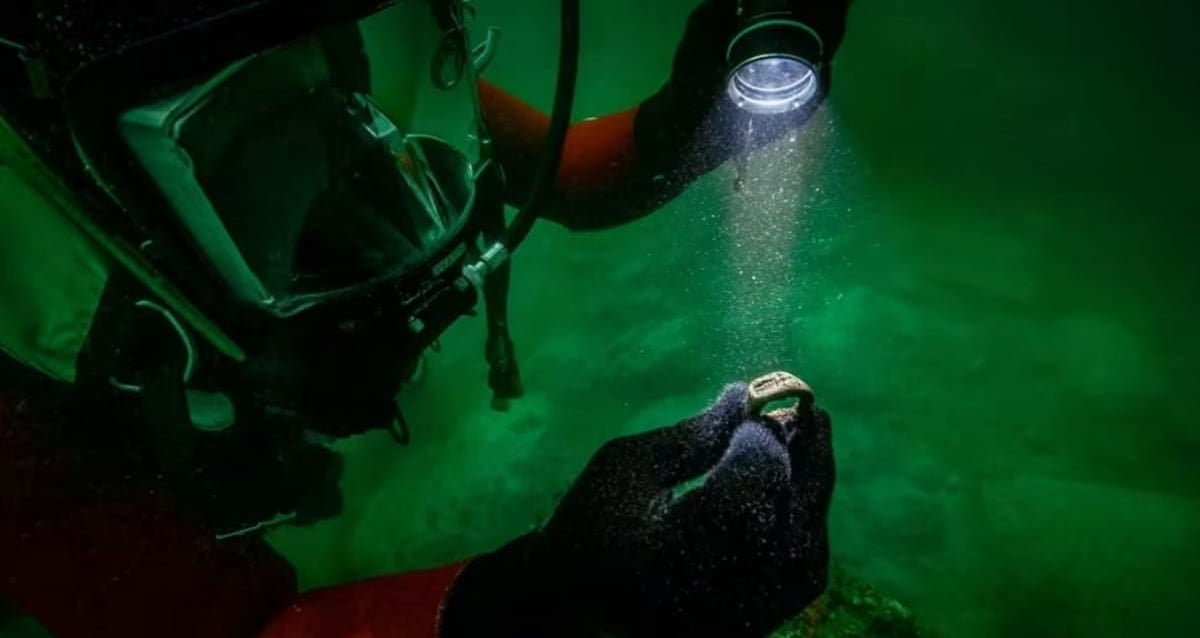
Archaeologists in Egypt have discovered a rare bronze seal ring featuring an engraving of the Lighthouse of Alexandria, one of the Seven Wonders of the Ancient World. The artifact was recovered from the waters of the Eastern Harbor in Alexandria, marking the first time this specific monument has been depicted on a ring of this type. The find is part of a broader excavation effort led by the European Institute of Underwater Archaeology and Egypt’s General Department of Underwater Archaeology.
The Discovery at Antirhodos Island
The ring was found near Antirhodos, a sunken island that once housed the royal palace of Alexandria. This area, known as Portus Magnus, was the heart of the ancient city’s maritime activity. The current excavation season focuses on four primary sites of interest within the Eastern Harbor: the Temple of Isis, the royal palace on Antirhodos, a nearby obelisk, and the Timonium, or the Palace of Antony.
Alongside the ring, divers have recovered a variety of other artifacts spanning from the fourth century B.C.E. to the fourth century C.E. These include:
- Tableware and ceramic vessels
- Glass bottles and vessel fragments
- Oil lamps
Function and Dating of the Seal Ring
The artifact is a seal ring, meaning the engraving of the lighthouse was designed to be pressed into wax or clay to create an impression. In antiquity, such rings were used for administrative and economic purposes, such as validating official documents, sealing correspondence, and securing containers of trade goods like olive oil or wine.
Dr. Hisham El-Leithy, Secretary-General of the Supreme Council of Antiquities, noted that the image on the ring resembles depictions of the lighthouse found on coins from the second century C.E., which suggests the ring was likely crafted during that era.
The Lighthouse of Alexandria: History and Destruction
Built in the third century B.C.E. and completed during the reign of Ptolemy II (284 to 246 B.C.E.), the lighthouse stood over 300 feet tall—roughly the height of a modern 40-story building. Located on the island of Pharos, its primary purpose was to guide ships safely to shore and prevent shipwrecks at night.
The structure remained a dominant landmark for centuries before its gradual decline. Its destruction was caused by a series of earthquakes that occurred throughout the Middle Ages:
- 956 C.E.: An earthquake caused significant structural cracks.
- 1303 and 1323 C.E.: Subsequent earthquakes brought the tower down completely.
Why does the Lighthouse of Alexandria no longer exist?
The lighthouse ceased to exist as a standing structure due to the combined effect of seismic activity and the time it took to repair the structural damage. After the earthquake of 956 C.E., the building began to lose its integrity. The final blows came in the early 14th century, during the 1303 and 1323 earthquakes, which reduced the tower to ruins.
Does any part of the Lighthouse of Alexandria still exist?
Yes, physical remains of the lighthouse now lie beneath the sea. In 1994, archaeologist Jean-Yves Empereur discovered the remains of the structure in the waters off Pharos Island. More recently, in 2025, archaeologists have continued to recover large stone blocks from the Eastern Harbor, providing physical evidence of the tower’s collapse.
How did Alexandria end up underwater?
Large portions of the ancient city, including the royal quarters and the island of Antirhodos, sank due to a combination of seismic activity and soil subsidence. Over centuries, earthquakes and the subsequent land subsidence caused the Mediterranean Sea to reclaim parts of the city, creating the underwater archaeological sites currently being explored by thep European Institute of Underwater Archaeology.
The Cultural Significance of Alexandria
The lighthouse was not only a functional maritime tool but a symbol of the city’s status as a global center of learning and trade. Alexandria was home to other legendary landmarks such as the Library of Alexandria, the Museum of Alexandria, the Serapeum temple, and the tomb of Alexander the Great. The discovery of the seal ring provides a new visual record of how the monument was perceived and used as a symbol of authority and administration in the Eastern Harbor region.