
On August 9, 1945, United States forces detonated an atomic bomb over the city of Nagasaki, Japan. The attack resulted in the immediate death of approximately 40,000 people, with the total death toll reaching an estimated 80,000 by the end of the year. This event, occurring three days after the bombing of Hiroshima, served as a decisive factor that led Japan to announce its surrender on August 15, effectively ending World War II.
The Manhattan Project and Nuclear Development
The deployment of nuclear weapons was the culmination of the Manhattan Project, a secret research and development program launched in 1942. This initiative was a collaborative effort between the United States, the United Kingdom, and Canada, with primary design work conducted at the Los Alamos Laboratory in New Mexico under the leadership of physicist J. Robert Oppenheimer.
The transition from theoretical research to active warfare occurred rapidly in the summer of 1945. Following initial testing on July 16, the U.S. military began identifying strategic targets. On July 25, 1945, General Thomas T. Handy issued a directive to General Carl A. Spaatz, outlining the delivery of “special bombs” to cities with significant industrial and military infrastructure. The primary targets included:
- Hiroshima
- Kokura
- Niigata
- Nagasaki
While Hiroshima was the first target, Nagasaki was added to the list due to its critical shipbuilding facilities and port infrastructure. This level of scientific advancement in weaponry represents a shift in human history, contrasting with earlier eras of scientific inquiry, such as Isaac Newton’s complex prediction about the end of the world, moving from prophecy to the actual capacity for global annihilation.
The Mission of the Bockscar
The second atomic mission was originally scheduled for August 11, but unfavorable weather forecasts forced the military to move the date forward to August 9. A B-29 Superfortress named the Bockscar was tasked with delivering the “Fat Man” bomb, a plutonium implosion device that was 40% more powerful than the uranium-based “Little Boy” used in Hiroshima.
The mission faced several complications that altered the intended outcome:
- Primary Target Failure: Major Charles Sweeney first attempted to bomb Kokura at 9:45 a.m., but heavy cloud cover and smoke from conventional bombing raids obscured the target.
- Fuel Constraints: By 10:30 a.m., the aircraft had insufficient fuel for multiple attempts, forcing a decision to proceed to the secondary target or discard the weapon.
- Target Deviation: Upon arriving at Nagasaki at 10:58 a.m., clouds again obscured the aim point. When a gap finally appeared, the bomb was released, but it missed the intended target by approximately two miles.
The “Fat Man” detonated at 11:02 a.m.. William Laurence, a journalist for the New York Times who was aboard the accompanying aircraft The Great Artiste, described the event in a September 1945 report, noting an intense flash followed by a massive pillar of purple fire reaching 10,000 feet.
Impact and Civilian Casualties
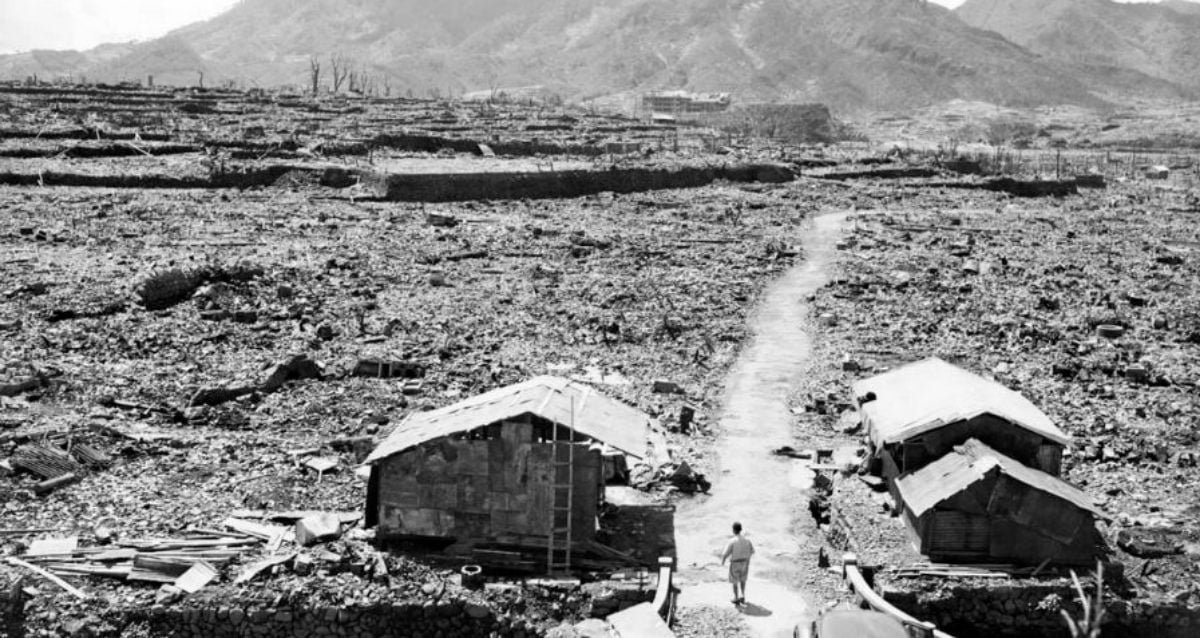
Despite the bomb’s increased power, the geographical layout of Nagasaki—specifically the Urakami Valley and surrounding hills—contained the blast, preventing the total destruction seen in Hiroshima. However, the effects within the blast zone were catastrophic. Of the 263,000 residents, roughly 39,000 were killed instantly, and 25% of the city’s housing was destroyed.
Survivor accounts provide a documentary record of the devastation. Yoshiro Yamawaki, who was 11 at the time, described a whitish-blue light followed by a roar that demolished his home, an account preserved by Nagasaki Peace. Other witnesses described the immediate physical trauma of the explosion:
Sakue Shimohira recalled seeing victims with charred bodies, ripped flesh, and severe burns that caused bodies to swell, as documented by Nagasaki Peace.
Shigeko Matsumoto, located just half a mile from the hypocenter, described the scene as a “hellscape” where burn victims entered bomb shelters with skin peeling in ribbons, a testimony archived by the 1945 Project.
The Surrender of Japan and Historical Legacy
The combination of the atomic bombings and the Soviet Union’s declaration of war on August 8 left the Japanese government with little room for negotiation. On August 15, Emperor Hirohito announced the intent to surrender, and the official Instrument of Surrender was signed on September 2, 1945.
The necessity of the Nagasaki bombing remains a subject of historical debate. While some argue it was essential to force a quick surrender and avoid a costly ground invasion, others contend that Japan was already on the verge of collapse. This ethical complexity is highlighted in the documentary The Fog of War, where former Secretary of Defense Robert McNamara cites General Curtis LeMay, who suggested that the victors of war are rarely prosecuted as war criminals.
The bombing of Nagasaki stands as a pivotal moment in military history, marking the first and only use of nuclear weapons in active conflict and establishing the nuclear age.