On November 22, 1963, President John F. Kennedy was assassinated in Dallas, Texas, while traveling in a presidential limousine through Dealey Plaza. A central point of the official investigation is the single bullet theory, which posits that one shot fired by Lee Harvey Oswald struck both President Kennedy and Texas Governor John Connally. This theory is essential to the conclusion that Oswald acted alone, as the timing between the impacts on the two men was too short for the rifle to have been fired twice.
The Mechanics of the Single Bullet Theory
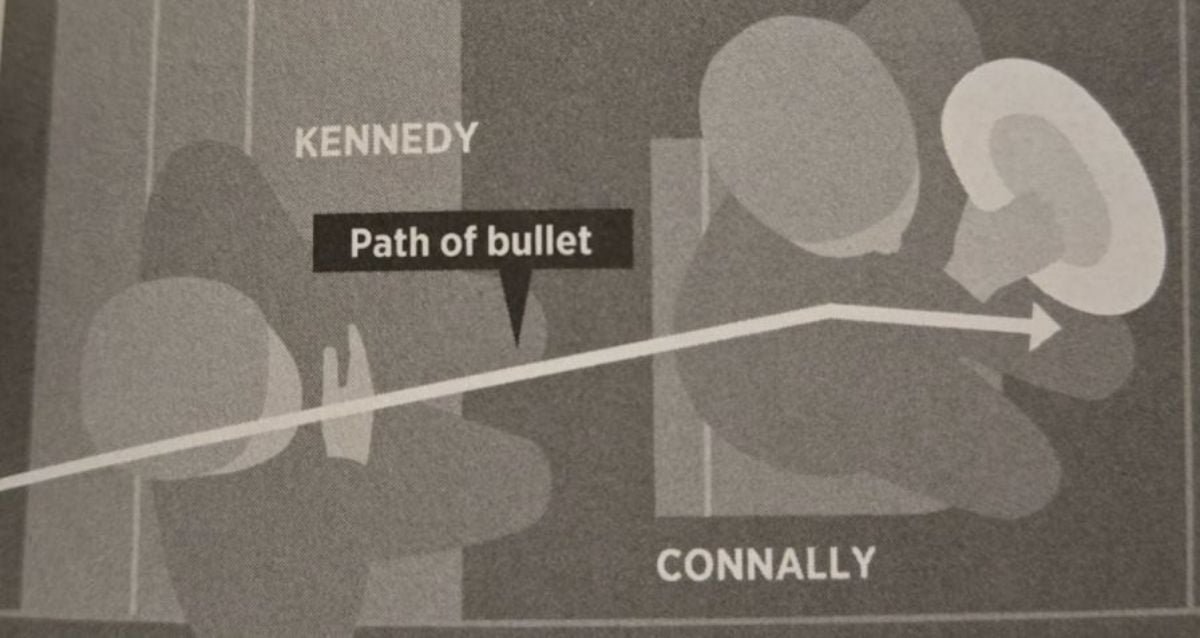
Commonly referred to by critics as the magic bullet theory, this hypothesis describes a complex trajectory for a single projectile. According to the official findings, the second shot fired by Oswald entered Kennedy’s upper back, exited through his throat, and then continued forward to strike Governor Connally.
The bullet’s path through Governor Connally was equally extensive. It entered his back, exited his chest, passed through his right wrist, and finally lodged in his left thigh. To achieve this, the projectile had to penetrate:
- 15 layers of clothing
- Seven layers of skin
- 15 inches of muscle tissue
- Rib and wrist bones
The Warren Commission Investigation
President Lyndon B. Johnson established the Warren Commission one week after the assassination to determine the facts of the event. The panel’s final report, published in September 1964, concluded that Lee Harvey Oswald was the sole gunman, firing three shots from the sixth floor of the Texas School Book Depository.
The Commission used the Zapruder film to analyze the timing of the events. Frame 225 shows Kennedy appearing to be hit, while Connally reacts between frames 235 and 240. This interval of approximately 2.3 seconds is considered too brief for a shooter to fire and accurately hit two separate targets with a bolt-action rifle. Therefore, the only logical alternatives were a second shooter or a single bullet hitting both men.
The Trajectory and the Limousine Layout
Critics argued that the bullet would have had to perform an impossible zig-zag maneuver. However, the Warren Commission noted that Governor Connally was not sitting directly in front of the president, but rather in a jump seat that was lower and slightly to the left. This alignment allowed the bullet to travel in a relatively straight line from the sixth-floor window through both men.
Evidence and Controversies: Exhibit 399
The physical evidence at the center of this debate is Warren Commission Exhibit 399, the bullet recovered near a stretcher at Parkland Hospital. The condition of the bullet raised suspicions, as it appeared relatively undeformed despite the amount of bone and tissue it allegedly traversed.
Further confusion arose from the testimony of Secret Service agent Paul Landis, who claimed to have found a bullet in the seat of the limousine and subsequently placed it on the president’s stretcher. This discrepancy has led some to question if Exhibit 399 was actually the bullet that struck Connally.
Modern Forensic Testing
Recent technological advancements have provided new perspectives on the case. In 2013, forensics experts Luke and Michael Haag utilized 3D laser scanners to re-evaluate the trajectories. Their findings, as reported by CBS News, suggest that a single bullet could easily have caused the wounds observed.
The experts explained that as a bullet passes through a body, it often becomes destabilized and begins to tumble. This yawing effect explains the nature of the entry wound in Governor Connally, which required a bullet that had already been deflected or destabilized by a previous impact.
Frequently Asked Questions About the Assassination
What did the bullet do to JFK’s head?
The third and final shot was the fatal blow, striking the president in the head. This shot caused massive cranial trauma, leading to immediate incapacitation and death. The trajectory of this shot is distinct from the single bullet that wounded Governor Connally.
What was Jackie Kennedy grabbing on the back of the car?
Immediately after the fatal head shot, Jacqueline Kennedy was seen climbing onto the rear trunk of the limousine. Witnesses and footage indicate she was attempting to retrieve a fragment of the president’s skull that had been displaced by the impact of the bullet.
How many bullets were recovered from the JFK assassination?
While three shots were fired, the primary piece of recovered evidence discussed in the single bullet theory is Exhibit 399. Other fragments were recovered during the autopsy of President Kennedy, but Exhibit 399 remains the most debated due to its role in linking the two victims to a single shot.
What did Connally think about the single bullet theory?
Governor John Connally initially disputed the theory, maintaining that he had been hit by a separate shot from the one that struck the president. However, forensic evidence and the timing of the Zapruder film have continued to support the single-bullet conclusion despite his personal recollection of the event.
Conclusion on the Lone Gunman Theory
The determination that Lee Harvey Oswald acted alone rests heavily on the validity of the single bullet theory. If the theory is false, the timing of the shots necessitates the presence of a second gunman. However, current forensic consensus, supported by 3D modeling and ballistic analysis, maintains that the trajectory was physically possible and consistent with the evidence found at the scene.