
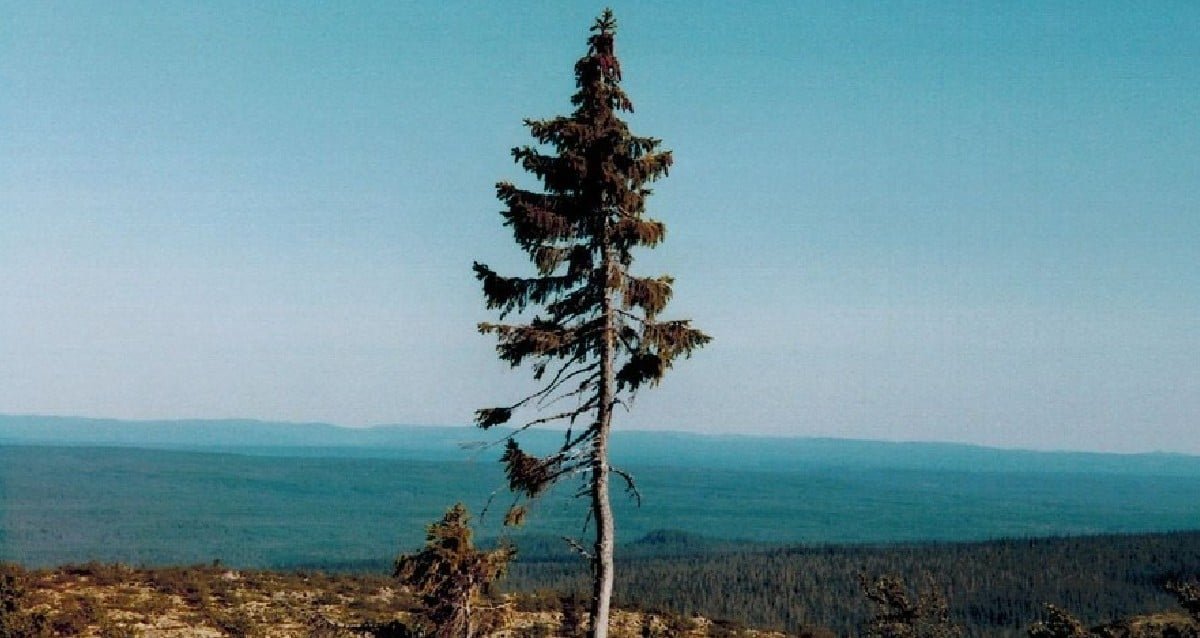
Old Tjikko is a Norway spruce located on Fulufjället Mountain in Sweden’s Dalarna province. Estimated to be over 9,500 years old, this tree has survived since approximately 7550 B.C.E., predating the majority of recorded human history. Despite its extreme age, the tree is only 16 feet tall and possesses a spindly, sparse appearance.
The Discovery of Old Tjikko
The tree remained unnoticed for millennia, growing in a shrub-like formation known as krummholz due to the harsh mountain environment. It was only in 2004, when scientists Leif Kullman and Lisa Öberg documented the specimen, that its true age was revealed. The shift from a shrub to a full tree was a direct consequence of warming global temperatures, which allowed the tree to grow vertically since around 1915, as CNN reported in 2008.
Old Tjikko vs Methuselah: Defining the Oldest Tree
A common point of comparison is the Old Tjikko vs Methuselah debate. While carbon dating suggests Old Tjikko’s root system is significantly older than the Methuselah tree (a Great Basin bristlecone pine in California), the latter is officially considered the oldest non-clonal tree in the world. This distinction is based on the biological difference between a clonal tree and a standalone specimen.
Clonal Growth and Regeneration
Old Tjikko is a clonal tree, meaning it regenerates from the same root system. As the individual trunks die off—typically after about 600 years—new stems emerge from the same root stock, as National Geographic explained in 2008. This process allows the root system to survive for thousands of years while the visible parts of the tree remain relatively young.
Comparison Table: Clonal vs Non-Clonal Trees
| Feature | Old Tjikko (Clonal) | Methuselah (Non-Clonal) |
|---|---|---|
| Estimated Age | Over 9,500 years | Almost 5,000 years |
| Growth Type | Root system regeneration | Single, continuous trunk |
| Loci | Fulufjället Mountain, Sweden | California, USA |
Other Ancient Clonal Colonies
Similar to Old Tjikko, other clonal organisms exist. In Utah, the Pando colony of quaking aspens is an even larger example. Pando’s root system is estimated to be between 8,000 and 80,000 years old, though its individual trees are typically only 100 years old. While the exact age of Pando is not known, it represents the same biological mechanism of survival through root-based regeneration.
Is the Old Tjikko Tree Still Alive?
Yes, the tree is still alive and continues to grow on Fulufjället Mountain. However, it has faced challenges in recent years. In the winter of 2023, heavy snowfall caused a significant portion of the tree’s tip to break off. According to Science Norway reported in 2023, approximately one meter (three feet) of the top was lost. Despite this physical damage, the 9,500-year-old root system remains intact, ensuring the tree’s continued survival.
Visiting Old Tjikko
Unlike the secret location of the Methuselah tree to prevent vandalism, Old Tjikko is accessible to visitors at Fulufjället National Park. A sign at the visitor center describes the tree’s name, given by Lisa Öberg, who named it after her Siberian husky, Tjikko. The tree grows nearly 900 meters above sea level, providing a view of the Rösjö lakes and the mountains in Idre.
Key Facts Summary
- Species: Norway spruce (Picea abies).
- Estimated Age: 9,500+ years.
- // Old Tjikko tree height: 16 feet.
- Discovery Date: 2004.
- Location: Fulufjället Mountain, Sweden.