
During the Cold War, the United States military launched Project Iceworm, a secret operation designed to hide nuclear missiles within the Greenland ice sheet. The objective was to create a concealed network of silos and tunnels to deter Soviet detection and maintain a strategic advantage in the Arctic region.
The Infrastructure of Project Iceworm
Project Iceworm involved the construction of a massive sub-ice facility. To maintain secrecy and operational flexibility, the military implemented the following features:
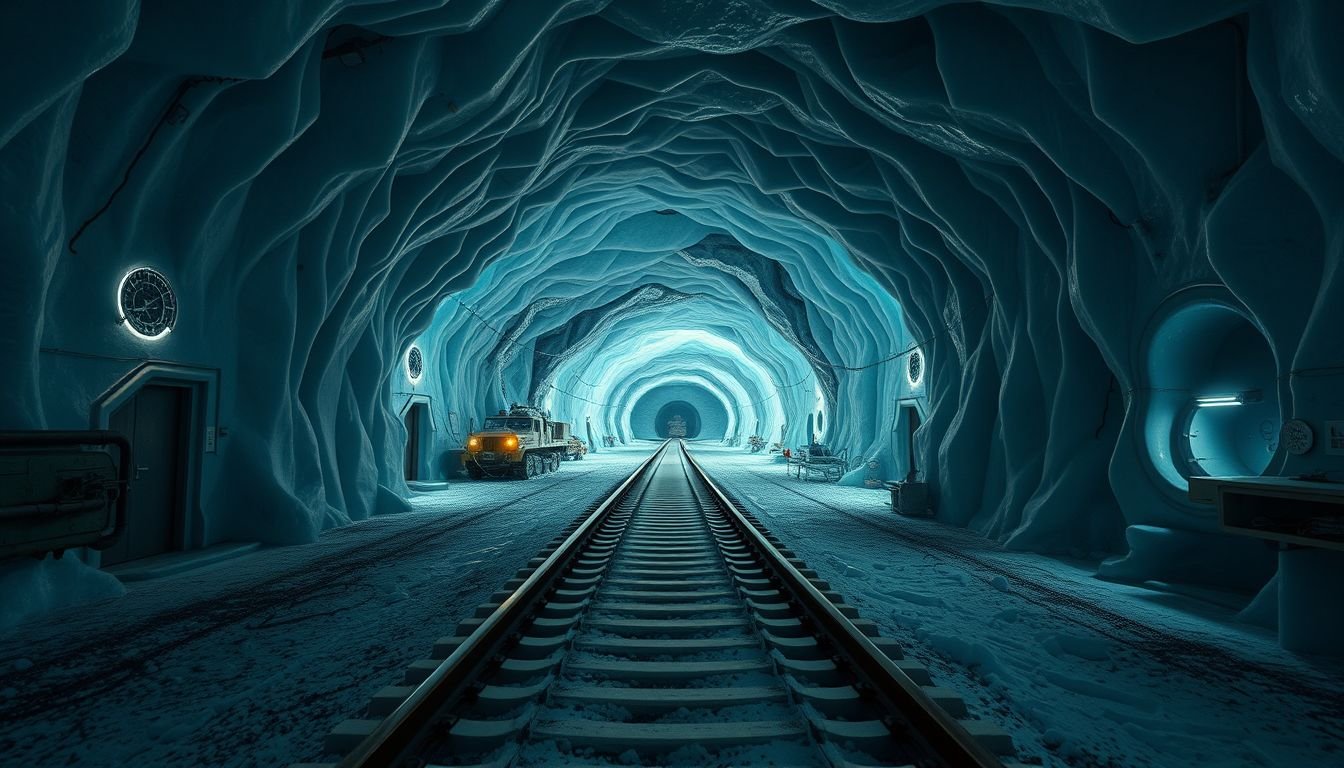
- Tunnel Network: A system of tunnels stretching nearly 2,500 miles beneath the ice.
- Rail Transport: Specialized rail cars used to move 600 nuclear missiles between silos, preventing Soviet planners from pinpointing the exact location of the weapons.
- Camp Century: A surface-level research center that served as a public cover for the clandestine missile operations.
Camp Century Operations and Design
Established 150 miles from Qaanaaq, Camp Century was an underground city engineered to withstand the extreme climate of northwestern Greenland. The environment presented significant challenges, including average annual snowfall of 4 feet, wind gusts reaching 125 miles per hour, and temperatures dropping to 70 degrees below zero.
To ensure the survival of personnel and equipment, engineers built laboratories, barracks, offices, and a movie theater beneath the ice. The facility was powered by a small nuclear power plant, which provided the necessary electricity and heat for the remote installation.
Geological Failures and Abandonment
The project ultimately failed due to the physical properties of the Greenland ice sheet. Despite the flat terrain, the ice was not stationary; it behaved like a viscous fluid, spreading and flowing toward the ocean over time. This movement caused several critical structural failures:
- Rail tunnels became too narrow for the transport cars to pass.
- The room housing the nuclear reactor required repeated expansions to remain functional.
Due to these unsustainable maintenance requirements, the military removed the nuclear reactor in 1964 and completely abandoned the site by 1966.
Discovery and Environmental Risks
While Camp Century was known to the public, the full scope of Project Iceworm remained secret until a 1997 investigation by the Danish government revealed classified documents. Later, NASA engineers used advanced ice-penetrating radar to detect the physical remains of the base beneath the ice.
Recent scientific findings indicate that the remains of the base may no longer be permanently sealed. In 2016, researchers reported that rapid global warming is accelerating the melting of the Greenland ice sheet, which could potentially expose the materials and debris left behind by the US military decades ago.