The Cliff House is a historic seaside resort located at Lands End in San Francisco, California. Established in 1863, the site has undergone three distinct architectural iterations, surviving natural disasters and accidents to remain a prominent landmark overlooking the Pacific Ocean. After closing in 2020, the building is currently undergoing renovations with plans for a future reopening.
The First Cliff House and Early Exclusivity
Built in 1863 by real estate tycoon Charles Butler with financial backing from State Senator John P. Buckley, the original Cliff House served as a restaurant and bar. Managed by Captain Junius G. Foster, the establishment was situated six miles from the city center, making it a destination for the wealthy elite who traveled by horse-drawn stagecoach.
The exclusivity of the location attracted high-profile guests, including three U.S. presidents and prominent families such as the Stanfords and the Hearsts. In June 1864, Mark Twain described the site as a castle-like structure perched on the brink of the ocean, noting the presence of sea lions and the grandeur of the coastline. However, the venue eventually developed a reputation for gambling and alcohol before being purchased by millionaire Adolph Sutro in 1881.
Disasters and the Second Iteration
Adolph Sutro’s ownership was marked by a series of destructive events that tested the resilience of the structure. Key incidents included:
- 1884: A bridge collapse caused by rowdy visitors resulted in dozens of people falling into the waves and sand.
- 1887: An abandoned sailboat carrying illegal dynamite ran aground and exploded, destroying half of the restaurant and shattering every window.
- 1894: The entire resort was destroyed by fire.
Despite these setbacks, Sutro continued to invest in the site. As noted by SF Gate, Sutro even capitalized on the 1887 explosion by keeping the bar open amidst the ruins to attract curious crowds.
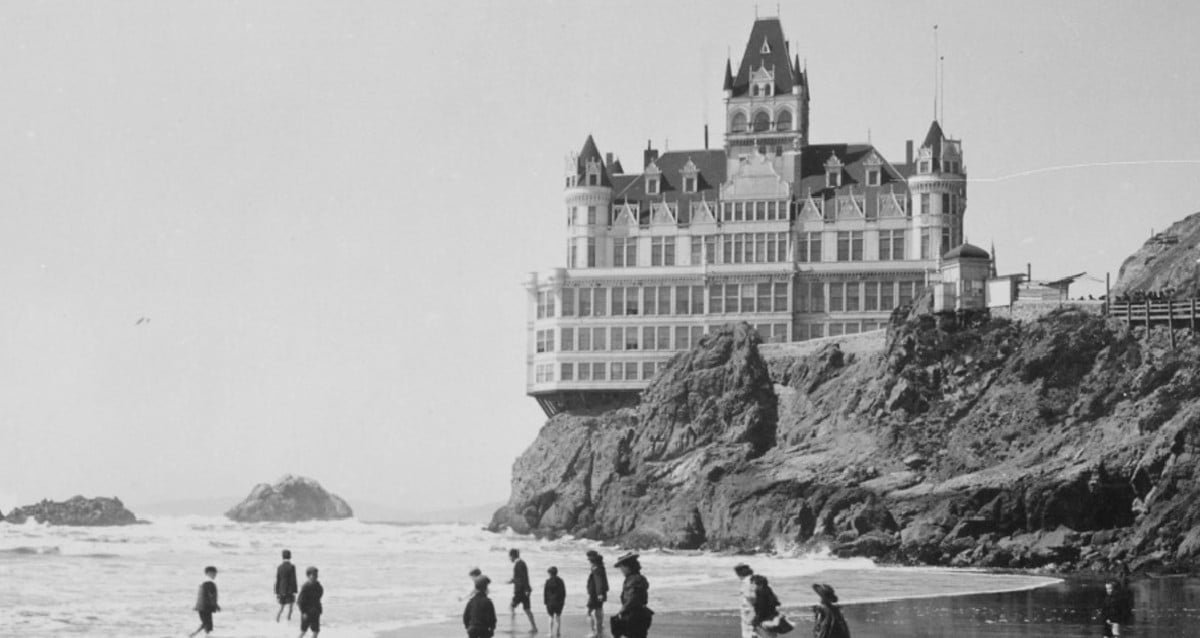
In 1896, the second version of the Cliff House opened. This iteration was a lavish eight-story Victorian structure featuring turrets, spires, an observation tower, and private dining rooms. Adjacent to this “seaside castle,” Sutro constructed the Sutro Baths, a massive saltwater swimming complex that included six pools, a skating rink, and a museum. While this version survived the 1906 San Francisco earthquake, it was completely destroyed by fire in 1907.
The Third Cliff House and Modern Era
Following the 1907 fire, Emma Sutro Merritt, daughter of Adolph Sutro, oversaw the construction of a third version of the resort. Opening in 1909, this structure was built using fireproof steel-reinforced concrete to prevent future losses. Unlike the previous ornate designs, the new neoclassical building featured a more modest profile that blended into the natural landscape.
The property changed hands in 1937 when the Sutro family sold the establishment. Over the following decades, various modifications were made, including the installation of a sky tram in the 1950s to transport tourists from the Sutro Baths to the resort.
National Park Service Ownership
In 1977, the National Park Service acquired the Cliff House, integrating it into the Golden Gate National Recreation Area. The site continued to operate as a restaurant until its closure in 2020. According to the National Park Service, the site remains a significant part of the region’s coastal history.
The building is currently undergoing extensive exterior repairs. The importance of the site as a cultural touchstone for the city was highlighted by Nicole Meldahl, executive director of the Western Neighborhoods Project, who told SF Gate in 2025 that the location provides a shared connection to the city’s ancestors and history.