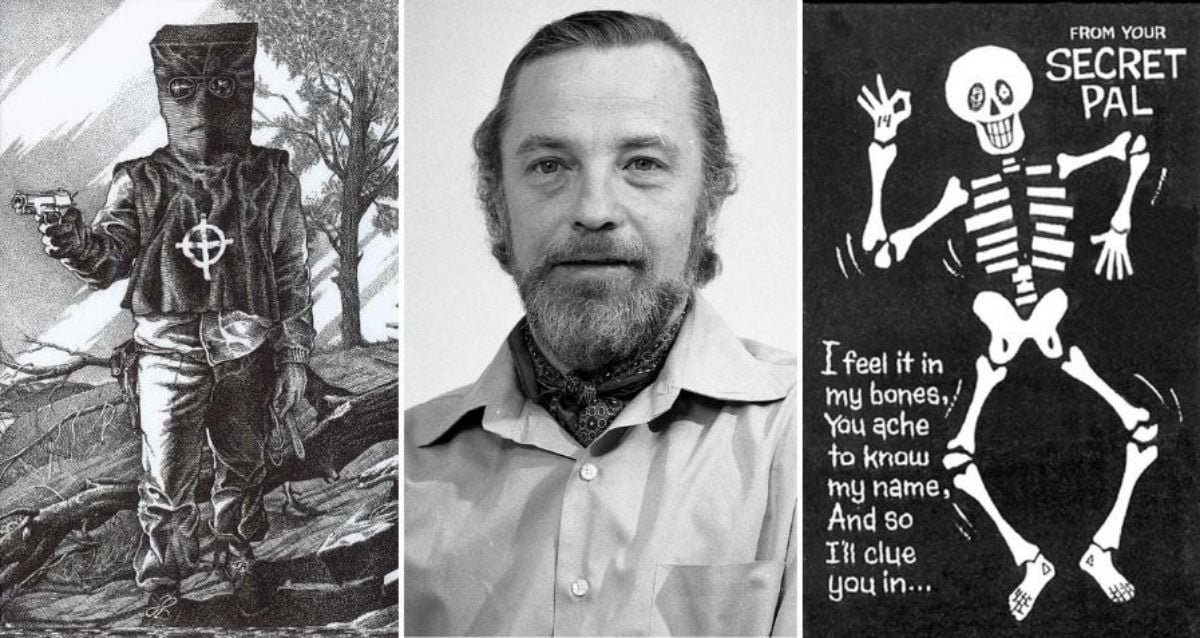
Paul Avery, a seasoned police reporter for the San Francisco Chronicle, became a direct target of the Zodiac Killer in October 1970. After spending over a year documenting the serial killer’s crimes and cryptic communications, Avery received a personalized threat in the mail that shifted his role from an observer to a potential victim. Despite the intimidation, Avery continued his journalistic pursuit of the unidentified criminal, expanding the scope of the investigation beyond the San Francisco Bay Area.
Who Was Paul Avery and What Was He Known For
Born Paul Stuart Depew II in Honolulu in 1934, the man who would become Paul Avery began his professional journey in journalism in 1955. His early career saw him working for various regional publications, including the Vicksburg Post-Herald in Mississippi, as well as newspapers in Texas, Alaska, and Hawaii. By 1959, he had established himself at the San Francisco Chronicle.
Avery’s career was marked by a willingness to immerse himself in high-stakes environments. During the 1960s, he took a leave of absence to move to Vietnam, where he co-founded a freelance photojournalism agency to document the conflict. Upon his return to California in 1969, he resumed his role as a police reporter, which placed him at the center of one of the most infamous unsolved murder cases in American history.
The Zodiac Killer Timeline and Avery’s Coverage
The Zodiac Killer’s spree of violence and psychological warfare began in the late 1960s. The primary events covered by Avery included:
- December 1968: The fatal shooting of David Faraday and Betty Lou Jensen in Benicia, California.
- July 1969: The attack on Darlene Ferrin and Michael Mageau in Vallejo; Ferrin was killed, while Mageau survived.
- August 1969: The killer sent the first set of cryptic letters to San Francisco newspapers. Paul Avery began covering the story, publishing an article on August 2, 1969, that included one of the killer’s ciphers.
- September 1969: The stabbing of Bryan Hartnell and Cecelia Shepard in Napa County.
- October 11, 1969: The murder of Paul Lee Stine in San Francisco’s Presidio Heights.
Avery did not merely report the facts; he challenged the perpetrator. Shortly after the Stine murder, he wrote an article describing the Zodiac as a “clumsy criminal” and a “liar,” a provocation that likely contributed to the killer’s fixation on him.
The Halloween Threat: “You Are Doomed”
On October 27, 1970, the Zodiac Killer sent a Halloween card addressed to Paul Avery. The card featured a skeleton and a poem that teased the journalist about the killer’s identity, concluding with the explicit warning: “Peek-A-Boo! You Are Doomed!”
In a subsequent interview to KRON-TV, Avery dismissed the message as an “idle threat” designed to garner more publicity. He pointed out the discrepancy between the killer’s claims of 14 victims and the five confirmed murders. However, Avery acknowledged the danger and took several safety precautions, including carrying a firearm and wearing a button created by coworkers that read “I Am Not Paul Avery.”
Expanding the Investigation: The Cheri Jo Bates Case
Rather than retreating, Avery used the threat as momentum to dig deeper. In November 1970, he published a theory linking the Zodiac to the 1966 murder of 18-year-old Cheri Jo Bates in Riverside, California. While law enforcement never officially confirmed this connection, Avery’s research suggested that the killer’s activities were not confined to the Bay Area, implying a wider geographic range of potential victims.
What Happened to Paul Avery After Zodiac
Despite the intensity of the Zodiac case, Avery’s career did not collapse. He transitioned to other major news stories, most notably the 1974 kidnapping of Patty Hearst. His professional path led him from the San Francisco Chronicle to The Sacramento Bee in 1976, and eventually to the San Francisco Examiner, where he worked until his retirement in 1994.
Regarding the question of whether Paul Avery was ever a suspect, there is no official record of him being a primary suspect in the Zodiac murders; he was consistently treated as a target and a chronicler of the crimes.
Fact vs. Fiction: The Portrayal in the Movie Zodiac
In the 2007 film Zodiac, Robert Downey Jr. portrayed Paul Avery. The movie depicts a version of Avery who spirals into drug and alcohol abuse and paranoia following the Halloween threat, leading to a professional downfall. In reality, the impact of the threat was far less destructive.
While Avery struggled with smoking and drinking, these habits did not ruin his career or drive him out of the Chronicle in the manner shown on screen. He remained a respected professional, contributing to books and reporting on high-profile cases long after the Zodiac’s letters ceased. Robert Downey Jr. later noted in a piece for the Los Angeles Times that Avery was a “serious journalist” and a true example of the profession.
The Death of Paul Avery
Paul Avery passed away on December 10, 2000, at the age of 66. The cause of death was pulmonary emphysema. He died without ever discovering the true identity of the Zodiac Killer, leaving behind a legacy of aggressive reporting and a firsthand account of the psychological games played by one of America’s most elusive criminals.