
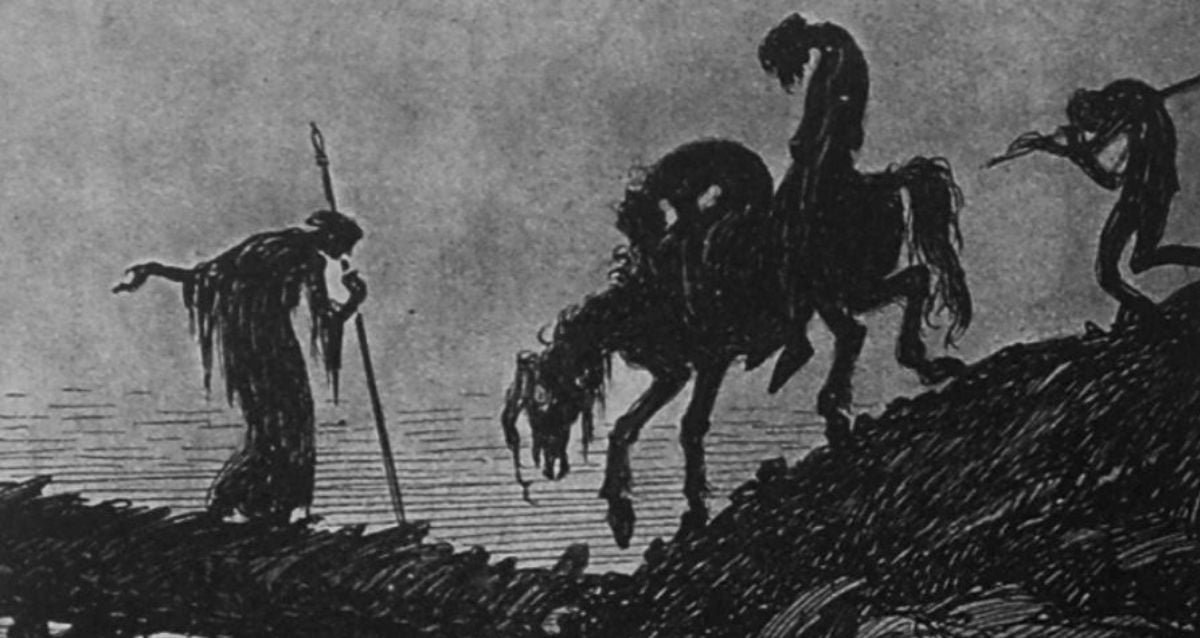
Helheim is the realm of the dead in Norse mythology, governed by the goddess Hel. Unlike popular misconceptions, it is not a place of eternal punishment or torment, but rather a neutral continuation of existence for those who did not die in battle. While Valhalla is reserved for heroic warriors, Helheim serves as the final destination for individuals who perished due to old age, illness, or accidents.
The Nature of Helheim and its Governance
Helheim is described as a frigid, misty realm located beneath one of the roots of Yggdrasil, the cosmic ash tree that supports the universe. The goddess Hel, daughter of the trickster god Loki and the giantess Angrboda, was appointed by Odin to rule this domain. According to the Prose Edda, Hel lives in a great mansion called Éljudnir, meaning “Sleet-Cold,” characterized by high walls and massive gates.
Visually, Hel Hel is often depicted as half blue and half flesh-toned, reflecting the duality of life and death. Despite her stern and grim demeanor, her role is primarily administrative rather than punitive. She manages the abodes of those sent to her, appointing the living quarters for the deceased.
Difference Between Hel and Valhalla
The afterlife in Norse mythology is not a binary system of heaven and hell. Instead, it is divided based on the manner of death. The primary differences are as follows:
- Valhalla: A majestic hall in Asgard where warriors who died bravely in combat are taken to feast, fight, and prepare for the endgame of the world.
- Helheim: A destination for the non-combat deaths. It is a neutral space where the deceased continue to engage in daily activities such as eating, drinking, and sleeping, mirroring their earthly life.
Helheim is fundamentally different from the Christian concept of Hell. While Matthew 13:42 describes a place of “weeping and gnashing of teeth,” Helheim is a land of icy mists where the inhabitants are not in distress.
The Journey to the Underworld
The path to Helheim is far more perilous than the realm itself. Living beings can travel to the underworld, though the journey is fraught with obstacles. In the Baldr’s Dreams poem, Odin travels to Helheim on his eight-legged horse, Sleipnir, to investigate his son’s nightmares. Upon arrival, he is confronted by Garmr, the blood-stained hound that guards the gates of the underworld.
Another notable journey is that of Hermod, the messenger deity, who attempted to retrieve Baldr after he was killed by a toxic mistletoe dart. Hermod’s journey involved riding for nine nights through deep and dark valleys before crossing a bridge guarded by the giantess Modgud. After confirming his purpose, Modgud directed him to the gates of Hel, where the goddess demanded that all things, both living and dead, weep for Baldr to release him.
Geographical and Mythological Context
The Norse underworld is sometimes confused with Niflheim. While some sources are vague, it is generally believed that Niflheim is the broader realm of ice and mist, and Helheim is the specific underworld located within it. Other accounts, such as the 12th-century Gesta Danorum, describe journeys to the underworld involving crossing a River of Blades, where the river flows through poisoned vales with swords and daggers.
Is Hel Evil in Norse Mythology?
Hel is not an evil goddess in her role as ruler of the dead. She is the daughter of Loki, and while her siblings, Fenrir and Jörmungandr, are destined to destroy the gods, Hel’s primary function is to keep order in her realm. She is not a judge of morality or a sinner’s jailer; she is simply the keeper of the dead who died “straw deaths” (deaths by old age or illness).
Do People Still Believe in Norse Gods?
While the majority of the world has transitioned to other religions, modern Heathenry and Asatru movements have revived interest in these deities. These practitioners treat the Norse gods not as objects of faith in a traditional sense, but as often as a way to connect with ancestral traditions and cultural identity.
Summary of Helheim’s Characteristics
The following table summarizes the key differences between the afterlife realms of the afterlife in Norse mythology:
| Realm | Inhabitants | Climate | Purpose |
|---|---|---|---|
| Valhalla | Heroic Warriors | Asgard | Preparation for Ragnarok |
| Helheim | Those who died of sickness or age | Icy and Misty | Continuation of Existence |
The narratives of Helheim provide a window into how ancient Norse people viewed death. It was not a perceived as a place of fear, but as a reflection of the mortal world, scaled to a cold, misty environment. The journey to the underworld was the daunting part, while the destination was a neutral space for the deceased to reside.