
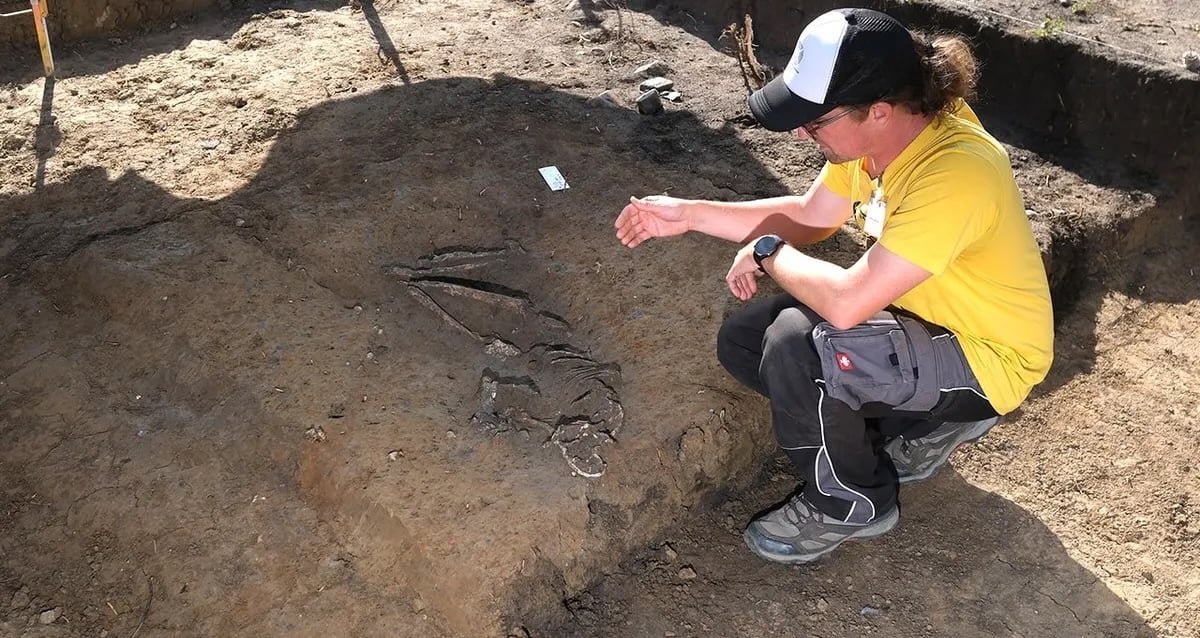
Archaeologists in Leipzig, Germany, have uncovered a 7,000-year-old Neolithic burial and the remnants of a prehistoric settlement during preventative excavations at the site of a planned elementary school. This discovery marks the oldest known grave ever found within the city limits of Leipzig, providing critical insights into the region’s early human habitation.
Archaeological Findings at the Construction Site
The discovery occurred during mandatory surveys conducted by the Saxony State Office for Archaeology to ensure historical artifacts were protected before building began. The site is located within the Leipzig Lowland Basin, an area known for its archaeological richness due to its natural protection from the flooding of the White Elster River.
Despite the land having been used for a building complex in the 1960s, researchers found that the prehistoric layers remained remarkably intact. The excavation revealed a comprehensive settlement rather than isolated objects, including:
- A fully intact human skeleton dating back approximately 7,000 years.
- The remains of a massive wooden longhouse measuring 98 feet in length.
- Partial remains of at least two additional wooden structures.
The Linear Pottery Culture and Funerary Customs
Experts have identified the remains as belonging to the Linear Pottery culture (LBK), a Neolithic group that existed across Europe between 5500 and 4500 B.C.E. The identification was based on the specific positioning of the body and the architectural style of the surrounding settlement.
The skeleton was found lying on its left side in a crouched position, a burial practice characteristic of the Linear Pottery culture. While the grave contained no pottery or other funerary goods, the context of the nearby longhouses confirmed the cultural affiliation. Currently, the age and sex of the individual remain undetermined, pending further laboratory analysis.
The transition from nomadic hunting and gathering to a sedentary farming lifestyle is a hallmark of this era. The discovery of such a large settlement in Leipzig suggests a sophisticated level of organization and permanent habitation in the region during the Neolithic period. More details can be found in the Saxony State Office for Archaeology announcement.
The Significance of Bone Preservation in Saxony
The find is considered a rare stroke of luck because bone preservation is typically poor across large parts of Saxony. In most cases, archaeologists can only identify graves by the shape of the pits or the presence of grave goods. Finding a fully preserved skeleton allows for more detailed biological and anthropological research into the early inhabitants of the area.
Are mass graves ever found in Germany?
Yes, archaeological and historical surveys in Germany have uncovered various types of mass graves. These range from prehistoric communal burials and plague pits from the Middle Ages to mass graves resulting from conflicts during World War II. Unlike the individual Neolithic burial in Leipzig, these sites usually provide data on sudden population losses or organized military casualties rather than sedentary cultural evolution.
What are the current archaeology jobs available in Germany?
Archaeology in Germany is often driven by preventative archaeology, similar to the Leipzig project. Most current employment opportunities are found in state offices for monument protection or private firms contracted by construction companies to perform mandatory surveys before urban development. These roles require expertise in field excavation, GIS mapping, and artifact analysis.
Next Steps for the Leipzig Site
The Saxony State Office for Archaeology will continue to survey the site until all relevant data is collected. Once the analysis of the skeleton and the longhouse structures is complete, the findings will be integrated into the broader understanding of Neolithic Europe. In the meantime, the excavated sections of the land are being released for the construction of the elementary school to proceed.