
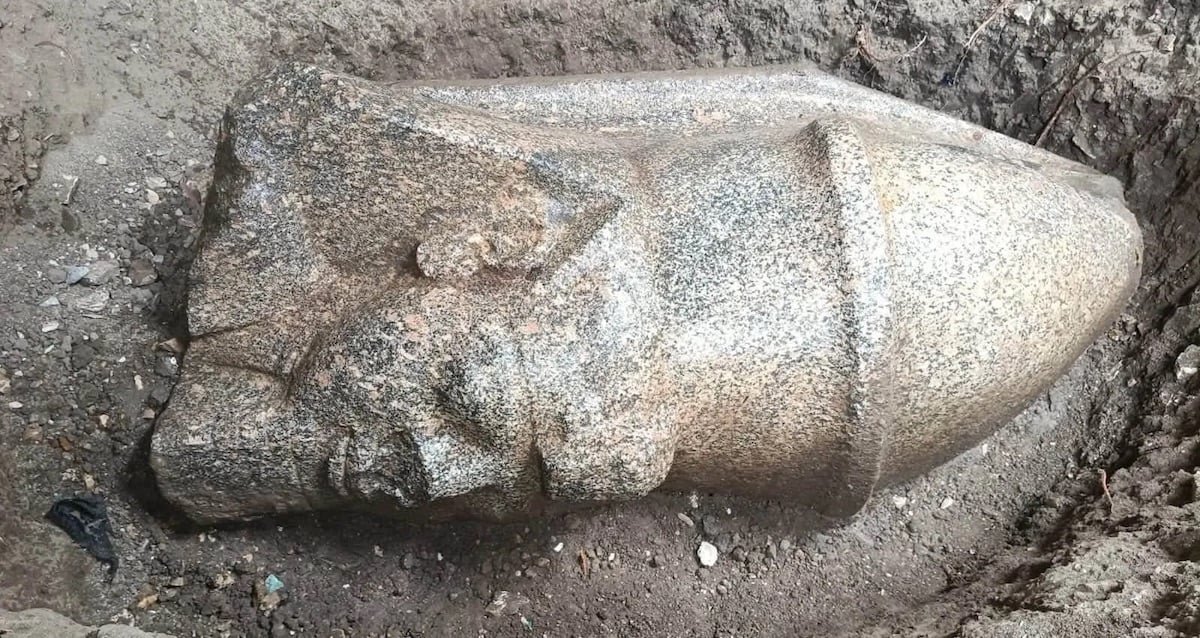
An Egyptian farmer in the village of Behbeit El-Hagar discovered the remains of two colossal statues of Ramesses II, one of ancient Egypt’s most prominent pharaohs. The discovery was made by Khaled al-Shahat, who first spotted a pink granite rock with hieroglyphics on his land during a survey of his property. After alerting the Egyptian Ministry of Tourism and Antiquities, archaeological teams were deployed to the site to fully unearth the artifacts.
Details of the Colossal Statues
Archaeologists have identified two distinct statue remains. The first, the larger of the two, is estimated to have reached a height of approximately 28 feet. Its head, measuring five feet tall, depicts the pharaoh wearing the double crown, symbolizing the unification of Upper and Lower Egypt. A fragment of the statue’s back pillar contains a hieroglyphic inscription identifying the pharaoh’s Horus name as “Hor-Ka-Nakht-Mery-Maat”.
The second statue is an eight-foot section featuring a head wearing the nemes, the traditional striped headdress of Egyptian royalty. While the base and legs are missing, the head remains well-preserved. Near these remains, a four-foot pink granite block was found with inscriptions describing the pharaoh as “King of Upper and Lower Egypt” and the “Son of Ra” (the sun god).
The Archaeological Significance of Behbeit El-Hagar
The location of the discovery is particularly significant because it sits on the western side of a temple complex dedicated to the goddess Isis. According to Live Science, Egyptologist Mahmoud Emam from Cairo University noted that previous findings of fragments inscribed with the name of Ramesses II near the Isis temple suggested the pharaoh had undertaken major building works at the site. This recent find confirms the presence of massive monuments dedicated to the pharaoh in this region of the Nile Delta.
Where was Ramses’ statue found?
These specific statues were discovered in the village of Behbeit El-Hagar in northern Egypt, within the Nile Delta region. This area is known for its archaeological potential, as it is part of a larger complex of temples and and monuments. The find is located specifically on the land of farmer Khaled al-Shahat, on the western side of the temple of Isis.
What did Ramesses II actually look like?
While the exact physical appearance of the pharaoh is unknown, archaeologists use these colossal statues and relief carvings to understand his royal imagery. The statues found in Behbeit El-Hagar depict him with traditional royal regalia, including the double crown and the nemes headdress, which served as the primary visual markers of his authority and power. These monuments were often designed to be imposing and idealized versions of the pharaoh’s image to project strength and strength across the empire.
Ramesses II and the Height of the Egyptian Empire
Ramesses II, who ruled from approximately 1279 to 1213 B.C.E., is recognized as one of the longest-serving and most powerful pharaohs in Egyptian history. During his reign, Egypt reached a peak of power, extending its influence into modern-day Syria. He is well known for his extensive building program, which included the construction of colossal monuments such as the temples at Karnak and Abu Simbel.
The discovery of these statues in the Nile Delta reinforces the pattern of Ramesses II’s tendency to erect monuments throughout the rest of of the country to solidify his image. As reported by CBS News, the Egyptian government honored Khaled al-Shahat for his honesty and civic responsibility by awarding him a plaque of appreciation and a trip to Saudi Arabia for the Umrah pilgrimage.
Other Recent Discoveries of Ramesses II Statues
The find in Behbeit El-Hagar is part of a recent surge in discoveries of Ramesses II’s image. In 2017, a statue was found beneath the streets of Cairo, and in 2024, the missing upper half of a colossal statue was recovered in the Minya Governorate, reuniting it with a bottom half found 94 years earlier. These findings continue to provide researchers with with the importance of the pharaoh’s architectural impact on the Nile Delta and the rest of the Egyptian landscape.
The Egyptian Ministry of Tourism and Antiquities has stated that excavations will continue on al-Shahat’s land to determine the overall importance of the site and uncover more about the pharaoh’s architectural contributions to the temple of Isis complex.