
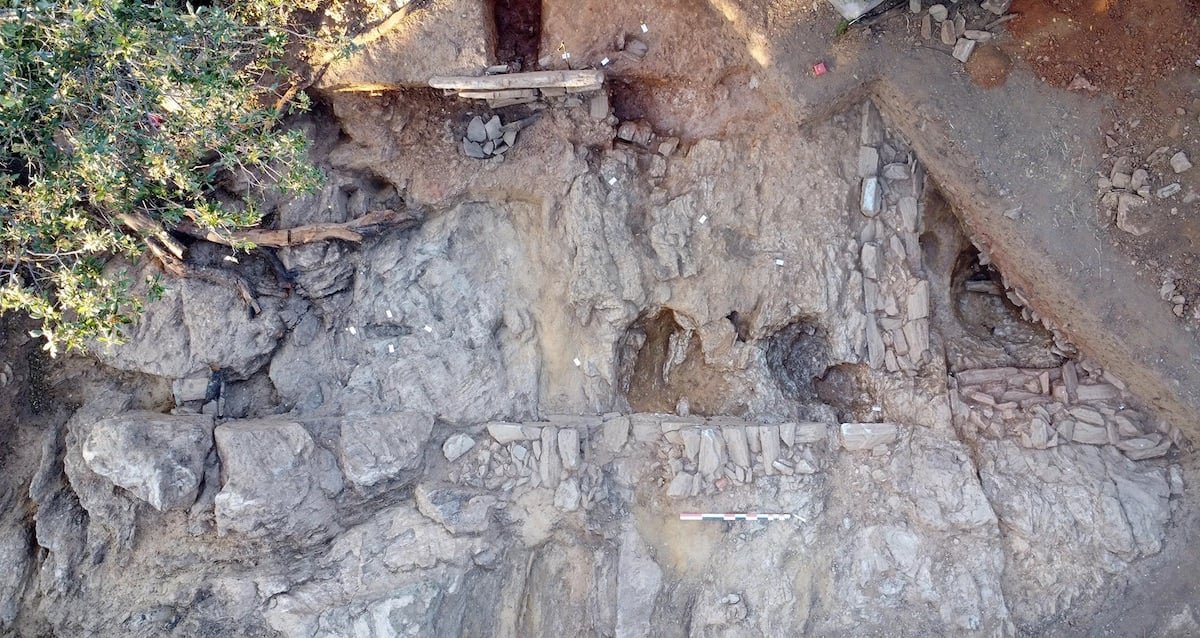
Archaeologists have uncovered the remains of a Roman-era dwelling carved directly into the bedrock of the Cap Corse peninsula in Corsica. The discovery was made during preventative excavations in May and June 2026, ahead of the construction of a new private residence. The structure, dating back approximately 1,600 years, was found 100 feet above a previously discovered Roman pier, suggesting the existence of a larger port settlement in the Bay of Meria.
Construction Techniques and Layout
The dwelling, which covers approximately 540 square feet, was built in two distinct phases. First, builders carved a foundation into the underlying schist, a metamorphic rock that splits easily into slabs. The removed material was then repurposed into square blocks, which were laid in an alternating parallel and perpendicular pattern to create secure, sturdy walls.
Researchers identified several post holes reinforced with stone wedges, indicating that large schist slabs were used as monoliths to partition the house into separate rooms. Additional post holes suggest the presence of upright beams that likely supported a tiled roof. Within the structure, archaeologists found a variety of domestic artifacts, including:
- Fragments of cooking pottery
- Glassware
- Iron tools
- A millstone discovered in a corner pit
The Bay of Meria Settlement
The proximity of the house to a Roman pier—discovered in the spring of 2025 during a statement put out by INRAP—indicates that this area was likely a hub of maritime activity. Dig director Brice Chevaux suggests that the pier was large enough to require a significant workforce, which in turn would have necessitated housing for laborers on the slopes of the bay.
Archaeologists believe this seaside village was active during the late Roman era and remained inhabited until the sixth century C.E. This theory is supported by ceramic fragments from Late Antiquity found at both the house and the pier. The discovery aligns with other finds in the Bay of Meria, such as a marble altar dedicated to Emperor Claudius discovered in 2012, reinforcing the idea that Cap Corse was an economic and cultural center integrated into Mediterranean trade networks.
Understanding Ancient Coastal Settlements
The discovery at Cap Corse provides a deeper understanding of how Roman coastal habitats were utilized. Unlike the rest of the peninsula, which stretches about 20 miles long, this area has seen only two preventative excavations, making these finds rare and significant. According to reports from Corse Net Infos, the limited land available in Meria makes these simultaneous investigations into a single chronological window highly valuable for researchers.
How do these finds compare to larger Roman cities?
While the Corsican find is a modest domestic dwelling, it differs from the massive urban planning of cities like Pompeii. In Pompeii, archaeologists have found entire city blocks and remains of entire city centers, whereas the Cap Corse discovery focuses on a localized, functional settlement likely dedicated to port laborers. While much of Pompeii is still to be excavated, the focus in Corsica is on understanding the small-scale economic networks that supported the larger Roman Empire’s maritime trade.