
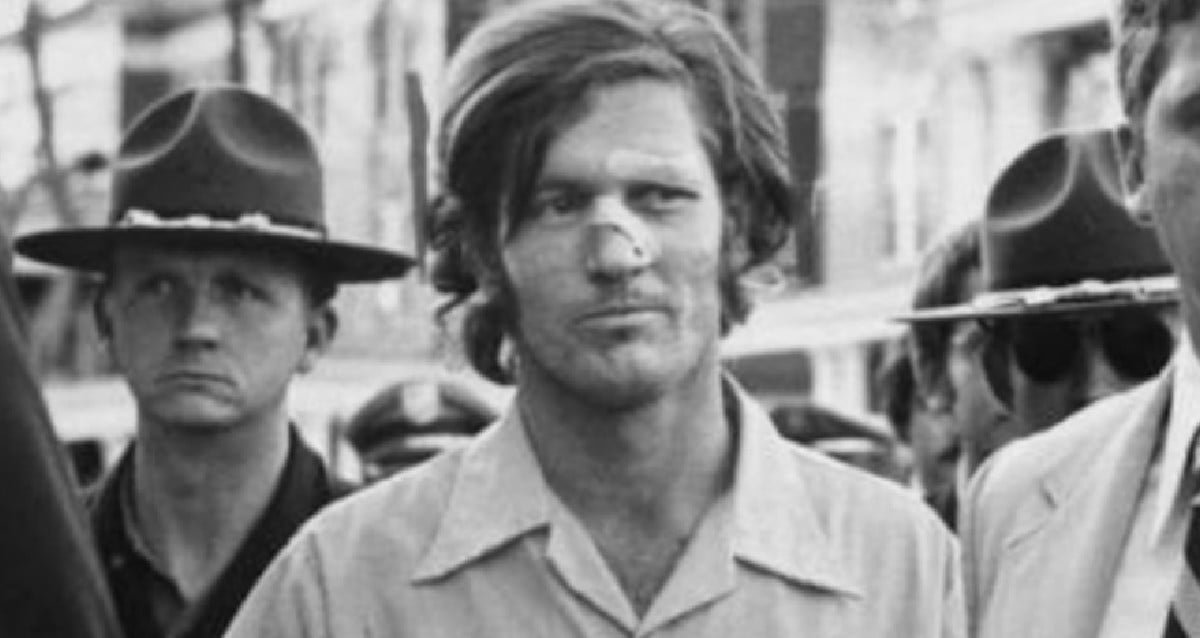
Paul John Knowles murdered at least 18 people between July and November 1974. Operating across multiple states, including Georgia, Florida, Texas, Nevada, and Alabama, Knowles carried out a rapid and violent series of killings that claimed between 18 and 35 victims in just four months.
Criminal Background and Early History
Born in 1946 in Orlando, Florida, Knowles established a pattern of criminal behavior from a young age. By the time he was 19, he had a decade-long criminal record and was imprisoned for the first time following the kidnapping of a police officer. Over the subsequent eight years, he repeatedly entered and exited prisons nationwide. In a recorded interview, Knowles admitted to a psychiatrist that he had been a criminal since childhood.
In early 1974, while incarcerated at Raiford Penitentiary in Starke, Florida, Knowles began a correspondence with Angela Covic, a waitress from San Francisco. Through these letters, Covic arranged for legal representation that eventually secured his parole. However, upon meeting him in person in May 1974, Covic ended the relationship, citing an aura of fear surrounding him. Knowles returned to Florida and was soon imprisoned again for stabbing a bartender during a physical altercation.
The 1974 Murder Spree
On July 26, 1974, Knowles escaped from jail by picking the lock of his cell. Within hours of his escape, he committed his first murder by breaking into the home of Alice Curtis, a 65-year-old retired teacher in Jacksonville. Curtis was found bound and gagged, and reports indicate she died of asphyxiation.
The ensuing four months were marked by a series of opportunistic and targeted attacks. The victims varied significantly in age and background, including children and the elderly. His methods were inconsistent, involving strangulation, shooting, and stabbing, which complicated the efforts of law enforcement to link the crimes. Many victims were also subjected to sexual assault and burglary.
Documented Victims and Locations
- Georgia: In August, Knowles killed 13-year-old Ima Jean Sanders and 49-year-old Marjorie Evelyne Howie.
- Ohio: In September, he murdered 32-year-old William Bates after sharing a drink with him.
- Nevada: He killed 62-year-old Emmett Johnson and 59-year-old Lois Johnson, a couple who were camping.
The lack of a consistent pattern in his victims or methods often mirrors the erratic nature of other high-profile killers, such as the cases involving Paul Avery and the Zodiac Killer threat, where unpredictable behavior challenged investigators.
Capture and Final Confrontation
In November 1974, Knowles abducted state trooper Charles Campbell and businessman James Meyer. Both men were later found shot to death and handcuffed to a tree. Following these murders, Knowles crashed his vehicle while being pursued by police. He fled into the woods near McDonough, Georgia, where he was held at gunpoint by 27-year-old David Clark until law enforcement arrived. Knowles was arrested on November 17, 1974.
While investigators officially linked him to 18 murders, Knowles claimed in taped confessions to have killed as many as 35 people. His history of manipulation and deception was noted by survivors and acquaintances. For instance, survivor Barbara Mabee Abel described his cruelty despite his outward appearance, and journalist Sandy Fawkes, who had a brief romance with him, described him as a dreamboat in the New York Daily News.
Death of Paul John Knowles
Knowles never faced trial for his crimes. In December 1974, he agreed to lead investigators from the Georgia Bureau of Investigation (GBI) to one of his crime scenes. During the transport, he used a paperclip to escape his handcuffs and attempted to seize a weapon from Douglas County Sheriff Earl Lee. GBI agent Ronnie Angel responded by shooting Knowles three times in the chest.
Paul John Knowles died instantly at the age of 28. Due to his sudden death, the exact number of his victims remains unconfirmed. Agent Angel later stated in the Macon Telegraph that it would be believable if Knowles had killed up to 100 people, given the scale and nature of his movements across the United States.