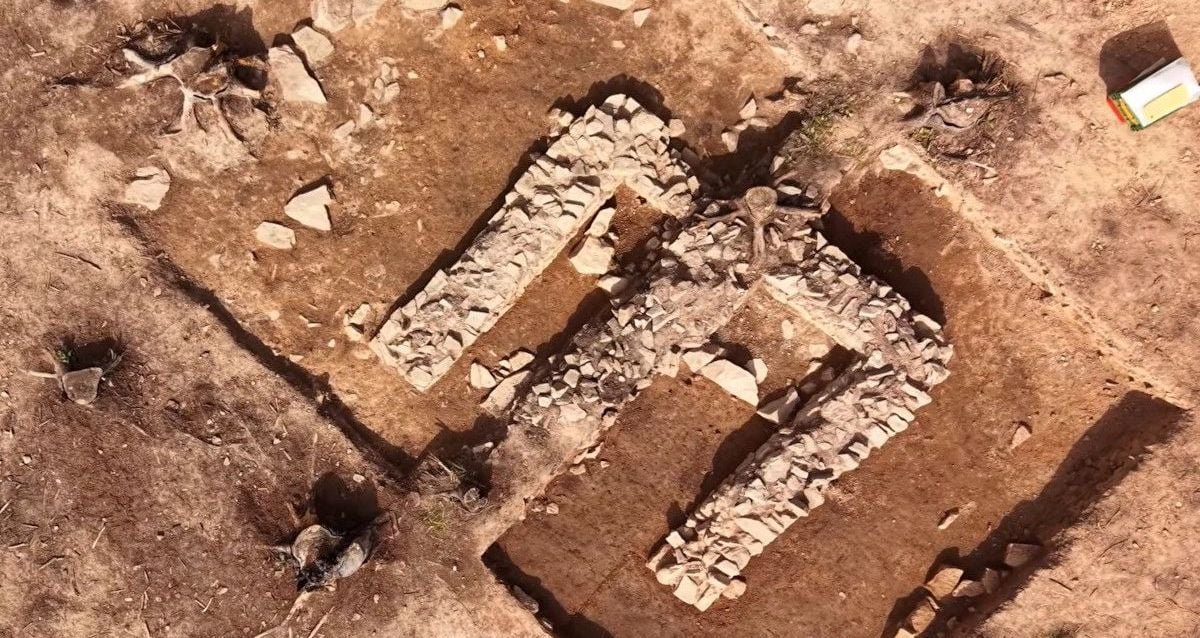
Archaeologists have uncovered the remnants of a Roman temple dedicated to Mars, the god of war, in the Taunus Mountains of central Germany. The site, located near the modern town of Rosbach vor der Höhe, was found just a few inches beneath the forest floor, having remained hidden for nearly two millennia. The discovery includes not only the temple structure but also significant artifacts that provide new insights into the civilian settlement surrounding the Roman military fort of Kapersburg.
Architectural Details of the Temple
The temple structure is a rectangle approximately 16 feet long with stone walls that are more than 1.5 feet thick. Excavations revealed that the temple likely had an ambulatory, or covered walkway, based on the strong foundations surrounding the outer structure. Interestingly, archaeologists noted that one side of the temple was either left open or enclosed with a wooden gate, as no fourth wall was found.
The Hessian Archaeology Department announced the findings, which are part of ongoing excavations of the Kapersburg vicus (civilian settlement) since 2024. Because the area has not been used for agriculture, the layers of preservation are considered unparalleled in the region of Hesse.
Key Artifacts and Religious Significance
Buried near the temple remnants, the team recovered several high-value artifacts that confirm the temple’s dedication to Mars. These include:
- A bronze statuette of Victoria: The Roman personification of victory, identified by her wings, a palm branch, and a victory laurel.
- Votive stones: Used by settlers to offer sacrifices or seek counsel and protection from the gods.
- Remains of a statue: Likely depicting Mars himself.
Archaeologists, including Katharina Grießhaber, reported to hessenschau that these findings highlight the religious life of the soldiers and civilians living in the border regions of the Empire.
The Role of Kapersburg in the Roman Empire
The Kapersburg fort was a critical part of the Upper German-Raetian Limes, the defensive system that secured Roman territory north of the Alps. For approximately 150 years, the auxiliary unit known as the Numerus Nidensium was stationed here. While the fort itself has been studied since the late 1800s, the surrounding vicus has remained largely mysterious until now.
The recent discovery of the temple and other structures reveals that the civilian settlement was not merely a support system for the fort, but a complex economic hub. Evidence of craft production, including a blacksmith workshop (smithy), was found, which researchers believe were later replaced by residential buildings. The discovery of Roman roads also helped archaeologists reconstruct the organization of the the civilian settlement.
Post-Roman Occupation and Late Antiquity
While military operations at Kapersburg ceased in the mid-third century C.E., artifacts suggest the site continued to be used. Archaeologists found a Late Antique brooch and pieces of pottery that date to the centuries following the fall of Rome. Researchers tentatively associate these items with Alemannic groups that occupied the region after the Roman departure, though further study is required to determine the exact nature of this transition.
Common Questions About Roman Temples
What is the oldest Roman city in Germany?
While many sites like Trier (Augusta Treverorum) are some of the oldest and most most significant Roman cities in Germany, the discovery at Kapersburg provides a detailed look at the Limes defensive line, which was a heavily fortified border region rather than a a major urban center.
What is the temple built and dedicated to all the Roman gods?
The temple dedicated to all the gods was known as the Pantheon. While the Pantheon in Rome is the most famous example, smaller local temples like the one found in Germany were often dedicated to a specific deity, such as Mars, to provide spiritual support for military outposts.
What is the most famous Roman temple?
The Pantheon is widely regarded as the most famous Roman temple due to its architectural brilliance and architectural scale. In contrast, the temple of Mars at Kapersburg is a relatively small, modest structure that reflects the same religious practices shared across the empire, from the capital to the distant borders of Germany.