

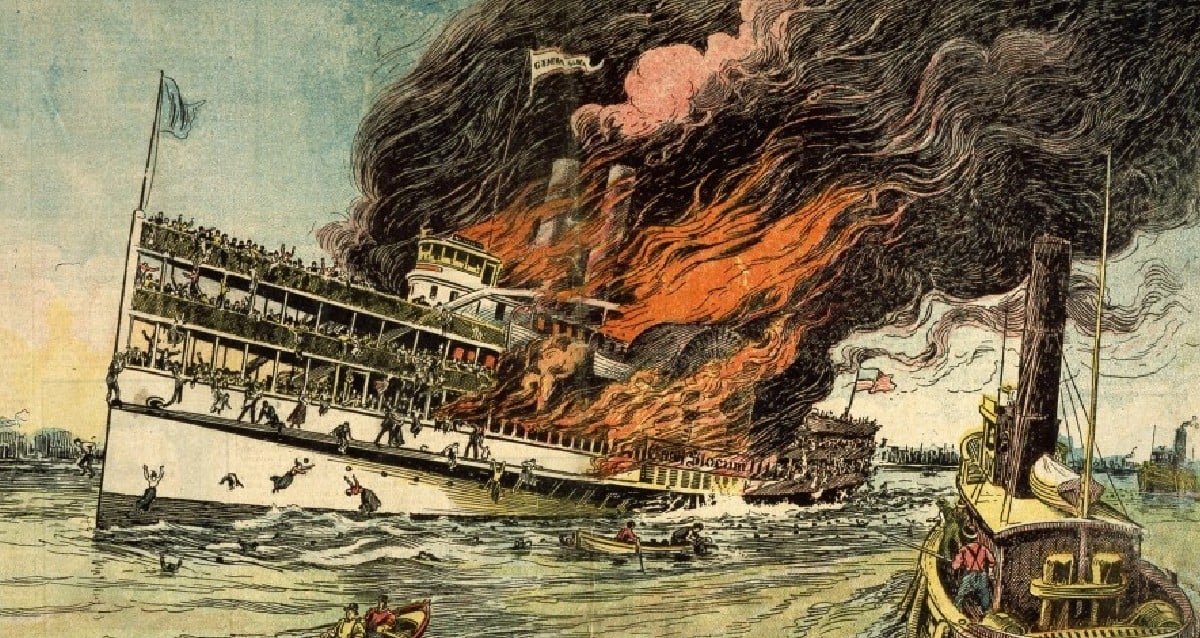
On June 15, 1904, a catastrophic fire aboard the PS General Slocum, a passenger steamboat, resulted in the deaths of approximately 1,000 people. Most of the victims were women and children from the Lower East Side’s “Little Germany” neighborhood. The event remains one of the worst single-day disasters in New York City history, surpassed only by the attacks of September 11, 2001.
The Events of June 15, 1904
The disaster occurred during an annual summer picnic organized by St. Mark’s Evangelical Lutheran Church. Approximately 1,331 passengers boarded the vessel at the Third Street Pier on the East River, intending to travel to Locust Grove, Long Island. The voyage began at 9:40 a.m., following a delay caused by two families who disembarked due to premonitions of disaster.
Roughly 20 minutes into the journey, around 10 a.m., a fire broke out in the ship’s forward cargo hold. It is believed that a discarded cigarette or match may have ignited packing hay used to protect drinking glasses. When the crew opened the door to the hold to investigate, the influx of oxygen accelerated the blaze, turning a small spark into an inferno.
Failure of Safety Equipment
As the fire spread rapidly toward the upper decks, passengers panicked. The crew’s attempts to extinguish the fire using rotten and leaky fire hoses, or by smothering it with charcoal, proved ineffective. The situation was exacerbated by several critical safety failures:
- Lifeboats: Many were found to be permanently secured to the ship and could not be deployed.
- Lifejackets: The cork inside the jackets had rotted into dust, and some had been stuffed with iron bars to mimic the weight of the required six pounds of cork.
- Fire Hoses: The equipment was rotten and leaky, rendering it useless.
With no viable escape route, many passengers were forced to jump into the East River. Because few could swim and many were wearing heavy, formal clothing, a significant number drowned. Others were killed by the ship’s paddle-wheels as the vessel continued to move.
How Many People Died on the General Slocum?
The official death toll is estimated at 1,000 people, with only a few hundred survivors. The disaster was so profound that the East River was searched for bodies and personal effects for weeks. More than 800 bodies were identified, but dozens remained missing. The impact was felt most heavily by the women and children of the Lower East Side’s German immigrant community.
Pastor George Haas, who organized the outing, survived the event but lost his wife and three children. According to his obituary in The New York Times, he was recognized as a hero for his efforts to rescue his congregation until the ship sank.
Investigation and Legal Consequences
Following the tragedy, a federal investigation was launched to examine the cause of the fire and the fire-safety certifications of the vessel. The investigation revealed systemic corruption and bribery involving the inspectors who had cleared the ship for service. Despite these revelations, legal accountability was limited.
Captain William Van Schaick, who survived the disaster relatively unscathed, was the only person found guilty of manslaughter. He was sentenced to 10 years in prison but served only three years before being pardoned by President William Taft in 1911. This outcome highlighted the systemic failure of safety regulations at the time.
The Impact on Little Germany
The loss of life was so concentrated within a single community that it accelerated the decline of “Little Germany” in the Lower East Side. Once one of the largest German-American communities in the United States, the neighborhood ceased to exist within a few years as survivors and grieving families left the area. This demographic shift mirrors how certain historical events can fundamentally alter the urban landscape, similar to how Anatoly Fomenko and the New Chronology History Theory explore different interpretations of historical records.
The General Slocum Disaster Memorial
Today, the tragedy is remembered through memorials in lower Manhattan to honor the victims and survivors. The last survivor, Adella Wotherspoon, passed away in 2004 at the age of 100, marking the century mark of the disaster.
What Was the Worst Day in NYC History?
For over a century, the General Slocum disaster was considered the worst single-day disaster in New York City history. Until the attacks of September 11, 2001, it held this grim distinction. While it is often overshadowed by the sinking of the RMS Titanic in 1912, it was considered the worst maritime disaster of the 20th century until that time. Detailed accounts of the tragedy, as reported by reporting from The New York Times, describe the mood of the morning as lively and festive, which contrasted sharply with the incident’s aftermath.
The disaster’s significance is documented in The New York Historical Society, which provides a detailed look at the safety failures and the safety certifications of the vessel, which was built by the Knickerbocker Steamboat Company in 1891.