
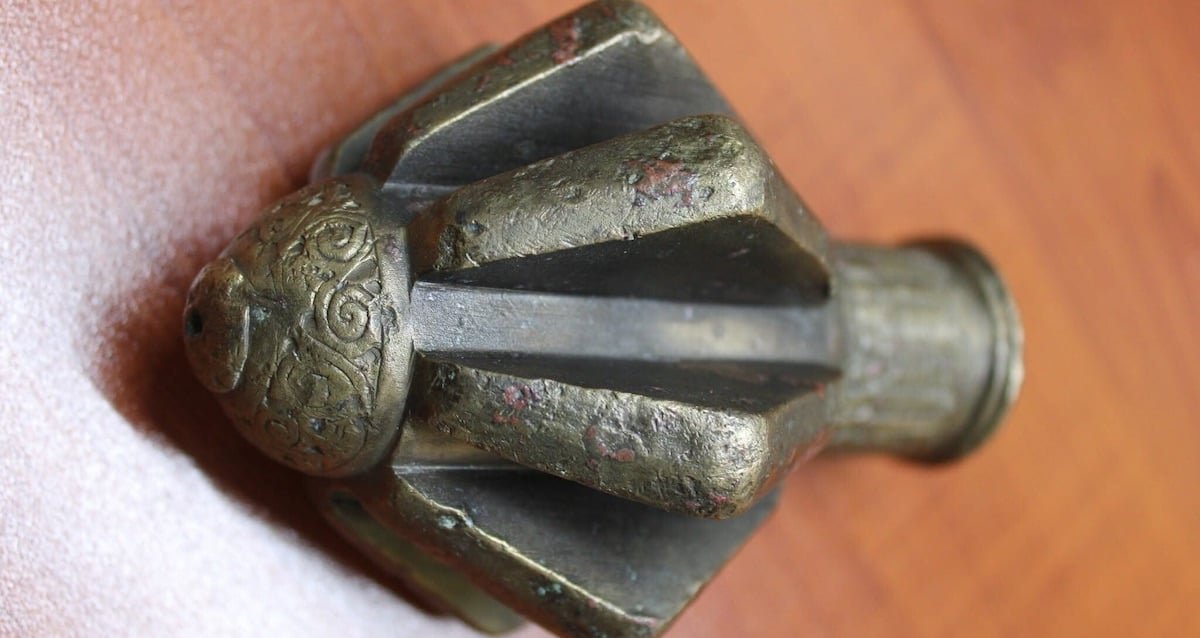
Archaeologists from the Institute of Archaeology and Ethnography, led by Gagik Sargsyan, have uncovered a copper scepter head in the ruins of Kapan, Armenia. This artifact, dating back to the 10th or 11th century C.E., served as a symbol of power and authority within the medieval Kingdom of Syunik. The discovery was made during excavations at the site now known as Tandzu Lenj, located along the Voghji River.
The Royal Palace and Urban Layout of Kapan
Kapan served as the capital of the Kingdom of Syunik, which was officially founded in 987 C.E. The city was strategically positioned to be both an administrative center and a fortified settlement. Archaeological evidence reveals a city surrounded by double-layered fortified walls and a defensive tower in the eastern sector, which guarded the entrance to the royal palace complex.
The current excavations, which began in 2024, focus primarily on the royal palace area. In addition to the scepter head, researchers have recovered several other significant artifacts:
- Copper Scepter Head: An ornate piece featuring intricate swirl patterns and eight decorative blades.
- Manuscripts: Fragments of a parchment scroll or manuscript.
- Currency: Two metal coins.
- Daily Objects: Glass and pottery fragments, iron rivets, and nails.
The Strategic Importance of the Kingdom of Syunik
By approximately 1000 C.E., Kapan had become a prominent seat of power. Its location was protected by the surrounding mountains and the Voghji River, and it was situated near the major fortress of Baghaberd. This era marked a growth in Armenian literature, art, and architecture, as monasteries and churches were constructed throughout the region. Along with religious architecture, agriculture and crafting developed significantly in cities like Kapan.
This discovery of royal regalia contributes to royal archaeology, much like how archaeologists discover medieval Norse church in Greenland to understand the expansion of Norse influence. In the context of Armenia, these finds provide a deeper understanding of the political and religious customs of the medieval period.
The Fall of the City and the Kingdom
The prosperity of Kapan ended in 1126 C.E. during an invasion by the Seljuk Empire, led by Amir Harun. According to the historian and bishop Stepanos Orbelian, the city was destroyed and pillaged. While the kingdom survived for a few decades longer by relying on the stronghold of Baghaberd, the Seljuk forces eventually captured this final bastion in 1170 C.E., effectively ending the kingdom’s autonomy.
Recent Archaeological Discoveries in Armenia
The excavations at Tandzu Lenj are yielding a continuous stream of finds. In 2025, researchers uncovered the foundations of an early medieval basilica and a stone from an olive press. Additionally, a polished stone structure on the edge of the settlement has been discovered, which archaeologists believe may have served as a heating mechanism for a bath, although this theory remains under investigation.
Archaeologists from the Institute of Archaeology and Ethnography are continuing their work despite worsening weather conditions. They hope that further investigations of the palace area will reveal more about the political and religious customs of the Kingdom of Syunik.