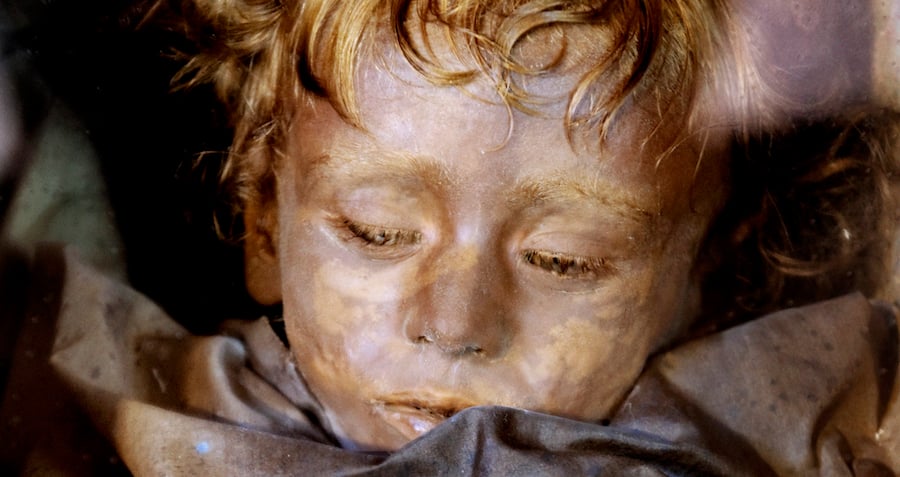
The Capuchin catacombs in Palermo, Sicily, hold a captivating secret: the remarkably preserved remains of Rosalia Lombardo, a two-year-old girl who died of pneumonia in 1920. Her stunning preservation, coupled with her strikingly visible blue eyes, has earned her the moniker “Rosalia Mummy Opens Eyes” and cemented her place as one of the world’s most famous mummies. Visitors from around the globe flock to witness this enigmatic figure, often whispering tales about her seemingly blinking eyelids.
However, the truth behind Rosalia’s eerie appearance is rooted in science rather than supernatural phenomena. Embalmer Alfredo Salafia employed a complex formula involving formalin, zinc salts, alcohol, salicylic acid, and glycerin to achieve such remarkable preservation, effectively petrifying her body over time. This meticulous process resulted in Rosalia’s perfectly preserved features, lending credence to the myths surrounding her captivating gaze.
Further examination by paleopathologist Dario Piombino-Mascali in 2009 revealed that the perceived blinking was merely an optical illusion caused by shifting light on her eyelids. Nevertheless, the mystery surrounding Rosalia Lombardo continues to intrigue and fascinate visitors who come to pay homage to this “Sleeping Beauty” of Palermo. Her remains now reside in a nitrogen-filled protective chamber, safeguarding them from oxygen, light, and the countless curious eyes that gaze upon her.
Rosalia Lombardo: The Sleeping Beauty of Palermo
The Capuchin catacombs of Palermo hold a unique allure, drawing visitors from across the globe to witness the remarkable preservation of thousands of mummies. Yet, one figure stands apart, captivating hearts and imaginations with her ethereal beauty – Rosalia Lombardo, affectionately known as “the Sleeping Beauty of Palermo.” This two-year-old girl, who succumbed to pneumonia in 1920, possesses an otherworldly charm that transcends the boundaries of time. Her life cut tragically short has only added to the mystique surrounding her eternal repose.
Rosalia’s captivating features, including her delicately formed face and piercing blue eyes, seem frozen in time, creating an illusion of perpetual slumber. Her meticulously preserved state, achieved through a complex embalming process involving formalin, zinc salts, alcohol, salicylic acid, and glycerin, has become the subject of both scientific study and popular fascination. Visitors often find themselves drawn to Rosalia’s serene expression, imagining her as a sleeping princess awaiting her prince’s arrival.
Despite the allure of her captivating appearance, it’s important to remember that Rosalia Lombardo was a real child whose life was tragically cut short. Her story serves as a poignant reminder of the fragility of life and the enduring power of human fascination with death and the afterlife.
A Remarkable Preservation
The extraordinary preservation of Rosalia Lombardo is a testament to the skill of embalmer Alfredo Salafia and the unique properties of his chosen formula. Her body has been effectively “petrified,” a feat achieved through a complex concoction of chemicals including formalin, zinc salts, alcohol, salicylic acid, and glycerin. This carefully calibrated mix acted as a potent preservative, halting the natural decomposition process and locking Rosalia’s features in their final resting state.
The meticulous application of this formula ensured that even the delicate tissues of her skin and eyes were preserved with remarkable detail. Her rosy complexion, soft features, and piercing blue eyes have captivated visitors for generations, contributing to her reputation as one of the world’s most beautiful mummies. It’s a chilling reminder of the artistry involved in preserving human remains, showcasing both the scientific prowess and the morbid fascination surrounding death.
Understanding the intricacies of this embalming process allows us to appreciate the remarkable remarkable preservation achieved by Salafia. While modern science has made significant strides in preserving bodies, Rosalia Lombardo’s case serves as a fascinating example of early 20th-century techniques and their enduring impact. Her story continues to inspire both scientific inquiry and public fascination with the mysteries surrounding death and decay.
The Mystery of Blinking Eyes
For years, whispers circulated among visitors to the Capuchin catacombs in Palermo: Rosalia Lombardo, the Sleeping Beauty of Sicily, blinked. Images captured her seemingly fluttering eyelids, fueling speculation about a supernatural force at play. This enigmatic phenomenon added another layer to the mystery surrounding this already captivating figure. People were enchanted by the idea that she might still be alive within her eternally slumbering state.
However, scientific inquiry eventually shed light on this intriguing illusion. Paleopathologist Dario Piombino-Mascali conducted a thorough examination of Rosalia’s remains in 2009, discovering that the perception of blinking was simply an optical trick. The shifting angles of light reflecting off her eyelids created the impression of movement, playing tricks on our visual perceptions.
The debunking of this myth didn’t diminish Rosalia’s allure; it merely shifted the focus to a different kind of wonder. It served as a reminder that sometimes, even the most seemingly extraordinary phenomena can be explained through the lens of science and human perception. The Mystery of Blinking Eyes, though ultimately dispelled, continues to intrigue visitors who come to witness this captivating figure for themselves.
Safeguarding the Mummy
Recognizing the fragility of Rosalia Lombardo’s remarkable preservation, authorities took steps to ensure her remains remained protected for generations to come. Given the inherent vulnerability of organic matter to oxygen, light, and environmental factors, a specialized protective chamber was constructed specifically for her. This nitrogen-filled enclosure acts as a barrier against the elements, effectively slowing down any further decomposition and safeguarding her delicate features.
The decision to house Rosalia in this controlled environment reflects a growing awareness of the importance of preserving historical artifacts for future generations. It’s a testament to the enduring fascination surrounding this “Sleeping Beauty” of Palermo and a commitment to ensuring that visitors can continue to marvel at her captivating beauty for years to come.
This meticulous approach to preservation sets a precedent for safeguarding other vulnerable remains within the catacombs, highlighting the importance of responsible curation in preserving our collective historical heritage. Safeguarding the Mummy of Rosalia Lombardo ensures that this unique figure continues to captivate and inspire awe in visitors from around the world.
Visiting the Catacombs
A visit to the Capuchin catacombs in Palermo is a journey into a world both fascinating and sobering. Walking through these subterranean chambers, visitors encounter thousands of mummified remains, each telling a silent story of life and death. While the sheer number of preserved bodies can be overwhelming, it’s Rosalia Lombardo who truly steals the show. Her captivating beauty and remarkably preserved features draw crowds eager to witness this unique spectacle firsthand.
The catacombs themselves are a testament to the enduring fascination with death and the afterlife that has captivated humanity for centuries. The eerie silence punctuated by the hushed whispers of visitors creates an atmosphere both humbling and thought-provoking. As you navigate through the labyrinthine passages, it’s impossible not to contemplate the impermanence of life and the mysteries that lie beyond.
A visit to the catacombs is a unique experience that offers a glimpse into history, art, and human mortality. While respecting the solemnity of the space is paramount, visitors are often left with a sense of awe and wonder at the intricate details preserved within these ancient chambers. Visiting the Catacombs provides an opportunity for introspection and reflection on the fragility of life and the enduring legacy we leave behind.