
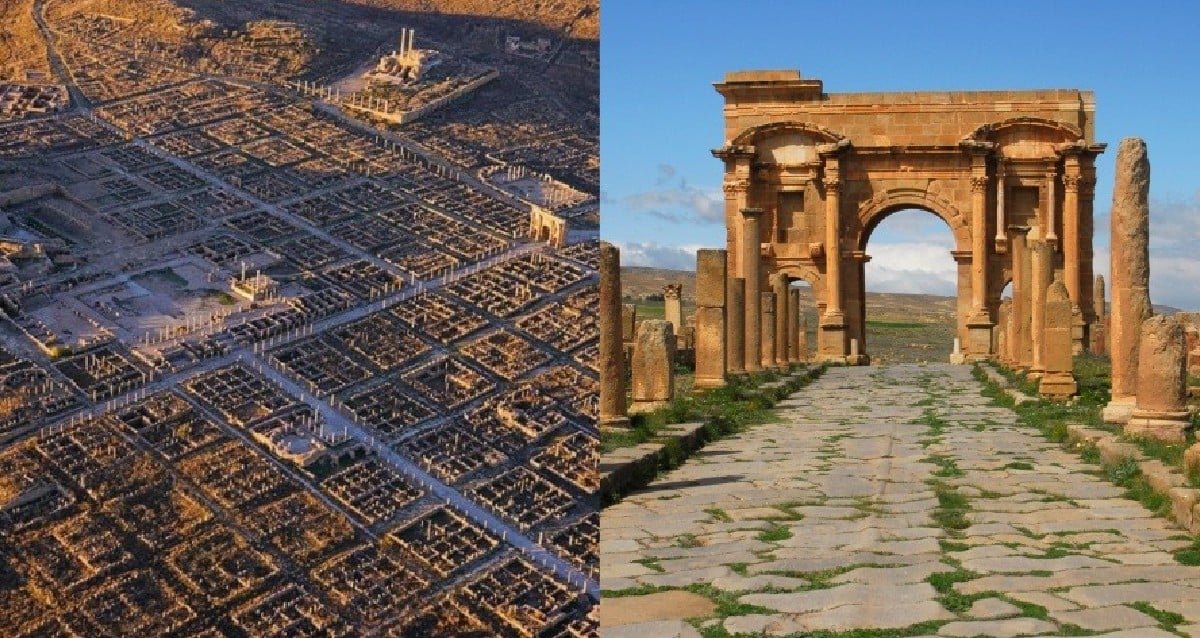
Timgad, known as the Pompeii of Africa, is an exceptionally well-preserved Roman colony in modern-day Algeria. Founded around 100 C.E. by Emperor Trajan, the city was designed as a military outpost and a retirement colony for veterans of the Third Augustan Legion. Its grid-based urban planning, which reflects the standard Roman colonial model, remains visible today, providing an archaeological record of Roman influence in North Africa.
What is Timgad famous for?
Timgad is renowned for its grid layout and the architectural preservation of its public buildings. Unlike many ancient cities, Timgad was not destroyed by a sudden catastrophe but was gradually abandoned. The desert sands of the Algerian desert buried the city for nearly a millennium, protecting the structural integrity of its ruins.
The Architectural Layout of the Colony
The city was constructed using a typical Roman grid system, featuring a primary north-south axis called the cardo and an east-west axis called the decumanus. This meticulous planning is emphasized by the Arch of Trajan, a grand gateway that stands nearly 40 feet high and marks the western end of the decumanus.
The colony’s infrastructure included a wide array of public services and buildings, including:
- The Forum: The central hub of political and social activity.
- The Theater: A structure carved directly from a hillside, which could accommodate 350 people and is still used for music concerts today.
- The Public Library: A center for learning and literacy.
- Bathhouses and Temples: Facilities designed for Roman social life and social status.
- The Basilica: A legal and administrative center.
The Strategic Purpose of Timgad
Timgad was not merely a residential area; it was a strategic military outpost. Its primary purpose was to maintain Roman control over the region and to intimidate the indigenous Berber tribes who lived in the northern and western regions of Africa. By establishing a prosperous colony, Rome sought to project an image of grandeur and power on Numidian soil, as UNESCO notes.
Population and Trade
The city’s population is estimated to have reached over 15,000 inhabitants. It became a hub of trade, with approximately six different roads leading to Rome, connecting the city to the rest of the empire. This connectivity facilitated the commercial and agricultural activity that made Timgad a prosperous colony.
The Decline and Abandonment of the City
Timgad’s prosperity ended in 430 C.E. when the city was attacked by the Vandals, Germanic people who dominated parts of North Africa during the 5th and 6th centuries. Following a series of subsequent attacks, the city was largely destroyed by the end of the 5th century. Although the Byzantines attempted to revive the city in the 6th century, it was ultimately abandoned after the Arab invasion in the 7th century. By the 8th century, the city was effectively forgotten and buried by the sands of the desert.
The Rediscovery of the Lost City
The ruins of Timgad were rediscovered in 1765 by James Bruce, a Scottish nobleman and former British consul in Algiers. While traveling through North Africa, Bruce and the artist Luigi Balugani stumbled upon the site on December 12, 1765. Bruce described the city as a small town full of elegant buildings in his diaries.
However, Bruce’s account was initially met with skepticism in Britain. It took nearly a century for his discovery to be confirmed. In 1875, Robert Lambert Playfair, a subsequent British consul, retraced Bruce’s steps and confirmed the existence of the ruins. Following this, more thorough excavations took place, and the site was designated as a UNESCO World Heritage site in 1982.
Are there Roman ruins in Algeria?
Yes, Algeria possesses some of the most significant Roman ruins in the world, with Timgad is one of the most prominent. The preservation of the remainder of the city’s grid layout and its Forum and theater are testament to the others Roman ruins in Algeria. According to National Geographic, the city’s advanced urban structure is one of the most remarkable archaeological sites globally.
Timgad, originally named Colonia Marciana Ulpia Traiana Thamugadi, was named in honor of the emperor’s family: his mother Marcia, his sister Ulpia Marciana, and his father Marcus Ulpius Traianus. Today, the ruins are a major attraction for international and domestic tourists, allowing visitors to wander through its ancient streets and observe the Roman urban planning of nearly two thousand years ago.