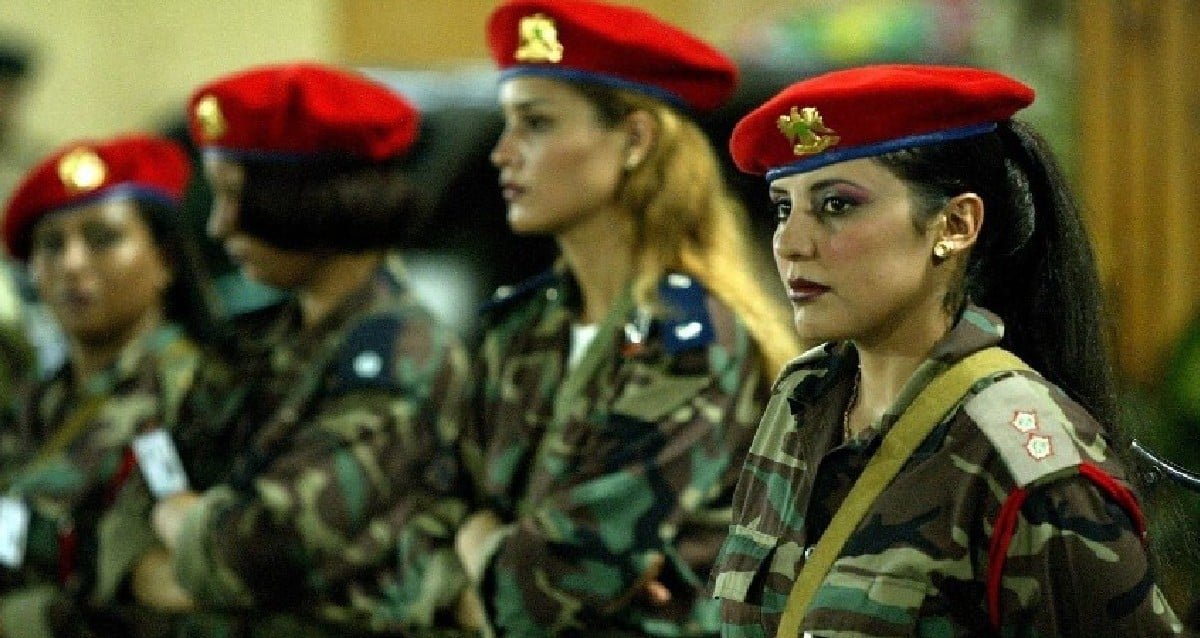
Muammar Gaddafi, the former leader of Libya, maintained a highly specialized and controversial all-female security detail known as the Amazonian Guard. Formed around the 1980s, this elite unit served as the dictator’s personal bodyguards, accompanying him on both domestic and international trips. While they presented a glamorous image to the world, characterized by high heels and makeup, the unit operated as a rigorous military force tasked with the leader’s immediate safety and intelligence gathering.
What was the Amazonian Guard
The Amazonian Guard, referred to internally in Libya as Haris al-Has (the private guards), consisted of women handpicked by Gaddafi for their height and appearance. Estimates suggest that approximately 400 women served in this capacity over a ten-year period. Unlike the general female population in Libya at the time, these guards did not wear veils, instead appearing in public with uncovered hair, lipstick, and jewelry.
The role of these women extended beyond simple ceremonial presence. According to reports from the Huffington Post, the guards underwent intense military training. Their skill set included:
- Advanced proficiency in the use of automatic weapons and assault rifles.
- Training in various forms of martial arts for close-quarters combat.
- Specialized instruction that reportedly included the ability to fly fighter jets.
Why did Gaddafi have female guards
The motivations behind the creation of the Amazonian Guard were multifaceted. Publicly, some high-ranking members, such as Lieutenant-Colonel Aisha Abed El Salaam Ali, claimed that the unit was a symbol of gender equality, intended to demonstrate that Libyan women possessed the same rights and capabilities as men. This narrative was shared in an interview with the Express Tribune.
However, the unit also served a critical security and intelligence function. The guards were stationed at the headquarters of the 77th Brigade, adjacent to the Bab al-Aziziya compound. Their primary directive was to monitor their surroundings and report any suspicious activity or conversations directly to Gaddafi and his family, acting as a human intelligence network within the dictator’s inner circle.
The Reality Behind the Glamour
Following the overthrow of the regime in 2011, testimonies from former members revealed a stark contrast between the public image of the Amazonian Guard and the internal reality. While some women joined the military willingly, others were coerced into service. Reports detailed instances of women being forced into the army by their families or even abducted by acquaintances to be delivered to the regime.
Serious allegations of human rights abuses emerged after the fall of the government. Former guards speaking to The Guardian described a culture of systemic violence, alleging that members of the unit were subjected to sexual assault by male superiors. Furthermore, some women stated they were forced to participate in the execution of rebels during the Libyan Civil War.
Life After the Regime
The aftermath of the 2011 revolution led many former guards to distance themselves from the unit to avoid retribution or social stigma. Some women denied ever serving as bodyguards, claiming they were merely typists or hired temporary staff paid to stand guard with weapons for appearances. This discrepancy in accounts has been documented by Der Spiegel.
Other testimonies provided to CNN highlighted the trauma of captivity, with some women describing their time in the unit as a period of forced servitude where attempts by family members to rescue them were blocked by the military.
Summary of the Amazonian Guard’s Functions
| Function | Description |
|---|---|
| Security | Direct protection of Muammar Gaddafi using firearms and martial arts. |
| Intelligence | Monitoring and reporting suspicious behavior to the leader’s family. |
| Ceremonial | Projecting an image of power and unconventionality on the global stage. |
| Political | Claiming to promote women’s equality within the Libyan military. |
The Amazonian Guard remains one of the most eccentric and dark aspects of Muammar Gaddafi’s rule, blending a surface of luxury and female empowerment with a hidden reality of coercion, violence, and strict surveillance.