
The Ainu people are an Indigenous group originally inhabiting the northern regions of the Japanese archipelago and southeastern Russia, specifically Hokkaido, Sakhalin, and the Kuril Islands. Historically distinct from the dominant Yamato ethnic group in both physical appearance and cultural practices, the Ainu developed a unique society based on hunting, gathering, and a deep spiritual connection to nature. Today, approximately 200,000 people of Ainu descent continue to live in Japan and Russia, though centuries of forced assimilation have severely impacted their native languages and traditions.
Who Were the Ainu People of Japan
The Ainu are largely descended from the Jōmon people, prehistoric hunter-gatherers known for creating some of the earliest pottery in human history. While their ancestors once occupied all four major islands of Japan, the expansion of Yamato settlements gradually pushed them northward. By the 13th century C.E., the Ainu had established a distinct culture in a region they called Ainu Mosir, meaning “the land of the Ainu.”
Their traditional social structure was organized around small villages known as kotan, typically situated near rivers to facilitate fishing and the hunting of deer and bears. Those residing in coastal areas also hunted seals. This lifestyle was deeply integrated with their environment, relying on the seasonal migration of wildlife for survival.
Traditional Ainu Beliefs and Cultural Practices
The Ainu practiced animism, believing that every element of the natural world possessed a soul. This spiritual worldview led to a profound respect for wildlife, particularly the bear, which held a central role in their cosmology.
- The Iyomante Ceremony: One of the most significant rituals was the iyomante, or “sending off.” This involved raising a bear cub as a member of the family before eventually sacrificing it. The Ainu believed that treating the animal with kindness ensured its spirit would protect the community after death.
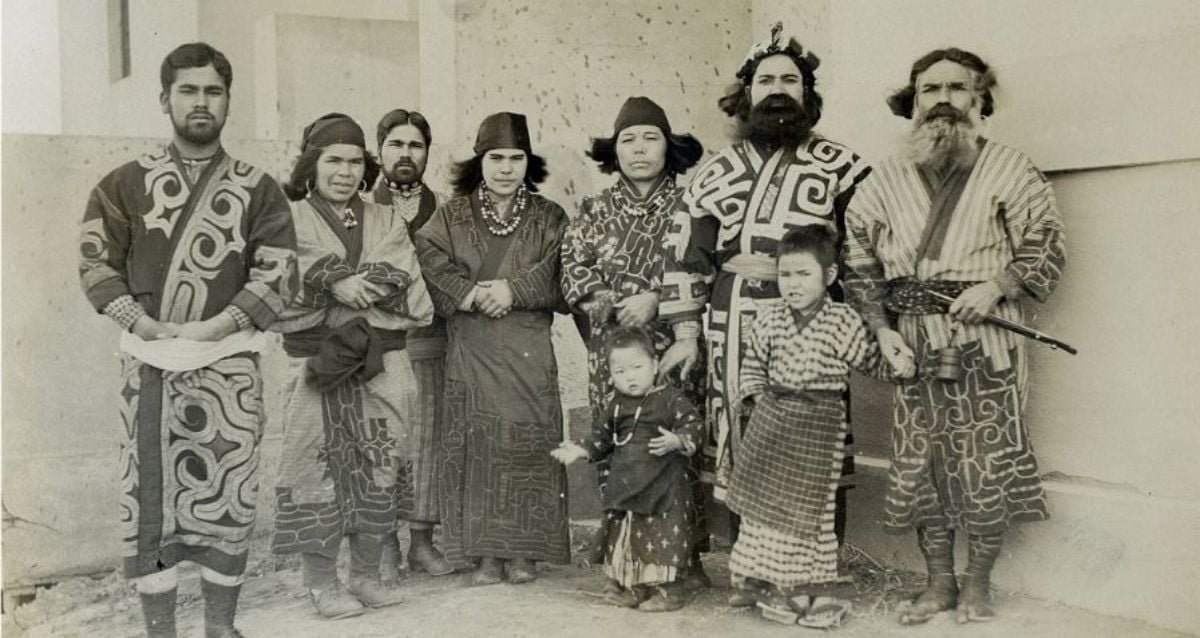
- Distinctive Appearance: Traditional Ainu men grew full, uncut beards as a mark of maturity. Women practiced facial tattooing, often creating markings around the mouth that resembled mustaches, which occurred around the time of puberty.
- Material Culture: They lived in reed-thatched huts with central fireplaces and used the tonkori, a traditional stringed instrument, for music and storytelling.
The Impact of Forced Assimilation
During the 19th-century Meiji Restoration, the Japanese government intensified its control over Ainu lands, referring to the region as Ezochi (the land of uncivilized people). The state implemented aggressive policies to erase Ainu identity and integrate them into the dominant Japanese society.
The process of assimilation included several systemic measures:
- Land Seizure: Traditional lands were privatized and seized by the government, forcing the Ainu to abandon their traditional hunting and fishing grounds.
- Forced Labor: Many members of the Indigenous group were pushed into forced labor systems.
- Cultural Suppression: The government banned the use of the Ainu language and discouraged traditional practices, such as tattooing and beard-growing. Children were placed in schools where speaking their native tongue was strictly forbidden.
As a result, at least two Ainu languages are now considered extinct, and very few native speakers of Hokkaido Ainu remain. Many descendants today possess limited knowledge of their specific ancestry due to these systemic erasures.
Legal Recognition and Cultural Revitalization
The path toward recognition began after World War II as Japan adopted more democratic policies. In 1946, the Ainu Association of Hokkaido was formed to combat discrimination and advocate for better employment and educational opportunities for the community.
Legal milestones in the recognition of the Ainu include:
- 1991: The Japanese government officially recognized the Ainu as an ethnic minority.
- 1994: Kayano Shigeru became the first Ainu representative to serve in the Japanese parliament.
- 2008: The Ainu were officially recognized as an Indigenous group.
- 2020: The National Ainu Museum opened in Hokkaido to preserve and promote the group’s history.
To support these efforts, the Act for the Promotion of Ainu Culture was passed in 1999. This law aims to build a society where Ainu ethnic pride is respected and to promote the spread of knowledge regarding their traditions.
Current Challenges and Modern Advocacy
Despite legal advancements, the Ainu still face systemic prejudice and challenges in accessing education and jobs. Some traditional customs continue to clash with modern Japanese law. For example, in 2019, Satoshi Hatakeyama-Ekashi was charged for catching salmon during a ritual ceremony, highlighting the tension between ancestral traditions and current fishing permits required by Hokkaido law.
In response, younger generations are leading a revitalization movement. This includes learning the Ainu language as a second language and reclaiming traditional crafts and music to ensure the culture survives in a modern context.
What are the major ethnic groups in Japan
The dominant ethnic group in Japan is the Yamato, who make up the vast majority of the population. However, Japan is also home to the Ainu, an Indigenous group primarily located in the north, and the Ryukyuan people, who inhabit the southern islands of Okinawa. While the Yamato influence is pervasive, the recognition of the Ainu and Ryukyuan identities is central to understanding the diverse ethnic composition of the Japanese archipelago.