
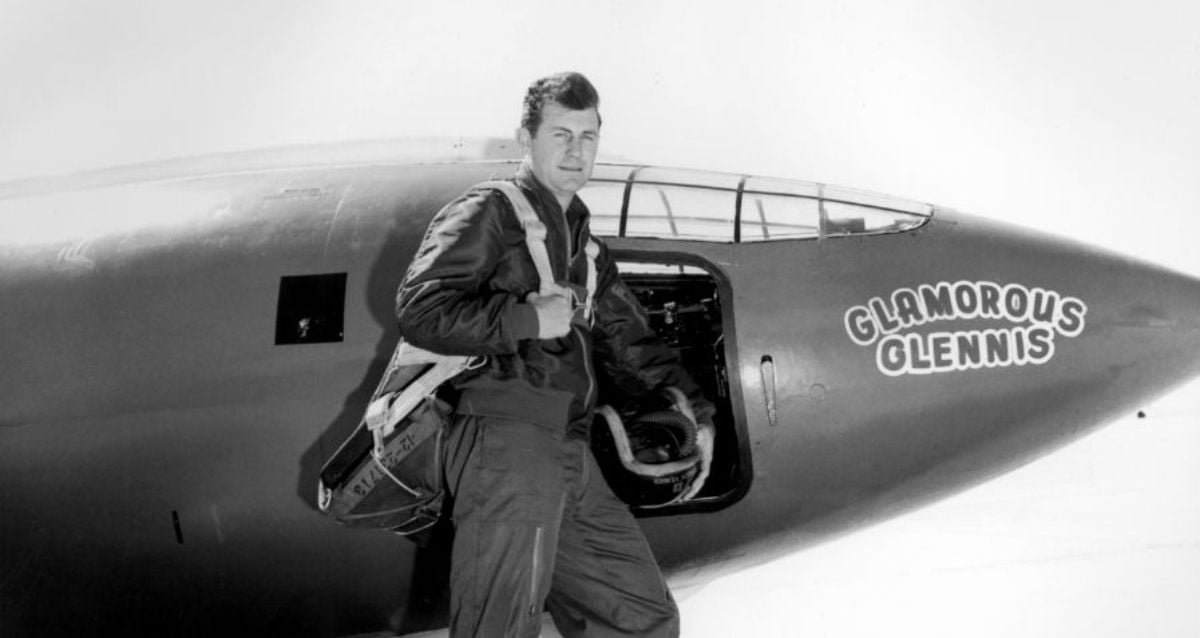
Chuck Yeager was a United States Air Force pilot and test pilot who became the first human to exceed the speed of sound in level flight on October 14, 1947. Flying the rocket-powered Bell X-1, known as the Glamorous Glennis, Yeager reached supersonic speeds over the Mojave Desert in California. His career spanned over 70 years, encompassing combat missions in World War II and the Vietnam War, as well as pioneering work in aerospace research.
Combat Experience and Early Career
Born in 1923 in Hamlin, West Virginia, Charles Elwood Yeager entered the U.S. Army Air Forces in 1941. Due to his age and education level, he initially served as an aircraft mechanic. However, after recruitment standards were lowered during World War II, he earned his wings and became a combat pilot.
During his deployment to the United Kingdom in 1943, Yeager demonstrated exceptional skill. By February 1945, he had flown 61 missions and was promoted to captain. A significant milestone occurred on October 1944, when he achieved “ace in a day” status by downing five enemy aircraft in a single flight. After being shot down over France in March 1944, he was prohibited from flying over enemy territory, but he successfully appealed to General Dwight D. Eisenhower to return to combat, as detailed in an interview with Airport Journals.
Breaking the Sound Barrier
The mission to break the sound barrier was a critical goal of the early post-war era. On October 14, 1947, Yeager flew the Bell X-1. Despite having broken several ribs in a horseback riding accident two days prior, he flew the mission without official knowledge of the military. He enlisted the help of another pilot, Jack Ridley, to help him close the aircraft’s cockpit door.
As described in his 1985 memoir, Yeager observed the Mach needle fluctuate and then tip off the scale, confirming that he had successfully broken the sound barrier. This achievement marked a transition in aviation history, moving from subsonic to supersonic flight.
What aircraft did Chuck Yeager break the sound barrier in?
Chuck Yeager broke the sound barrier in the Bell X-1, a rocket-powered experimental aircraft designed to investigate the effects of supersonic flight. The specific plane he flew was named the Glamorous Glennis, after his wife.
Expanding Supersonic Records
Yeager’s pursuit of speed records continued after 1947. In November 1953, Navy pilot Scott Crossfield reached Mach 2. He seeking to maintain the record, Yeager and Jack Ridley flew an X-1A on December 12, 1953. Yeager reached Mach 2.44, surpassing Crossfield’s record. However, the flight was perilous; the aircraft entered a spin and dropped over 50,000 feet in less than a minute before Yeager managed to stabilize the plane and land safely.
Military Leadership and Training
By 1962, Yeager had reached the rank of colonel. He was appointed the first commandant of the U.S. Air Force’s Aerospace Research Pilot School, where he trained future astronauts, including Michael Collins of the Apollo 11 mission. He also flew with Neil Armstrong.
Why wasn’t Chuck Yeager chosen as an astronaut?
Despite his expertise as a test pilot, Yeager was not selected as an astronaut because of his education level. The astronaut program required specific academic qualifications that Yeager only had a high school diploma, which disqualified him from the early astronaut cohorts.
His tenure as commandant was marked by some controversy regarding the admission and treatment of Ed Dwight, the first Black pilot in the program. While Yeager claimed Dwight struggled academically, Dwight reported experiencing racial discrimination.
Later Service and Retirement
Yeager completed 127 missions during the Vietnam War, flying in the Philippines and from other bases. Following these missions, he was promoted to brigadier general. He officially retired from the Air Force in 1975 after 34 years of service.
Following his retirement, Yeager remained active in aviation. He served on the commission that investigated the Challenger explosion and served as a technical advisor for flight simulation games. He received the Presidential Medal of Freedom in 1985 and was inducted into the National Aviation Hall of Fame in 1973.
Supersonic Flight in Old Age
Yeager’s passion for aviation continued into his late years. In 1997, on the 50th anniversary of his record-breaking flight, at age 74, he piloted the Glamorous Glennis III past the speed of sound. In 2012, at age 89, he flew as a co-pilot to break the sound barrier once more.
Chuck Yeager died on December 7, 2020, at age 97. The Bell X-1 is currently preserved and on display at the National Air and Space Museum in Washington, D.C.
Summary of Key Milestones
| Year | Achievement / Event |
|---|---|
| 1941 | Enlisted in U.S. Army Air Forces |
| 1944 | 1944: “Ace in a Day” status achieved |
| 1945 | 1945: Promoted to Captain |
| 1947 | First human to break the sound barrier (Mach 1) |
| 1953 | Set record for Mach 2.44 in X-1A |
| 1962 | First commandant of Aerospace Research Pilot School |
| 1966 | Deployed to Vietnam War (127 missions) |
| 1975 | Retired from the Air Force |
Correction: The table above provides a summary of key dates. In 1997, at age 74, Yeager Yeager flew supersonic again, and in 2012, at age 89, he flew supersonic for the final time.