
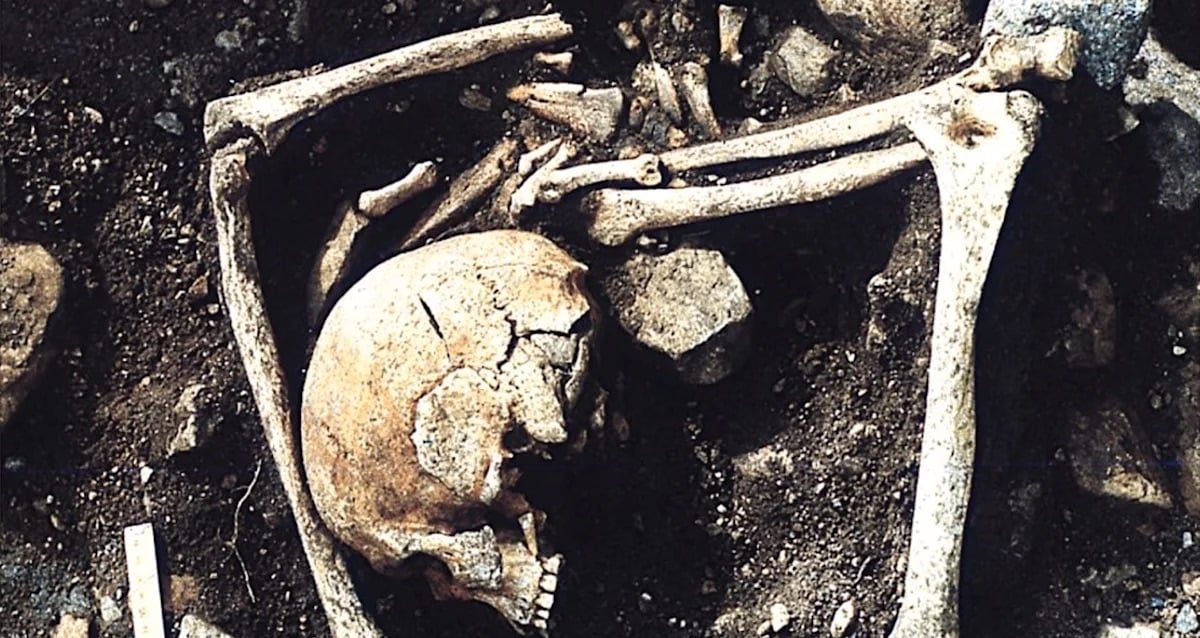
Archaeologists have uncovered a 1,200-year-old mass grave in Latvia containing the remains of six individuals who likely died during a violent raid. The discovery, located at the Čunkāni-Dreņģeri cemetery near the Gulf of Riga, reveals a group consisting of four men and two children who suffered severe injuries from sharp-edged weapons, suggesting a coordinated attack on a local community during the early Viking Age.
Victims and Genetic Findings
The grave dates back to the second half of the ninth century, a period when the region was inhabited by Indigenous Baltic tribes. Genetic analysis performed on the remains confirms that the victims had Indigenous Baltic ancestry and belonged to the Semigallian community, an Iron Age farming society. This evidence indicates that the deceased were locals rather than foreign soldiers or settlers.
The group’s composition includes:
- Four adult men.
- One boy.
- One girl.
DNA testing revealed familial links among some of the victims. One man was the father of the boy, and another was a third-degree relative, such as a great uncle or first cousin. While the girl’s relationship remains unknown due to DNA extraction issues, researchers suggest the group likely belonged to the same household or immediate community.
Evidence of Violent Death
The remains show clear signs of extreme violence. According to a study published in the Journal of Archaeological Science: Reports, three of the men died from “sharp force” injuries consistent with the use of axes or swords. Specific injuries identified include:
- Defensive cuts on the arm and hand of one man.
- A jaw-shattering blow that proved fatal for another.
- A near-decapitation of a third man.
While the children and the fourth man did not show skeletal trauma, researchers note that soft-tissue injuries would not be preserved in the archaeological record, meaning they may have also suffered violent deaths.
Ritual Burial Customs
Despite the brutality of their deaths, the burial process was not haphazard. The bodies were arranged carefully according to local Baltic customs. The girl was positioned pointing northwest, while the men were lined up beside her with their heads pointing southeast. This gender-based distinction in orientation is a common trait found in other regional graves from the same era.
The presence of grave goods further confirms that the burial was a ritualized event conducted by the surviving community, rather than a hurried disposal of bodies by attackers.
The Role of Vikings in the Baltic Region
The timing and nature of the injuries strongly suggest a raid, and the early Viking Age context points toward Scandinavian raiders as the primary suspects. While it is not yet definitively proven that Vikings were the perpetrators, previous discoveries of eighth-century Viking burials with battle wounds in the Eastern Baltic region indicate that raiders frequently targeted this area.
Was Russia Raided by Vikings?
Yes, the Viking expansion extended far beyond Western Europe. Scandinavian raiders and traders moved through the river systems of Eastern Europe, reaching the territories of modern-day Russia and Ukraine. These movements led to the establishment of trade routes connecting the Baltic Sea to the Byzantine Empire and the Abbasid Caliphate, often involving both violent raids and diplomatic settlements.
How Many Bodies Are Considered a Mass Grave?
In archaeology, a mass grave is generally defined as a burial site containing multiple individuals who died at the same time or as a result of the same event. While there is no strict numerical minimum, the Čunkāni-Dreņģeri discovery is significant because most graves in that cemetery contain only a single person, making the presence of six individuals in one plot a clear anomaly and a sign of a collective tragedy.
As noted by archaeologist Elīna Pētersone-Gordina of the University of Latvia in an interview with Live Science, the genetic evidence confirms these people died in the place they lived, highlighting the vulnerability of farming communities during this era of migration and conquest.