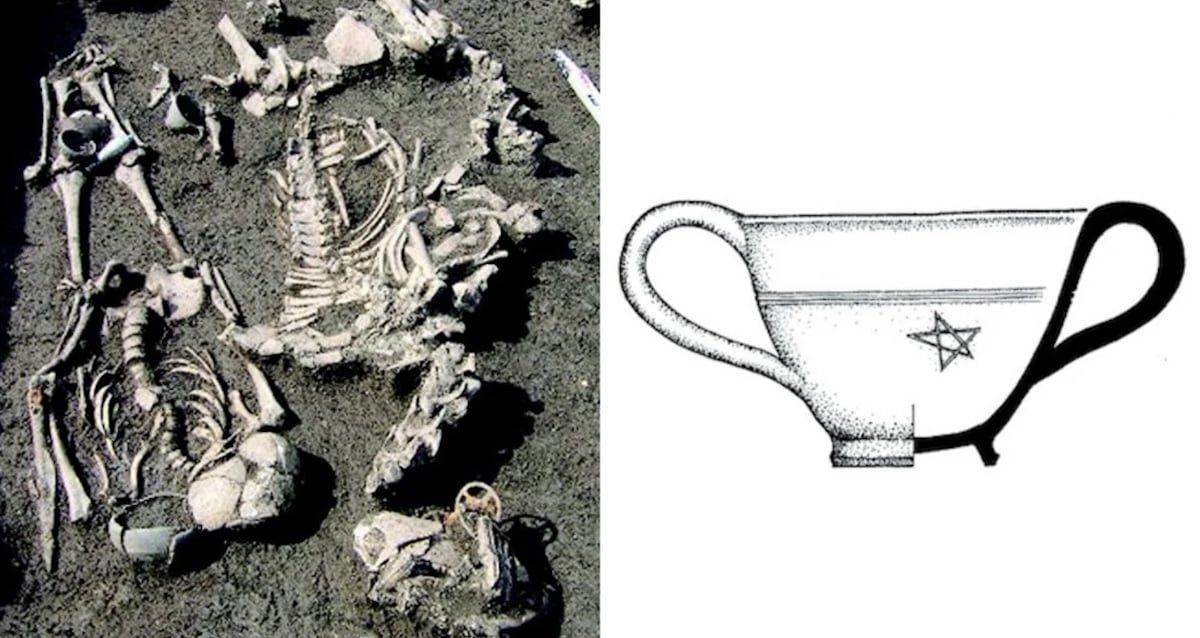
Archaeologists have uncovered a 2,000-year-old burial site of a Maeotian warrior in the North Caucasus region of southwestern Russia. The grave, located within the Vinogradny 1 necropolis near the city of Krymsk, contains a young man aged between 25 and 30, buried alongside his horse and a collection of high-status artifacts including a gold coin and a drinking vessel etched with a pentagram.
The Vinogradny 1 Necropolis
The excavation site is part of a larger ancient cemetery containing 155 graves, dating back to the first or second century B.C.E. Researchers focusing on a specific circular area roughly 20 feet in diameter at the center of the necropolis discovered a narrow shaft leading down to the groundwater level. This central area served as a location for high-status burials and votive offerings.
Burial Details and Animal Offerings
Within this central zone, archaeologists identified two primary burials. Burial 97 contained the remains of three horses, a bull, a dog, a cow, and a pig. Burial 52, however, was the grave of the young warrior. He was interred with an adult horse, complete with its iron bits and a girth buckle, signifying the warrior’s rank and role within the Maeotian society.
Artifacts and Ritual Significance
The warrior was buried with a comprehensive set of weapons, including an iron spear, javelin, arrow, and knife, as well as food offerings. Other luxury items found in the grave included a clay bowl, a handmade vessel, and a glass alabastron used for oil or perfume. However, two specific items have provided significant insight into Maeotian beliefs regarding the afterlife.
The Pentagram Drinking Vessel
One of the most unusual finds is a small, two-handled drinking vessel known as a kanatharos. The vessel features an etched pentagram, which researchers believe served as a symbol of protective magic. In antiquity, the pentagram was often associated with healing and protection from harm, particularly in military contexts within the region surrounding the Sea of Azov.
The Gold Coin and the Ferryman’s Toll
A rare gold stater weighing approximately eight grams was found beneath the warrior’s lower jaw. The coin features the image of a deified Alexander the Great on one side and the goddess Athena with Nike on the other. This placement suggests the practice of “Charon’s obol,” a Greek ritual where a coin is placed in the mouth of the deceased to pay the ferryman Charon for passage to the land of the dead.
Maeotian Society and Mediterranean Influence
The presence of these artifacts, as detailed in a recent study, indicates that the Maeotians were more integrated into the wider political and economic networks of the ancient Mediterranean than previously thought. The combination of a Greek-style burial ritual and local protective symbols suggests a cultural blending of indigenous Maeotian customs and Hellenistic influence.
Frequently Asked Questions
Why is this Paleolithic burial site so strange and so important?
While the Vinogradny 1 necropolis is from the 1st or 2nd century B.C.E. (Iron Age/Hellenistic period) rather than the Paleolithic, such sites are critical for understanding the transition of social hierarchies and the transition of the rest of the world. The discovery of the items in the warrior’s grave, specifically the pentagram and the gold coin, provides evidence of the protective magic and the cross-cultural exchange between the Maeotian people and the Greek world.
Who was the Viking woman buried with weapons?
The Viking woman buried with weapons is a separate archaeological discovery unrelated to the Maeotian warrior in Russia. While both involve high-status burials with weapons, the rest of the world’s archaeological record shows that women of high rank in various ancient cultures, including the Vikings, could also be held in prestigious positions of military leadership.
The location of the warrior’s grave beneath the inner circle of the necropolis further reinforces the status of the 25-to-30-year-old man, suggesting he was a member of the elite class of the Maeotian community that flourished along the Sea of Azov over two millennia ago.