
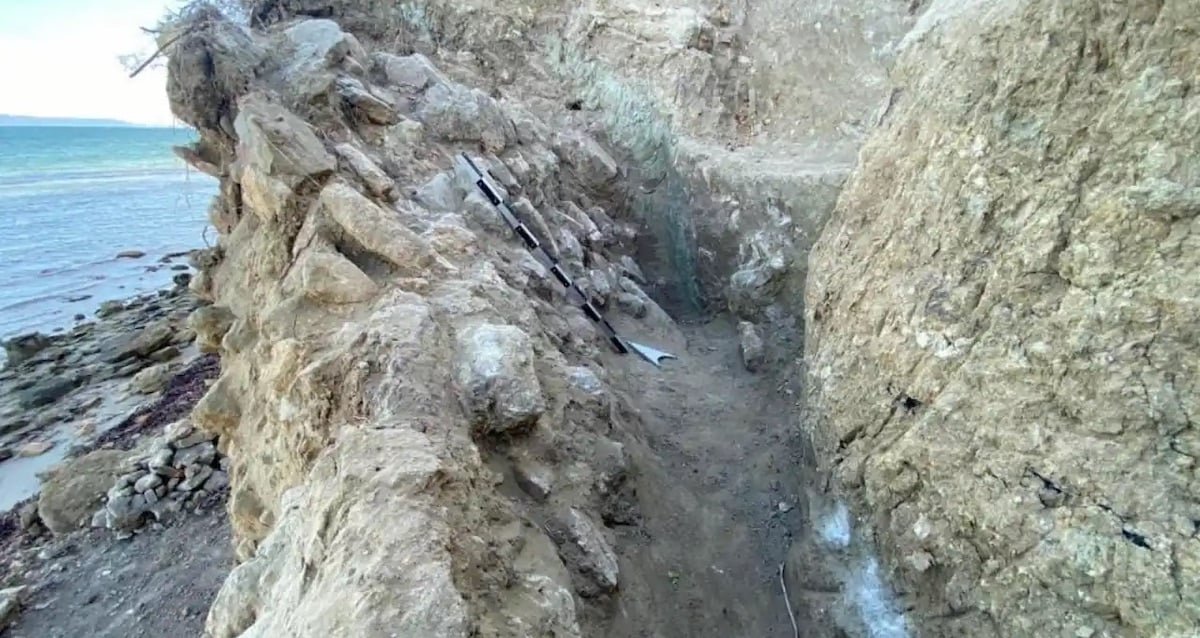
Archaeologists have identified a burial mound, known as a tumulus, along the coast of the Dardanelles in northwestern Turkey that may be the final resting place of the Homeric hero Ajax the Great. The site, located at Işıldaktepe Altı, is positioned near the ruins of the ancient city of Troy and aligns with historical accounts of the warrior’s burial.
The Discovery at Işıldaktepe Altı
The site was first identified in 2011 by Rüstem Aslan of Çanakkale Onsekiz Mart University and Fecri Polat of the Troy Museum. Initially, researchers believed the location held the remains of a Copper Age village dating back 5,000 years. However, subsequent rescue excavations conducted by the Çanakkale Museum in 2024, prompted by storm damage, revealed that the site was an intentional burial mound.
The tumulus was constructed using soil and materials transported from a nearby ancient settlement. Evidence of this is found in the interior soil, which contains Copper Age and Bronze Age pottery, spindle whorls, a bone awl, and tuna vertebrae. The structure’s design includes rows of stones joined with clay, covered by a clay layer approximately 8 to 10 inches thick to prevent erosion.
Alignment with Ancient Historical Accounts
The location of Işıldaktepe Altı is strategically close to the ancient Greek city of Rhoiteion. This alignment is significant because ancient geographers have long linked this area to Ajax’s burial. Specifically, Strabo noted that Ajax’s tomb was located on a headland near Rhoiteion, and Pausanias recounted stories about bones being exposed along the coast due to wave erosion.
According to these accounts, the bones were of massive proportions, with some reports suggesting a skeleton measuring 16 feet long and kneecaps comparable to a discus. While these descriptions are likely mythologized, the physical presence of a tumulus in the specified region supports the possibility of the site being a dedicated monument to the warrior.
The Role of Tumuli in the Troad Region
Archaeologists C. Brian Rose and Reyhan Körpe wrote a 2016 paper discussing the association between tumuli discovered northwest of Troy and the burial sites of Homeric heroes. These mounds often functioned as landmark monuments or early tourist sites for visitors to the region, maintained over centuries to preserve the memory of the memory of the warriors.
The Işıldaktepe Altı mound was built sometime after the Late Bronze Age, although a precise date has not yet been determined. This construction method is similar to other monuments in the area, such as the Beşik Sivritepe site, which is associated with the hero Achilles.
Do Historians Believe the Trojan War was Real?
The discovery of the tumulus at Işıldaktepe Altı adds to the ongoing debate regarding the historicity of the Trojan War. While the Homeric epics are poetry, many historians and archaeologists believe that the Trojan War was based on a real series of conflicts between the Mycenaean Greeks and the residents of the cities in the Troad region of Asia Minor. The physical evidence, such as the ruins of Troy (Hisarlik) and the burial mounds of heroes, suggests that a major war occurred, although the specific details of the Homeric accounts may have been embellished over time.
The findings were recently published in TRMuseum, the official journal of the Troy Museum.
Further Evidence of Ancient Coastal Settlements
Archaeologists continue to investigate the Copper Age village remains found at the top of the hill at Işıldaktepe Altı, which date back to approximately 3000 B.C.E. This indicates that early residents may have moved to higher ground as sea levels rose, providing insight into how environmental changes affected early human settlements on the Turkish coast.