
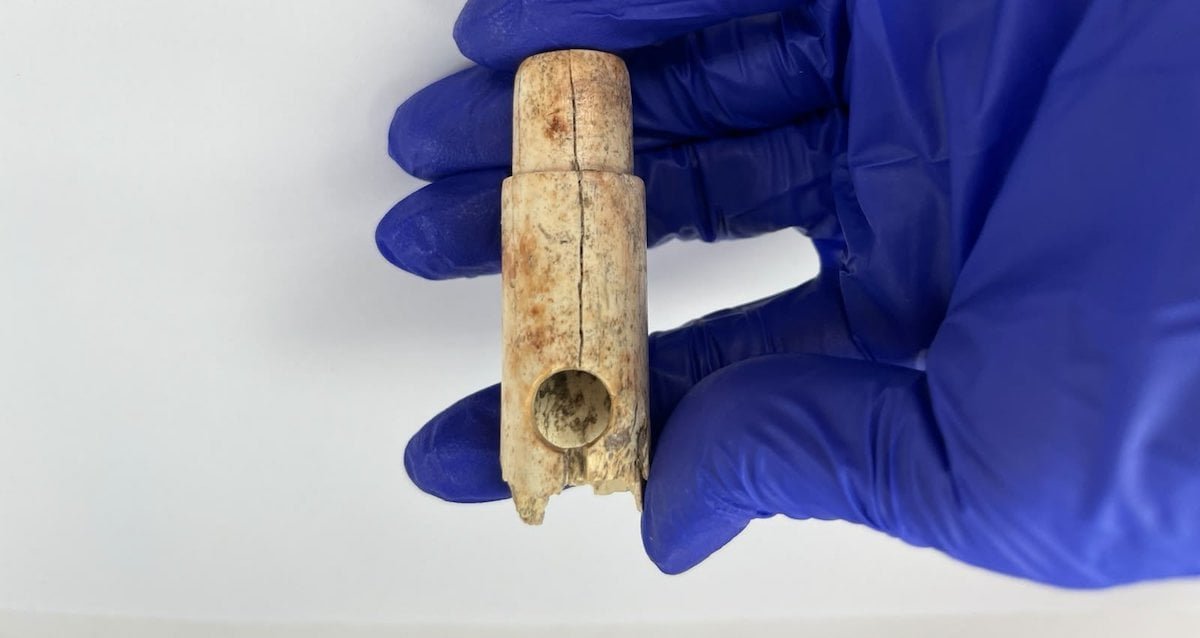
Archaeologists excavating the ancient city of Troy in northwestern Turkey have unearthed a bone flute, marking the first musical instrument ever discovered in the site’s 160-year history of excavations. The artifact, dated to approximately 2,800 years ago, was found in the site’s Archaic layer, suggesting it originates from the eighth century B.C.E.
The Discovery of the Bone Flute
The discovery was announced by the Turkish Ministry of Culture and Tourism. While the head of the instrument has been preserved, the main body of the flute has been lost. Dr. Rüstem Aslan, the director of the excavations, noted that while musical instruments are often depicted in ancient art, finding a physical specimen in Troy is an unprecedented event.
The eighth century B.C.E. is a pivotal era in classical antiquity. This period coincides with the first Olympic Games and the legendary founding of Rome by Romulus and Remus. For Troy, this was a time of resurgence, as the city began to regain importance after centuries of decline.
Cultural Context and the Connection to Homer
Researchers believe the bone flute provides a window into the daily lives and folkways of the people who lived in Troy 2,800 years ago. The timing of the discovery is particularly significant because it aligns with the period associated with the Greek poet Homer. The composition of the Iliad and the Odyssey is generally dated to the eighth century B.C.E., the same era as the flute.
In Book 10 of the Iliad, Homer describes the sounds of flutes and pipes echoing across the Trojan plain. While the Trojan War is traditionally thought to have occurred around 1200 B.C.E., the inclusion of flutes in the narrative may reflect the musical culture of Homer’s own time rather than the actual war era.
The 4,500-Year-Old Humanoid Idol
Alongside the flute, archaeologists discovered the head of a humanoid idol dating back approximately 4,500 years. This artifact was found in a fire-damaged layer corresponding to Troy II, the city’s Early Bronze Age phase. During this period, Troy was a fortified settlement with strong connections to other civilizations across western Anatolia due to its strategic location near the Dardanelles Strait.
What Were Bone Flutes Used For?
Historically, bone flutes are among the earliest known musical instruments. They were used for a variety of purposes, including ritualistic ceremonies, communication, and entertainment. The presence of such an instrument in Troy suggests that music played a functional role in the social and cultural fabric of the city, whether for religious rites or everyday leisure.
Have the Remains of Troy Been Found?
Yes, the remains of the ancient city of Troy have been found and are located in northwestern Turkey. The excavations have been ongoing for over 160 years, revealing multiple layers of occupation, from the Early Bronze Age to the Early Hellenistic period. The discovery of the bone flute and the humanoid idol further enriches the archaeological record of the city, offering new insights into the cultural traditions of the city that inspired the legendary Trojan War.
Dr. Aslan also highlighted a modern coincidence: a recent film adaptation of the Odyssey produced the music for the Sirens using a reconstruction of an eighth-century B.C.E. flute, similar to the one found in the excavation. This underscores the ongoing interest in reconstructing the own sounds of antiquity.