
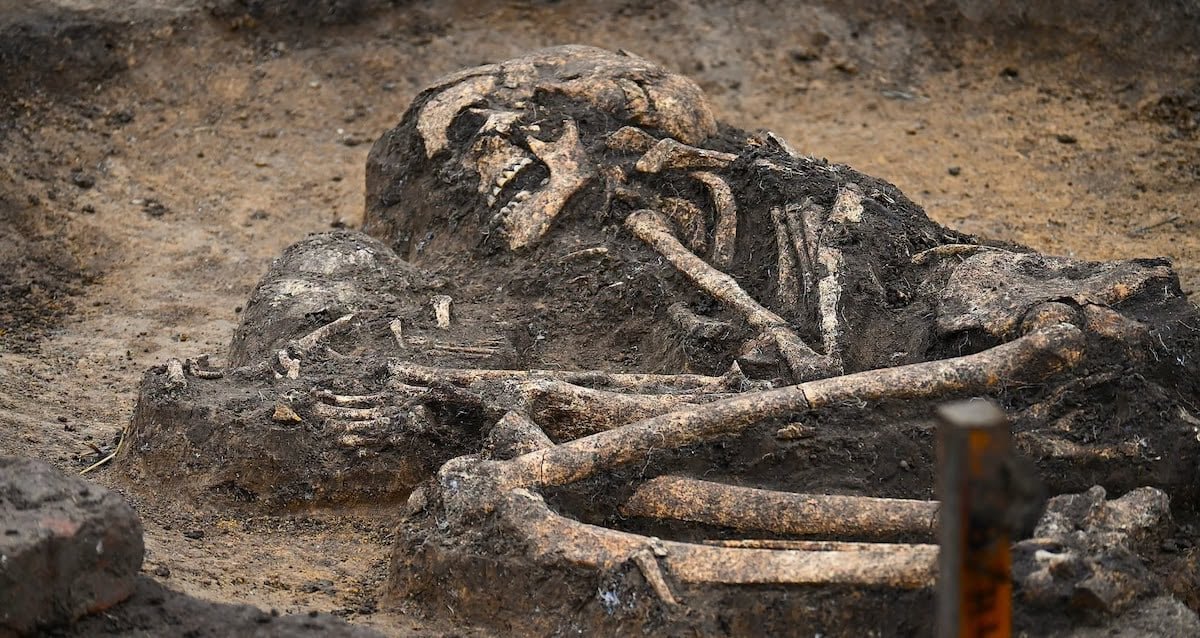
Archaeologists in the Central Bohemian Region of Czechia have uncovered a 4,300-year-old burial featuring a woman holding a newborn baby. The discovery was made during preventative excavations conducted between January and September 2026 ahead of the construction of a bypass road in Brandýs, near Prague. The woman, estimated to be approximately 30 years old, was found lying on her right side in a crouched position with the infant cradled in her arms, face to face.
Details of the Early Bronze Age Discovery
The excavation, carried out by the Institute for the Preservation of Archaeological Heritage of Central Bohemia (ÚAPPSČ), revealed a grave tentatively dated to 2300 B.C.E. This period corresponds to the early stages of the Únětice culture, a Central European society that existed from roughly 2300 B.C.E. to 1600 B.C.E. and is known for its expertise in bronze metallurgy and the amber trade.
Researchers suggest the woman may have died during or immediately after childbirth, leading to the joint burial with the newborn. While the face-to-face positioning suggests a close familial relationship, archaeologists are proceeding with caution. Previous studies of other Únětice burial sites have shown that individuals sharing a grave are not always biologically related. This cautious approach is similar to the methodology used in other European finds, such as the Neolithic burial found during school construction in Leipzig.
Additional Archaeological Finds in Brandýs
The site yielded more than just the Bronze Age grave. The excavation area, which spanned just over a mile from Zápy to Pražská Street, uncovered evidence of a later Germanic settlement. Artifacts dating from the first to third centuries C.E. were recovered, including:
- Various implements made from animal horns.
- Assorted ancient tools.
- A fragment of a glass bead.
- A separate Roman-era grave containing the remains of a woman.
The presence of glass beads and specialized tools suggests that the Germanic settlement was home to skilled artisans. These findings provide a broader chronological context for the region, showing continuous or recurring human activity from the Early Bronze Age through the Roman period.
The Únětice Culture and Funerary Practices
The Únětice culture, named after the village of Únětice northwest of Prague, is characterized by specific social structures and burial customs. Common features of their funerary practices include:
- Crouched positions: The positioning of the woman in the Brandýs grave is consistent with typical Únětice burials.
- Social stratification: While some burials featured lavish grave goods such as bronze artifacts and ceramic pots, others were more modest, reflecting the social status of the deceased.
- Mound burials: The culture is well-known for its princely mound burials.
The Brandýs discovery is considered unique due to the specific nature of the mother-and-child burial. In contrast, excavations at a site in Mikulovice revealed that most women buried there were at least 55 years old, contradicting initial expectations that many would have died during childbirth. This makes the discovery of a 30-year-old woman with a newborn particularly significant for understanding the demographics and health of the Únětice population.
Next Steps in Biological Analysis
The human remains have been extracted for in-depth biological examinations. These analyses aim to confirm the biological relationship between the woman and the infant and determine the exact cause of death for both individuals. By documenting the grave in full and applying modern forensic techniques, researchers hope to gain a clearer understanding of the domestic and social realities of the Early Bronze Age in Central Europe.