
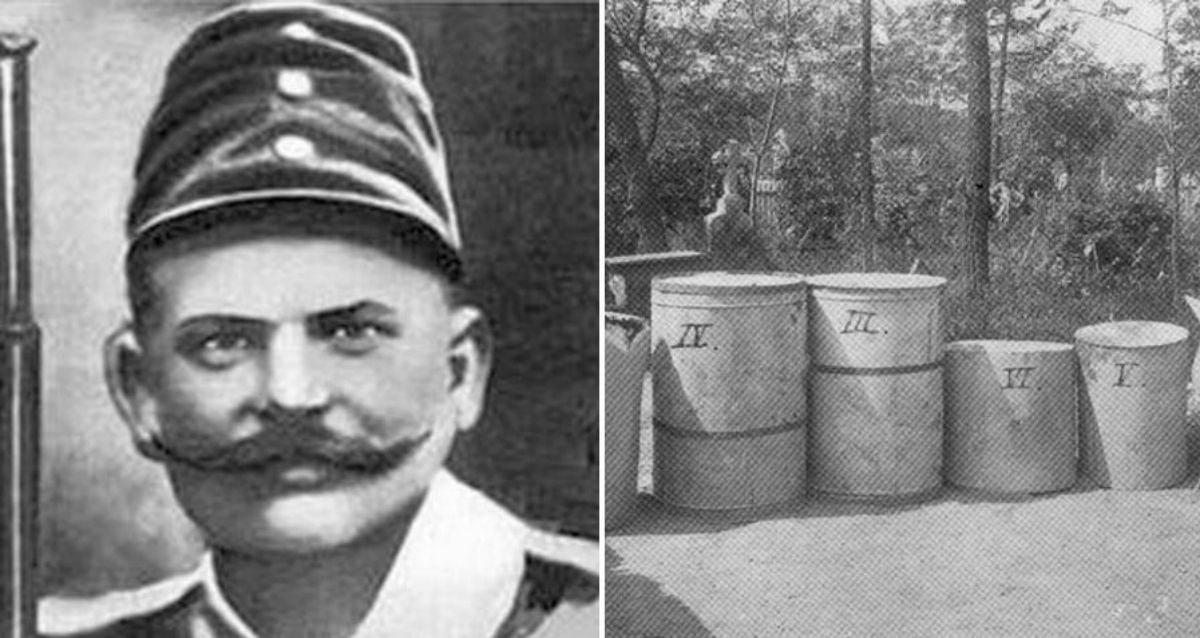
In 1916, authorities in Cinkota, Hungary, discovered the remains of 23 women and one man on the property of a local tinsmith named Bela Kiss. The victims were found stored in metal drums filled with alcohol, some exhibiting puncture wounds in their necks, which led to the public and press labeling him as the “Vampire of Cinkota.” This mass discovery occurred while Kiss was serving in the Austro-Hungarian Army during World War I, leaving his home and property under the care of a housekeeper.
Modus Operandi and Victim Selection
Bela Kiss began his killing spree around 1903, utilizing local newspapers to lure victims. He frequently posted advertisements posing as a lonely widower seeking a companion or wife, and in some instances, he offered services as a fortune teller or matchmaker. This method allowed him to target women who had no close family members, ensuring that their disappearance would not be immediately reported to the police.
Once a woman arrived at his home, Kiss would strangle them. After the murder, he sealed the bodies in metal drums. To avoid detection, he told neighbors and police who questioned the barrels on his property that he was storing fuel for the impending European war. He also maintained a correspondence with over 70 women, through which he frequently convinced them to send him money by promising marriage.
The Discovery of the Bodies
The crimes were uncovered in 1916 by his landlord, Marton Kresinszky, and a neighbor, Bela Takacs, who entered the property to perform renovations. Upon opening one of the metal drums, they discovered a decomposing corpse. This discovery led to a full police investigation, which uncovered the rest of the remains.
According to reports from the Index, the newspaper Az Újság detailed the horrific nature of the findings. Investigators also found a locked room in the house containing books on poison and the occult, alongside the extensive correspondence with his potential victims.
Evidence of Ritualistic Behavior
During the autopsy of the remains, police noted that several victims had puncture wounds in their necks and that blood had been drained from their bodies. This specific detail contributed to thelikelihood of the case being framed as a ritualistic or “vampiric” crime, although no one knows for certain if this was part of a deliberate pattern or a result of the decomposition process in alcohol.
The Escape and Mysterious Disappearance
When the crimes were discovered, Bela Kiss was serving as a soldier in the Austro-Hungarian Army. The Budapest police, led by Karoly Nagy, coordinated with military officials to arrest him. However, Kiss managed to evade capture. When authorities arrived at a military hospital in Serbia, they found that he had placed the corpse of another soldier in his bed to deceive investigators.
Following his escape from the military hospital, Kiss vanished. While there were various sightings reported over the following years, none were ever confirmed. Some theories suggest he died in combat during World War I, others believe he may have been imprisoned in Romania or died of yellow fever in Turkey. One of the most intriguing claims is a reported sighting of Kiss in Times Square, New York City, in 1932, but this remained unverified.
Summary of Known Facts
- Estimated Victims: At least 24 people (23 women and one man).
- Method of Luring: Newspaper ads posing as a widower or matchmaker.
- Method of Killing: Strangulation.
- Method of Disposal: Metal drums filled with alcohol.
- Key Discovery: Landlord and neighbor discovered the first body in 1916.
- Status: Never captured or officially confirmed dead.
Despite the extensive evidence and the discovery of numerous bodies, Bela Kiss was never brought to justice. His disappearance remains one of the most unsolved mysteries of the early 20th century, leaving the victims’ families and the following generations with no legal closure.