Archaeologists in the Jotunheimen mountains, located approximately 200 miles northwest of Oslo, have recovered 48 prehistoric arrows from melting glaciers. The oldest among these finds dates back between 5,000 and 6,000 years, providing critical evidence of early human activity in southern Norway.
Materials and Composition of the Arrowheads
The discovered artifacts include both shafts and heads, demonstrating a wide variety of materials used by prehistoric hunters. The recovery process has revealed a diverse range of tools, including:
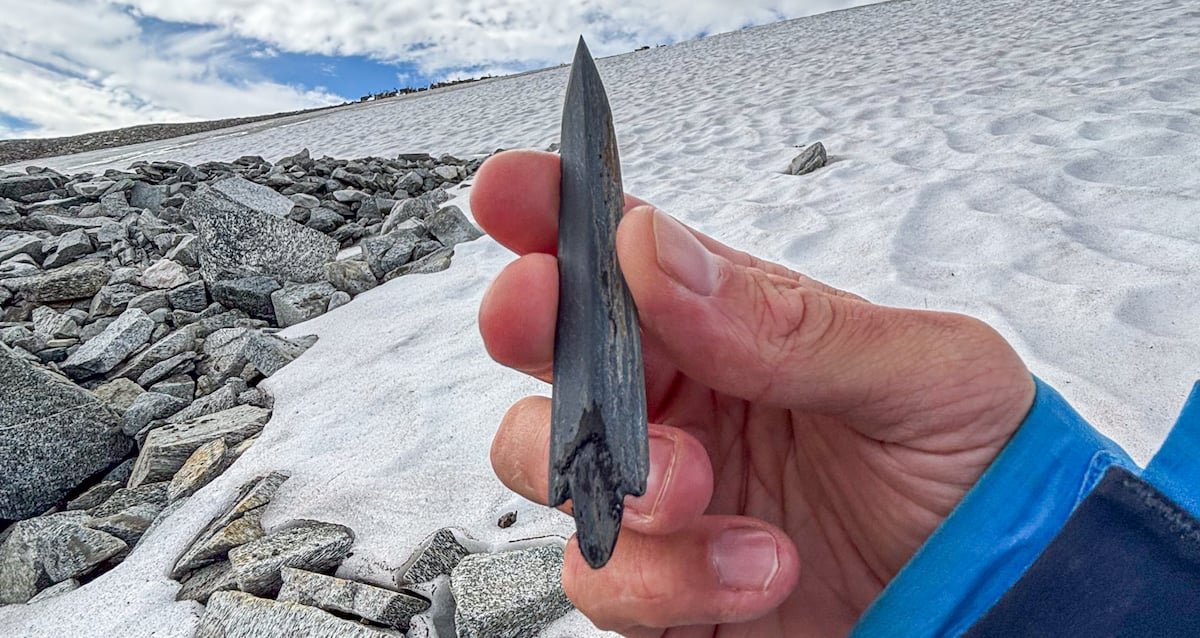
- Slate: The oldest arrowhead found this season was crafted from slate, discovered on a boulder among gravel.
- Freshwater Mussel Shell: A 3,000-year-old arrow, recovered fully intact with its wooden shaft, was uniquely made from a shell.
- Bone and Iron: Other arrowheads in the collection range from bone to iron, indicating a transition in technology over several millennia.
The Role of Secrets of the Ice Program
The recovery of these artifacts is conducted by Secrets of the Ice, a collaborative glacial archaeology program between the Innlandet County Council and the Museum of Cultural History in Oslo. Since 2006, the team has investigated the region, uncovering more than 5,000 artifacts across 73 archaeological sites.
The program’s findings have spanned various eras, including hunting equipment for reindeer, ancient footwear, and Viking swords. The preservation of these items is due to the ice, which prevents the decay of organic materials such as wood, hide, sinew, and textiles. According to a statement from Secrets of the Ice, the ice acts as a natural freezer, offering an exceptionally detailed glimpse into prehistoric life.
What Ancient Human History is Revealed by Melting Ice?
The melting ice is unveiling layers of history that were previously inaccessible. While early excavations in 2006 focused on finds dating back less than 2,000 years, recent discoveries are reaching deeper, older layers of the glaciers. This pattern indicates that the oldest ice contains the oldest artifacts, as the newer layers melt away first.
This process provides researchers with a new understanding of how prehistoric people utilized the high-mountain regions for hunting and travel during the Stone and Bronze Ages. However, the recovery of these items is now a race against time, as these artifacts are exposed to the air and begin to degrade rapidly once the ice disappears.
Is the Ice in Norway Melting?
Yes, the ice patches and glaciers of the Jotunheimen mountains are melting at an accelerated rate due to human-caused climate change. Lead archaeologist Espen Finstad noted in an interview with Science Norway that large ice patches have been reduced to small fragments, describing the current state as brutal.
The disappearance of these glaciers serves as a dual-purpose discovery: while it allows archaeologists to uncover ancient tools and weapons, it also documents the environmental shift in the region. The loss of the ice means that the window of opportunity to recover these items is shrinking, as the artifacts are no longer protected by the the cold, anaerobic environment of the glacier.
Preservation and Future Study
The 48 arrows recovered this season will be stored at the Norwegian Mountain Center in refrigerated displays to prevent degradation. Following this, they will undergo further conservation processes at the Museum of Cultural History in Oslo in December. This ensures that the organic components, such as the wooden shafts, remain intact for scientific study.
As the glaciers of the Kvitingskjolen mountain, specifically near the Langfonne, Storfonne, and Handklefonne glaciers, continue to retreat, researchers expect to find more items from the Stone Age. The current trend shows that the older the artifact, the deeper it was embedded in the ice, and as the ice melts further, the Stone Age is effectively emerging from the frozen ground.