

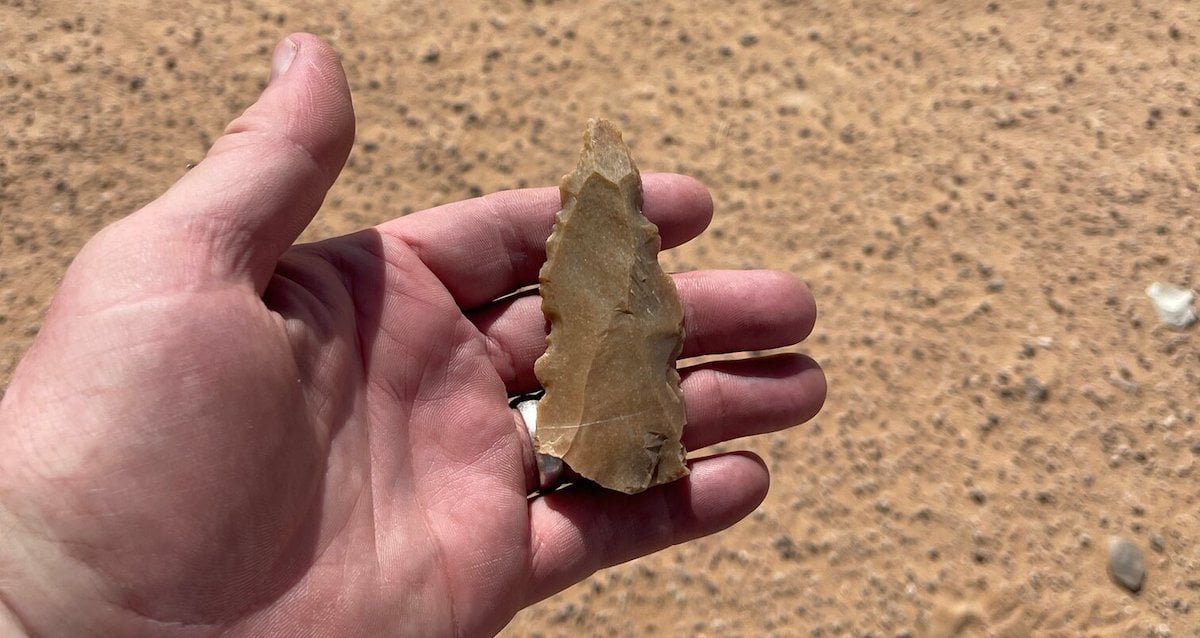
Archaeologists have discovered what may be the oldest poison-tipped weapons ever recorded, found at a 125,000-year-old human settlement in Saudi Arabia. The discovery, detailed in Science, reveals that early humans used toxins from the arrow-poison tree (Acokanthera schimperi) to enhance their hunting capabilities.
The ‘Uruq Aljelibah Site and Environmental Context
The artifacts were unearthed at ‘Uruq Aljelibah, a site located in the Empty Quarter, one of the world’s driest deserts. While the region is currently arid, evidence shows that 125,000 years ago, the area featured a large freshwater lake approximately 130 square miles in size and up to 95 feet deep. This ecosystem supported a diverse range of wildlife, including hippopotamuses, buffalo, and ostriches, providing a necessary resource for human habitation.
The presence of these resources allowed early humans, likely Homo sapiens, to establish a permanent settlement rather than simply passing through the region. This contradicts previous theories that the Arabian Peninsula was merely a transit corridor between Africa and Asia. The discovery of processed plant materials, such as fibers and wood, alongside over 5,500 stone artifacts, indicates a sophisticated level of occupancy.
Chemical Analysis of Hunting Tools
Among the stone artifacts, researchers identified several sharp points with impact damage consistent with hunting large animals. Microscopic analysis revealed that these points still carried remnants of animal tissue. More importantly, the team found residue matching the plant fibers of the Acokanthera schimperi tree, native to southern Arabia and eastern and central Africa.
This chemical evidence suggests that prehistoric hunters dipped their stone points into extracts from the arrow-poison tree to paralyze or kill their prey. As noted in Live Science, these weapons are substantially older than previous records, such as the 60,000-year-old poisoned arrowheads found in South Africa.
Technological Sophistication of Early Humans
Researchers emphasize that these tools were not simply stone flakes, but complex assemblies. Early humans combined stone, wood, plant fibers, and resins to create effective weapons. This level of technological advancement suggests a higher degree of cognitive complexity than previously attributed to early Homo sapiens in this region.
Similar to how ancient fossils provide insights into prehistoric wildlife, these artifacts provide a rare glimpse into the same period’s human behavior. The find is significant because Paleolithic sites that preserve both hunted animals and processed plant materials are exceptionally rare.
Implications for Human Migration and Settlement
The findings at ‘Uruq Aljelibah provide a critical update to the changing understanding of early human movement. Because the age of the site aligns with early movements of Homo sapiens out of Africa, it proves that early humans were capable of adapting to and exploiting the lake-based environments of the Arabian Peninsula.
In a statement, study co-author Michael Petraglia stated that the site helps researchers reconstruct the exact behaviors of these prehistoric people, from the processing of plants to the construction of specialized hunting gear. This discovery shifts the perspective on early humans as nomads uprooting their region, much like how archaeological evidence of Viking raids reveals the specific patterns of movement and conflict in later history.
The evidence of poison-tipped weapons demonstrates that early humans were not only surviving in Arabia, but were using advanced chemical knowledge of their environment to secure food sources and effectively hunt large mammals in a region that is now a barren desert.