

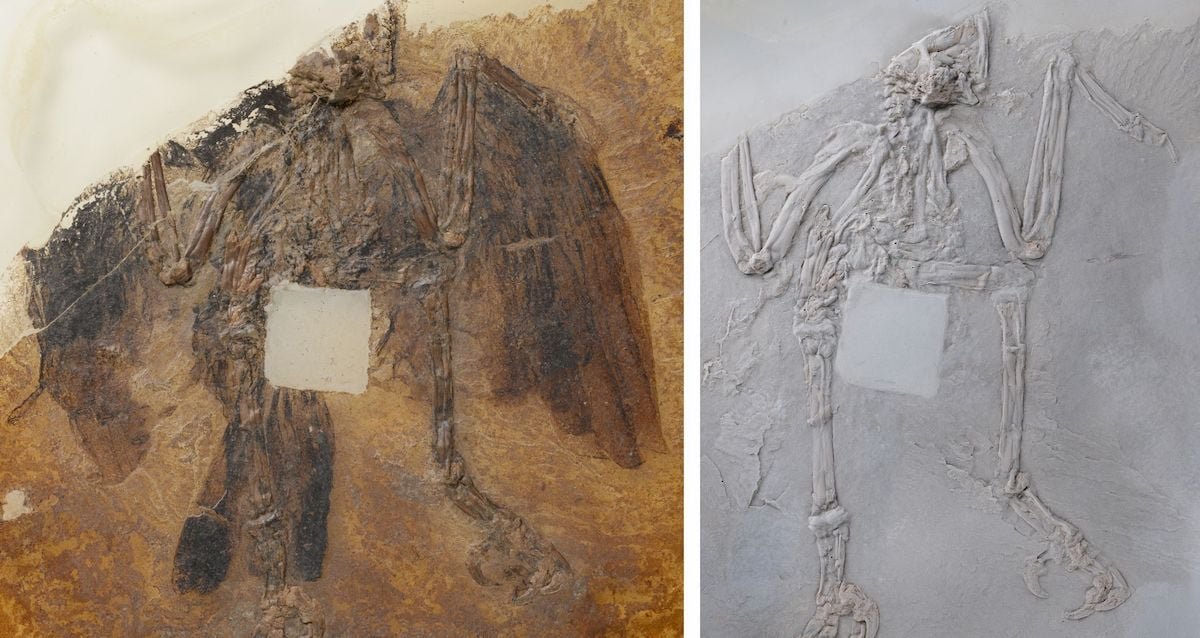
Paleontologists have discovered an exceptionally well-preserved fossil of a young owl, dating back 47 million years, in the Messel Pit in Germany. This find, identified as a new species called Masillastrix blattophaga, provides critical data on the evolution of owls, specifically regarding when these birds transitioned from being active during the day to being nocturnal hunters.
The Discovery of Masillastrix blattophaga
Unearthed in 2025, the specimen was found in the Messel Pit, an ancient lake bed from the Eocene epoch (roughly 56 to 34 million years ago). The fossil is remarkably intact, measuring fewer than five inches from head to feet. While the other remains are nearly perfect, the skull is the only part that is not fully preserved.
The discovery was detailed in a study published in Current Biology, which highlights the importance of of this particular specimen for understanding avian evolution. This find is similar to other prehistoric discoveries, such as the ancient 400-million-year-old fish, in terms of providing a window into extinct species’ biology.
Evidence of Diurnal Hunting Habits
One of the most striking features of the fossil is the presence of a cockroach still located in the owl’s stomach. Researchers identified the cockroach by comparing it to another fossilized insect found nearby. The insect was blue-green and iridescent, a trait associated with diurnal activity. Because the owl had consumed a day-active insect, researchers conclude that Masillastrix blattophaga was likely a diurnal hunter.
Additional anatomical evidence supports this theory. The upper wing bones of this prehistoric owl are stockier than those of modern nocturnal owls, indicating that the bird was not built for the silent flight necessary for nighttime hunting. This anatomical difference suggests the bird searched for prey during the day, as confirmed in a statement from the Senckenberg Research Institute and Natural History Museum.
How Long Ago Did Owls Evolve to Become Nocturnal?
The consensus among scientists is that owls evolved from a diurnal ancestor. This belief is based on several factors:
- Head-rotation bone structure: Some earlier owl fossils show similarities to diurnal raptors.
- Eye protection: Protruding bones that may have functioned as protection from the sun.
The earliest known nocturnal owl species dates back to approximately 35 million years ago in the Late Eocene. Given that the Messel Pit owl was active during the day, this narrows the transition period from diurnal to nocturnal behavior to the window between 47 million and 35 million years ago.
Dr. Gerald Mayr of the Senckenberg Research Institute and Natural History Museum provided further context in an interview with Live Science, noting that most owl fossils are typically represented by isolated bones, making complete specimens like this one rare and essential for understanding the evolution of modern birds.
Frequently Asked Questions about Prehistoric Owls
What did the prehistoric owl eat?
The Masillastrix blattophaga owl consumed insects, specifically an iridescent cockroach, which served as the primary evidence for its diurnal nature.
What is the oldest bird fossil ever found?
While this German fossil is exceptionally well-preserved, it is not the oldest known owl fossil. The oldest known specimen, Ogygoptynx wetmorei, was found in Colorado and dates back approximately 60 million years.
How long ago did owls evolve?
Owls have a complex evolutionary history, owl fossils like Ogygoptynx wetmorei show they existed at least 60 million years ago, but the transition to nocturnal hunting occurred between 47 and 35 million years ago.
Much like how Viking raid evidence reveals insights into historical human migration, these paleontological finds provide a concrete timeline of biological evolution.