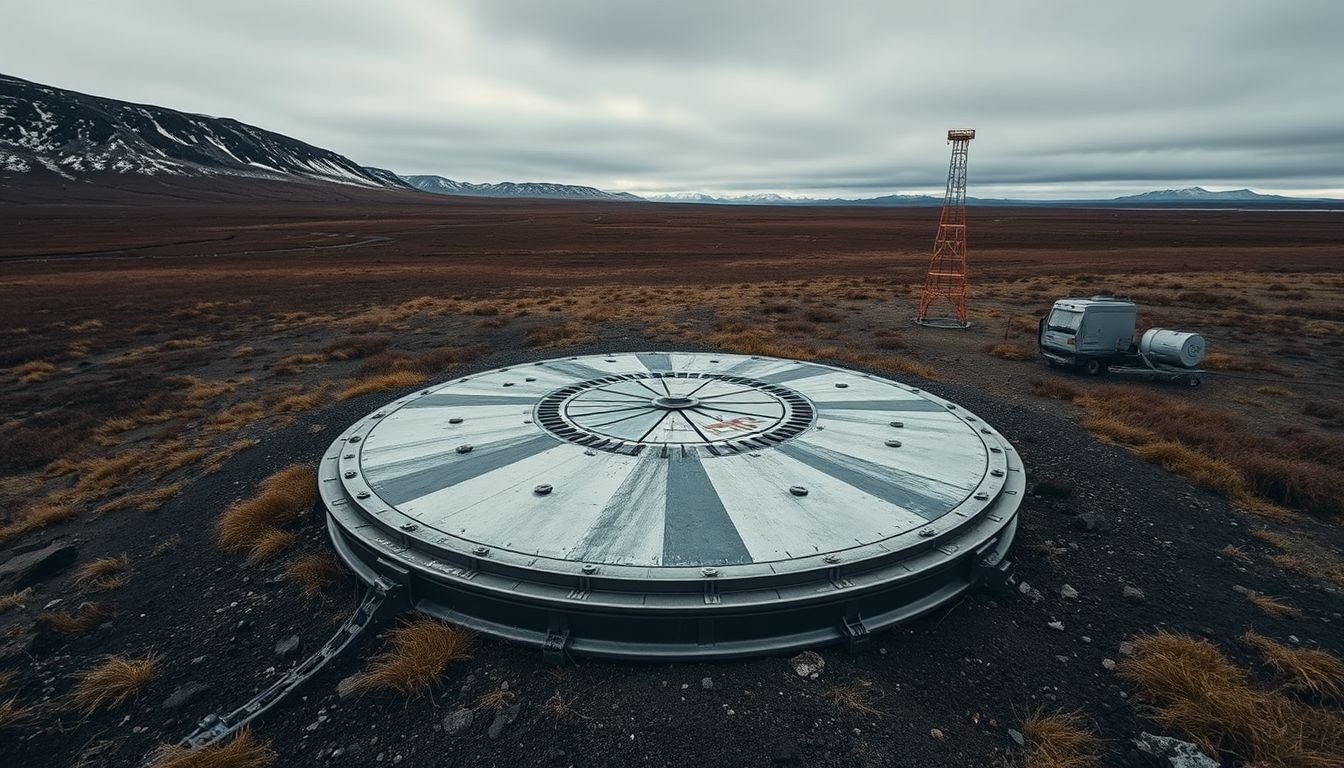

The Kola Superdeep Borehole is the deepest man-made hole in the world, reaching a maximum depth of 40,230 feet (approximately 12,262 meters). Located on the Kola Peninsula in northwestern Russia, just inside the Arctic Circle, the project was launched in 1970 by Soviet scientists to investigate the Earth’s crust and the boundary between the crust and the mantle, known as the Mohorovičić discontinuity (Moho). The primary goal was to obtain direct geological data to replace the same assumptions based on seismic wave studies.
What did they find at the bottom of the Kola Superdeep Borehole?
Contrary to initial expectations, the drilling team did not find the expected basalt rock. Instead, they encountered only granite and metamorphic rocks. The most significant discovery was that the behavior of rock under extreme heat and pressure changed. At 40,000 feet, granite—which is typically a brittle rock—behaved more like a stiff plastic, deforming instead of breaking. This shifted the scientific understanding of how the Earth’s interior behaves under extreme conditions.
Geological Surprises and Chemical Reactions
The team discovered saline water flowing through cracks in the rocks between 16,000 and 23,000 feet. This water was not groundwater or surface water that had seeped down, but was released from the rocks themselves due to high heat and pressure. Additionally, scientists found evidence of chemical reactions between this water and the surrounding rock, which provided new insights into the rocks’ composition and composition changes.
Why did they stop drilling the world’s deepest hole?
Drilling operations were halted due to a combination of technical failures and political instability. In 1984, a drill malfunction occurred, which forced the team to pull the drill back to 23,000 feet and restart the drilling process through a different path. After five years, they reached their previous depth in 1989, but the project was eventually abandoned shortly after the 1991 fall of the Soviet Union. The hole was subsequently sealed to prevent any geological instability.
Key Facts about the Kola Superdeep Borehole
The project provided a massive amount of geological data that provided a more accurate understanding of the Earth’s inner workings. Key findings include:
- Maximum Depth: 40,230 feet.
- Temperature: Temperatures at the deepest point reached approximately 350 degrees Fahrenheit, which was nearly double the predicted temperature.
- Tectonic Setting: The Kola Peninsula is composed of granite and metamorphic rocks that are over half a billion years old.
- Tectonic Boundary: The project failed to reach the Moho boundary, although it provided critical data on the deepest hole in the world.
Common Questions about the Deepest Hole
People often wonder if anyone has ever fallen into the Kola Superdeep Borehole. Due to the technical nature of the drilling site and the project’s sealed top, the Kola Superdeep Borehole was managed as a professional geological site, and no such accidents occurred. While some urban legends regarding the Kola Superdeep borehole sounds, which regarding the sounds of hell, the scientific reality is that the team was only dealing with geological processes and geological pressures.
The project remains a landmark in geological science, providing a direct sample of the process of the Earth’s crust. Therefore, the deepest hole in the world remains a landmark of scientific curiosity and remains a landmark of scientific geological exploration of the Earth’s interior.