Dinosaurs have captivated human imagination for centuries, but recent discoveries continue to reshape our understanding of these magnificent creatures. Every new find leads us closer to the truth about their appearance, behavior, and biology, often dispelling long-held myths. One of the ongoing debates that has flown under the radar is about the posture and movement of the iconic Triceratops. This article delves deep into the fascinating research surrounding this dinosaur’s stance and how it has implications for our understanding of dinosaur evolution.
Understanding Triceratops through modern animal research
Research into dinosaur posture is often limited by the fossil record, which primarily provides skeletal remains. Paleontologists have long grappled with the challenge of reconstructing the movements and stances of dinosaurs like the Triceratops, given that fossils can be quite ambiguous. Recent studies have turned to modern animals to gain insights into the possible postures of these prehistoric giants.
Fossils reveal only part of the picture; knowledge of soft tissues and musculature is crucial for a comprehensive understanding. For instance, the way an animal moves is significantly influenced by its muscle structure and joint configuration. By studying living animals, researchers can develop hypotheses about how extinct species like the Triceratops might have functioned.
Dr. Shin-ichi Fujiwara and Professor John Hutchinson conducted pivotal research that highlighted these points. They published their findings in the Proceedings of the Royal Society B in 2012, providing evidence that the Triceratops likely had a forelimb posture more akin to mammals than to sprawling reptiles.
To arrive at their conclusions, the researchers employed a systematic approach:
- Measured the elbow bones of 318 modern tetrapod species.
- Analyzed joint mobility across different species.
- Created a comprehensive database of skeletal structures.
- Identified muscular roles in relation to limb posture.
This method allowed them to draw parallels between Triceratops and modern species, leading to compelling insights about its biomechanics.
Research methodology and findings
The research conducted by Fujiwara and Hutchinson was groundbreaking for several reasons. They recognized that understanding limb posture requires more than just looking at bones; it necessitates a detailed examination of how animals use those bones in motion.
The team measured the elbow joints of both mammals and reptiles, focusing on the olecranon—the part of the elbow where the triceps attach. Their findings showed that:
- Upright animals, like dogs and rhinos, have a larger olecranon, allowing for better leverage of the triceps muscles.
- Sprawling animals, like lizards, rely more on flexor muscles that keep their limbs closer to their bodies.
- The role of musculature differs significantly between upright and sprawling postures.
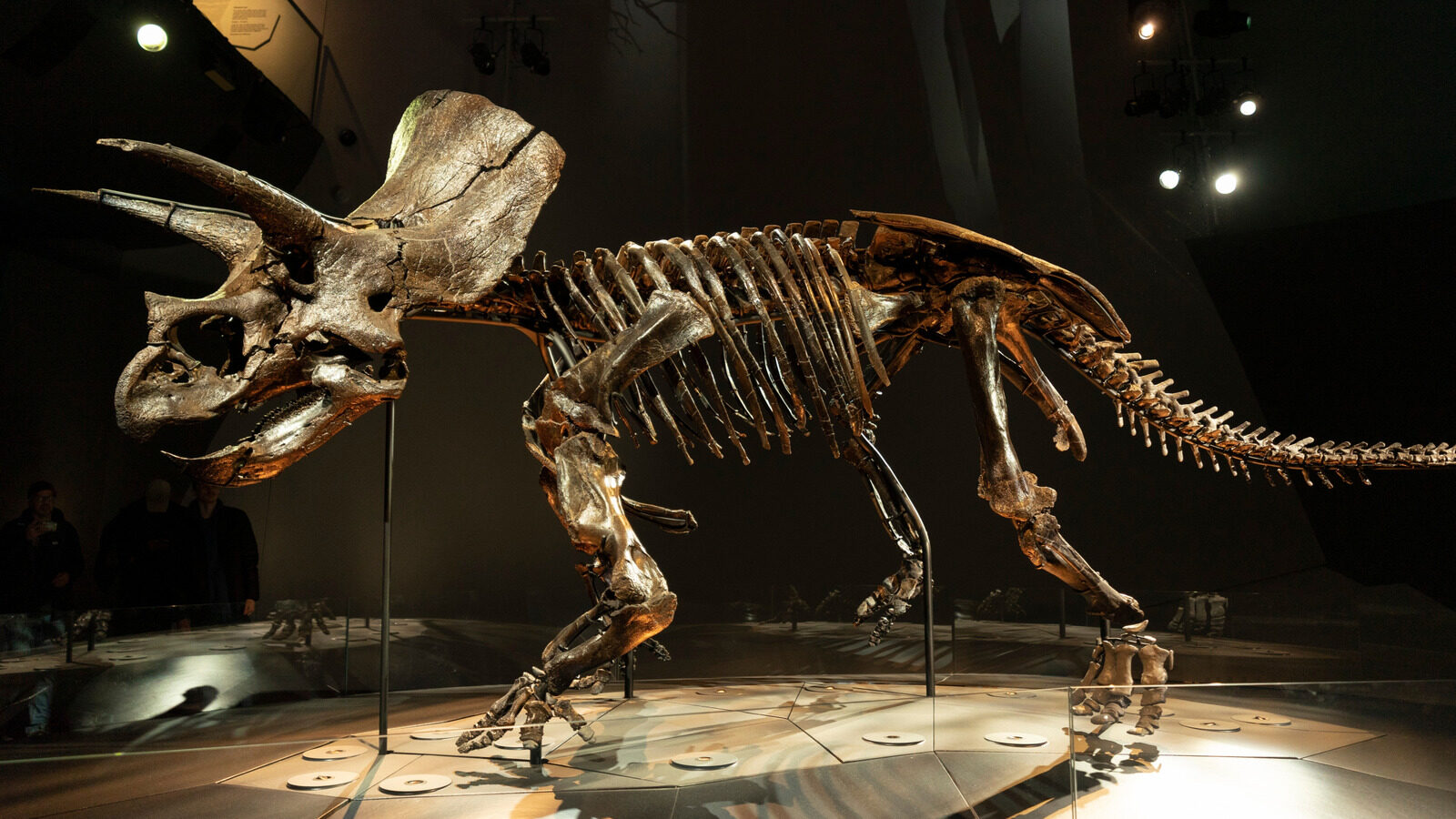
These distinctions led to the conclusion that the mechanics of Triceratops’ limbs were more aligned with those of upright mammals, suggesting that it likely stood with its limbs positioned directly beneath its body, similar to a rhino.
Implications for the athleticism of Triceratops
One of the more surprising outcomes of this research is the implication that Triceratops might have been more athletic than previously believed. If the dinosaur stood upright like a rhino, it could have had greater agility and strength compared to a sprawling posture.
This realization adds a new layer to our understanding of Triceratops as a herbivore capable of more dynamic movement, potentially influencing its ability to evade predators or navigate its environment more effectively.
As Professor Hutchinson noted in an interview with Phys.org, the findings are based on rigorous statistical data collected from real specimens. While not conclusive proof of a mammalian posture, they represent a significant step in the ongoing debate over Triceratops’ stance.
Debate continues: The semi-erect hypothesis
Despite the compelling evidence in favor of a more upright posture, the debate over the Triceratops’ stance is far from settled. Some paleontologists argue that there is still room for a semi-erect posture, where the limbs are somewhat splayed but not entirely like a lizard’s. This viewpoint suggests a more nuanced understanding of how different species might have adapted their postures for various ecological niches.
As new fossils are discovered and technology advances, it is likely that our understanding of Triceratops and other dinosaurs will continue to evolve. The ongoing research underscores the complex interplay between anatomy, behavior, and environment in shaping the lives of these ancient creatures.
The broader significance of these findings
The implications of this research extend beyond just the Triceratops. Understanding limb posture in dinosaurs provides valuable insights into their behavior, locomotion, and ecological roles. By comparing extinct species to modern animals, scientists are uncovering the evolutionary pathways that led to the diverse forms of life we see today.
Moreover, such studies can aid in the conservation of modern species by highlighting the importance of structural adaptations in response to environmental pressures. As we draw parallels between ancient and contemporary life, we gain a deeper appreciation for the complexity of evolution.
Future research directions
As paleontology continues to advance, future research will likely focus on integrating more technologies to study the biomechanics of dinosaurs. Techniques such as:
- 3D scanning of fossils to analyze joint structures in detail.
- Computer simulations to model movement and biomechanics.
- Genetic studies on the descendants of dinosaurs, like birds, to better understand evolutionary changes.
These approaches could shed light on unresolved questions regarding not only Triceratops but also other species, enhancing our understanding of their lifestyles and the environments they inhabited.