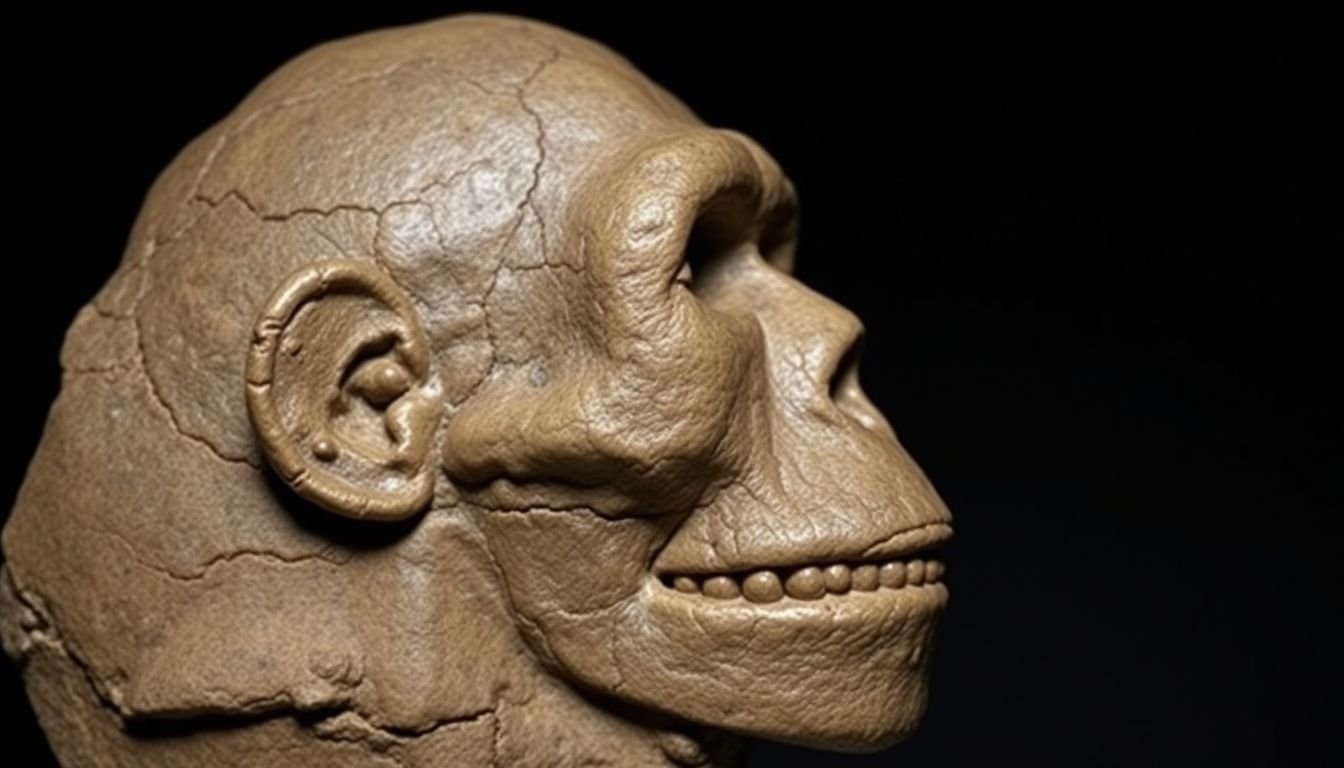
Researchers have utilized advanced digital reconstruction techniques to recreate the face of a 1.5-million-year-old Homo erectus specimen known as DAN5. The resulting model reveals a mixture of primitive and advanced anatomical features, challenging the traditional linear understanding of the human evolution timeline and suggesting a more complex, non-linear path of development.
The Digital Reconstruction of the DAN5 Fossil Face
The reconstruction process began with a limited set of remains: five teeth and five skull fragments. To build a complete facial model, scientists employed micro-computerized tomography to create precise 3D scans of each piece. This technology allowed researchers to determine the original orientation of the fragments and digitally fill in gaps.
The team used a mirroring technique to restore missing elements; for instance, the right molar was mirrored to recreate the missing left one. Similarly, the curvature of the cheekbones and skull was extended based on existing angles. This methodology, also used to analyze fossils from the National Museum of Ethiopia, National Museums of Kenya and Georgian National Museum, allows anthropologists to visualize ancestral faces with high accuracy.
Anatomical Anomalies and Evolutionary Implications
Once the model was finalized, two specific features stood out as unexpected for a specimen of this age:
- Nasal Structure: The nose was flatter and wider than other Homo erectus models from the same era.
- Dental Morphology: The large, flat molars closely resemble those of Homo habilis, an older human ancestor.
Despite these primitive traits, the specimen possessed a large brain case consistent with later Homo erectus adaptations. This combination of traits suggests that human evolution did not follow a straight line but rather a “zig-zag” pattern where different populations merged and diverged. This complexity is why scientists dislike the term missing link in evolution, as it oversimplifies a web of interbreeding and diverging species.
Understanding the Human Evolution Timeline
The fossil record is the primary tool for mapping our ancestry, as genetic material degrades over time. While DNA evidence shows that modern Eurasians carry Neanderthal genes, the oldest extracted human DNA only dates back 300,000 to 400,000 years. For older specimens like DAN5, researchers must rely on morphological comparison and carbon dating.
Is it 100% proven that humans evolved from apes?
Taxonomically, humans are classified as great apes, sharing a common ancestry with chimpanzees, bonobos, gorillas, and orangutans. While direct genetic parenthood cannot be traced back millions of years, the morphological evidence from the fossil record strongly supports the theory of common descent through various hominin species.
What did humans look like 5 million years ago?
Five million years ago, ancestors were significantly more ape-like than Homo erectus. They lacked the expanded brain cases and refined facial structures seen in later hominins. The transition from these early forms to species like Homo habilis and eventually Homo erectus involved gradual changes in jaw shape and cranial capacity, similar to how other species evolved, such as the ancient 400-million-year-old fish discovered in recent years.
The Mystery of Early Hominin Diversity
The DAN5 discovery reinforces the idea that the human family tree is an interwoven network. Many extinct hominin species diverged from the main ancestral line only to interbreed with later ancestors. This mosaic of features—mixing the dental traits of H. habilis with the cranial capacity of H. erectus—indicates that early human evolution was a dynamic process of merging and diverging populations.