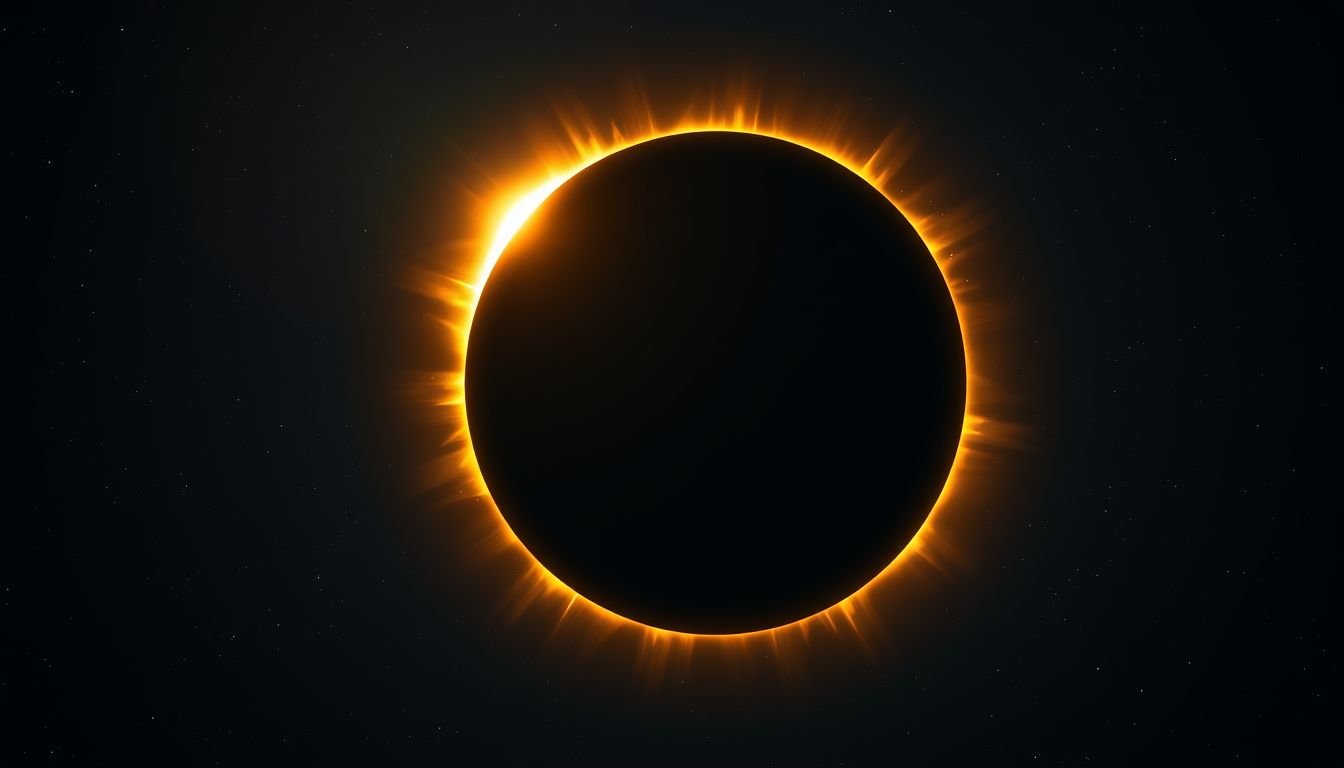

For centuries, human civilizations have viewed solar and lunar eclipses as omens of death and disaster. While modern astronomy explains these events as the precise alignment of the Sun, Moon, and Earth, the sudden disappearance of daylight or the shifting colors of the moon often triggered widespread panic. Today, these superstitions persist in some cultures, though science now identifies the root of these fears as confirmation bias and a lack of astronomical knowledge.
The Symbolic Meaning of Eclipses and Death
In many ancient cultures, an eclipse symbolized the temporary death of the sun or moon, which was interpreted as a sign of instability or the fall of a powerful leader. This perceived instability often extended to the political realm, where astrologers claimed that eclipses were closely tied to the fate of rulers. In ancient Mesopotamia, priests and early scientists, who could predict the timing of an eclipse, would often replace the real king with a substitute to protect the monarch from the perceived supernatural danger.
What does an eclipse symbolize for death?
Historically, the symbol of an eclipse has been linked to the disappearance of the sun or moon, which represented the life-force of the empire. When the light vanished, it was believed that a great leader’s life would also vanish. This belief is a a form of debunking the myth of natural phenomena being supernatural omens, as the astronomical event is entirely separate from human mortality.
Types of Solar and Lunar Eclipses
To understand why these myths persist, it is helpful to distinguish between the different types of solar and lunar eclipse. A total solar eclipse occurs when the moon passes directly between the sun and the earth, blocking the sun’s light entirely. An annular solar eclipse, meaning the moon is too far from the earth to completely cover the sun, creates a “ring of fire” effect. The difference between annular and total solar eclipse events is primarily a matter of distance and orbital path.
- Total Solar Eclipse: The moon completely covers the sun, causing day to turn into night.
- Annular Solar Eclipse: The moon covers the sun but leaves a thin ring of light.
- Lunar Eclipse: The earth moves between the sun and the moon, causing the moon to appear red, often called a Blood Moon.
Coincidental Tragedies and Confirmation Bias
The prevalence of eclipse omens prevailed throughout history due to coincidental tragedies. When a ruler died shortly after an eclipse, it was seen as a proof of prophecy. However, this is a a form of confirmation bias, where people only remember the events that fit the existing belief and forget the thousands of eclipses where no tragedy occurred. This is similar to how some people still look for major space mysteries that defy current scientific understanding, trying to find patterns where none exist.
The Case of King Henry I of England
A famous example is King Henry I, who lived during the 12th century. It was reported that his death coincided with an eclipse, and as he departed for France the day before the event, the darkening sky was seen as a warning. While he never returned to England, the prophecy was deemed correct. In reality, however, King Henry I died two years after the eclipse actually happened, following a short illness, proving the narrative was rewritten to fit the myth.
The Biological Reality of Eclipse-Adjacent Deaths
While most eclipse myths are supernatural, some deaths have occurred due to biological factors related to the trip to see an eclipse. King Mongkut of Siam, who ruled from 1851 to 1868, was a skilled astronomer who predicted a total solar eclipse with incredible precision, even outperforming French astronomers. However, during his trip to a remote village to observe the event, he was bitten by a mosquito. He died of malaria weeks later. The “false dusk” caused by the eclipse may have increased mosquito activity, providing a biological rather than supernatural explanation for his death.
Modern Superstitions and the 2026 Eclipse
Despite the scientific consensus, superstitions continue to evolve. Some people still ask how the 2026 solar eclipse will affect zodiac signs or the spiritual significance of the Blood Moon eclipse in 2026. Recent events, such as the death of King Harald V of Norway, which occurred within half an hour of a lunar eclipse peak, have kept these beliefs alive. As noted by Jim Holstein of the Field Museum via WTTW News, superstitions remain embedded in our imagination, though the only real danger during an eclipse is to one’s retina if viewed without protection.
What is the myth behind lunar eclipses?
Lunar eclipse myths often involve the moon being consumed by a celestial creature, such as a dragon or a wolf, and making the moon appear red. This is often referenced in a lunar eclipse in bible contexts or other ancient texts, where the red moon is seen as a sign of divine judgment or catastrophe. Science, however, explains this the phenomenon as the earth’s atmosphere filtering the sun’s light, which only allows red wavelengths to pass through and reach the moon.