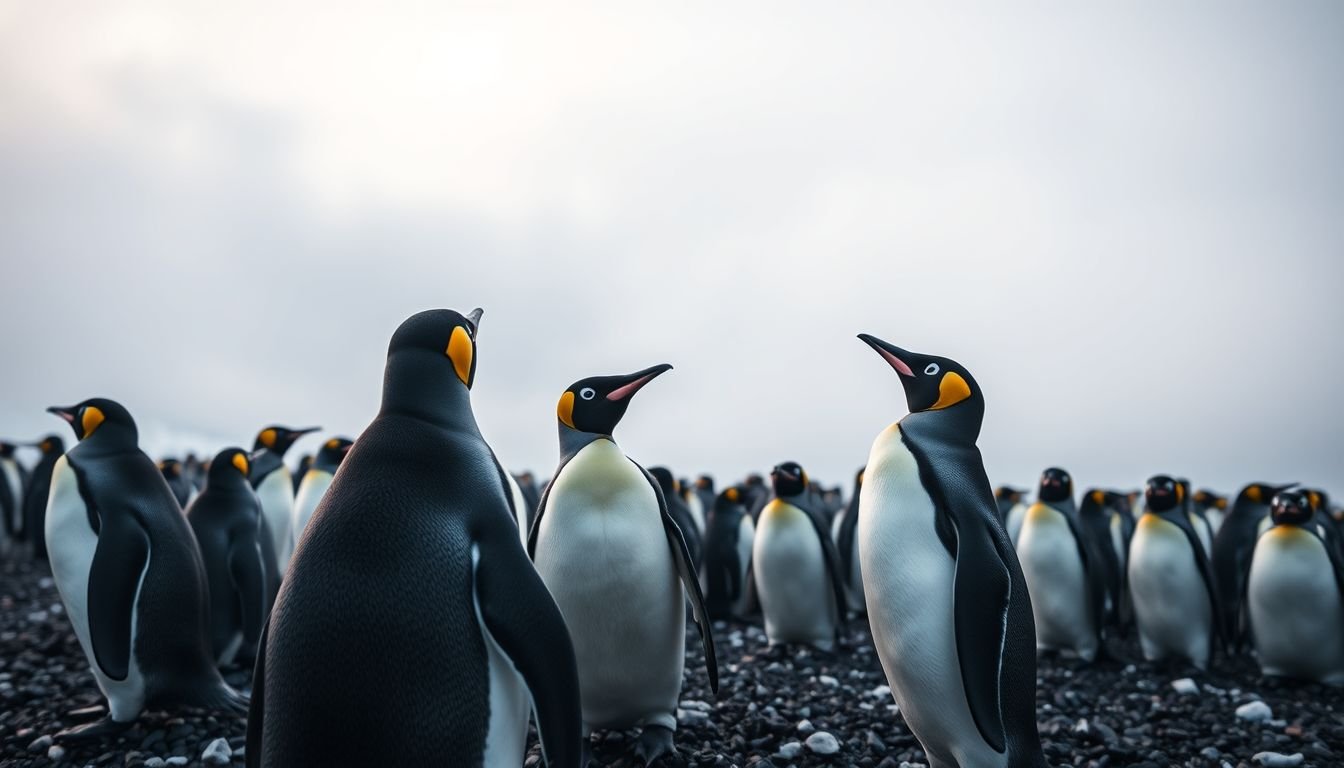

Penguin guano, the accumulation of waste from large colonies, is significantly impacting the atmosphere of Antarctica. A 2025 study has revealed that the nitrogenous waste breaks down into ammonia gas, which facilitates the formation of clouds and fog in the region. This process occurs when the ammonia interacts with sulfurous gases emitted by marine phytoplankton, creating particles known as cloud condensation nuclei (CCN).
The Mechanism of Cloud Formation
The process begins with the emission of ammonia from penguin colonies. Researchers at Argentina’s Marambio Station observed that ammonia levels in the air were approximately 13.5 parts per billion (ppb), which is roughly 1,000 times higher than the levels found in areas without penguins. These spikes in ammonia levels were directly linked to wind direction, increasing when the wind blew from the direction of the penguin colonies.
Marine phytoplankton, small plant-like organisms that provide food for krill, produce sulfurous gases. When these gases combine with chemicals like ammonia and dimethylamine from seabird waste, they create the particles necessary for clouds to form. This natural cloud seeding process is similar to artificial cloud seeding, though it is driven by biological activity rather than silver iodide compounds.
Is Penguin Poop Cooling Antarctica?
Yes, these biological emissions are believed to have a cooling effect. The clouds formed from penguin guano act as a protective shield, reflecting sunlight back into space. This mechanism helps regulate local temperatures by preventing some of the solar radiation from reaching the ice surface.
This phenomenon is not unique to Antarctica. Previous research from the Arctic has shown that migratory seabird waste contributes to atmospheric ammonia, which reflects sunlight during the warm summer months, resulting in a local cooling effect.
Impact on Global Climate and Sea Levels
The relationship between penguin populations and the atmosphere is critical because Antarctica holds approximately 90% of the Earth’s freshwater. Any disruption to the local fauna can have global repercussions. The region is currently experiencing accelerated ice melt due to warming, which contributes to rising global sea levels.
According to the Intergovernmental Panel on Climate Change, sea levels could rise between 11 and 21 inches by 2100, with worst-case scenarios predicting a rise of up to six feet. Maintaining stable seabird populations is essential to prevent further ecological imbalances that could accelerate this process.
Environmental Threats to Penguin Colonies
Despite the extreme climate of the Antarctic Peninsula, where coastal regions can drop to -40 degrees Fahrenheit and the interior to -76 degrees Fahrenheit, penguin populations face several modern threats. These include:
- Pollution: Chemical contaminants affecting the health of the
- Ship traffic: Increased human activity in the region.
- Climate warming: Changing temperatures that impact food sources and breeding grounds.
The research suggests that because there are few other sources of these chemicals in the region, penguin waste is a major contributor to the creation of cloud condensation nuclei. In some areas, researchers found up to a 10,000-fold increase in CCN formation specifically where penguins were present.