
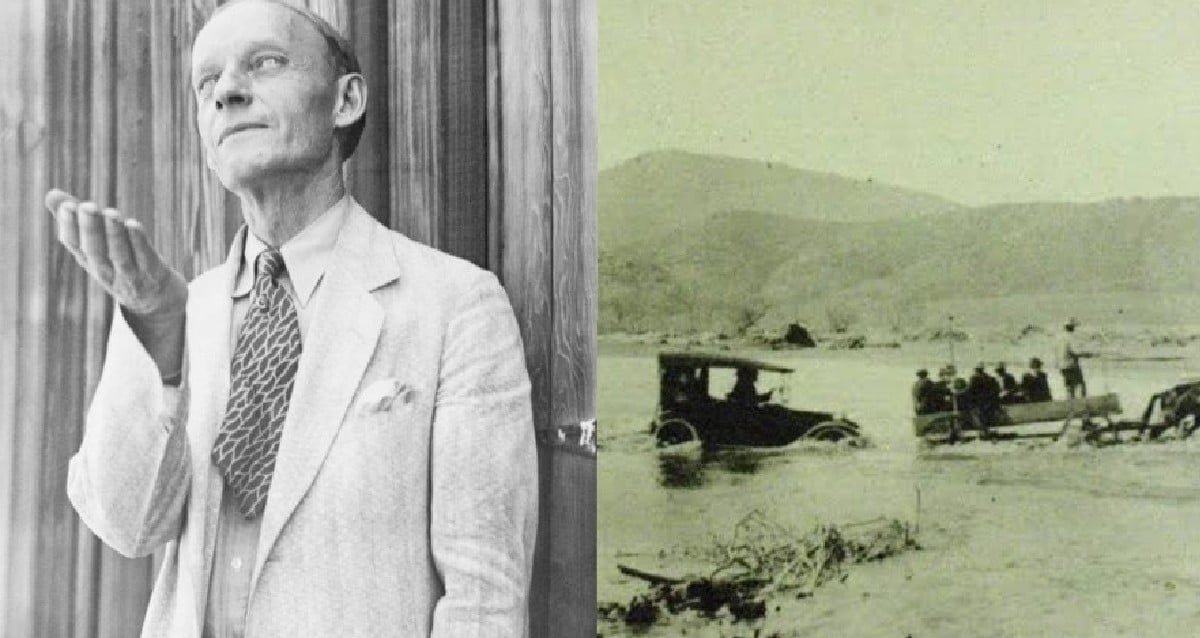
Charles Hatfield was a prominent early 20th-century figure known as a rainmaker who claimed the ability to induce precipitation through a secret chemical process. While he gained fame for ending droughts in various regions, he is most notorious for his involvement in the 1916 San Diego floods, which resulted in significant property damage and loss of life.
The Methods of Pluviculture
Born on July 15, 1875, in Fort Scott, Kansas, Hatfield initially worked as a sewing machine salesman. However, his interest shifted toward pluviculture, the practice of inducing rain. According to the San Diego History Center, he began experimenting with weather modification from a windmill tower on his parents’ ranch in Gopher Canyon.
Hatfield described himself not as a creator of rain, but as a moisture accelerator. His process involved the following elements:
- A proprietary mixture of 23 different chemicals.
- The use of an evaporation tower to release the chemicals into the atmosphere.
- The assistance of his brother, Paul, in managing the operations.
Early Successes and Professional Growth
Hatfield began commercializing his services in 1904 when he was hired in Los Angeles during a dry spell. He promised to produce one inch of rain for a fee of $50, a goal he achieved within two days. This success launched a career that took him across several U.S. states and international borders. Between 1907 and 1920, he provided services to:
- Farmers in Oregon.
- Agricultural workers in the San Joaquin Valley.
- Clients in Texas, Idaho, Kansas, and Arizona.
What Did Charles Hatfield Do in San Diego?
The most significant event of Hatfield’s career occurred in 1916. City officials hired him to fill the Morena Reservoir, located 60 miles east of San Diego. The agreement stipulated a payment of $10,000 if the reservoir was filled by the end of the year. San Diego History Center reports that Hatfield began his operations in January 1916, utilizing his chemical towers.
The resulting weather patterns were catastrophic. In the first two months of 1916, approximately 30 inches of rain fell on the region. The consequences included:
- The collapse of the Lower Otay Dam in the Tijuana River Valley, which killed nearly two dozen people.
- Severe flooding in downtown San Diego, with water reaching depths of five feet.
- The disruption of rail lines, forcing the city to rely on boat transportation for goods for over a month.
The total financial damage was estimated at $3.5 million.
Did Charles Hatfield Get Paid for His Services?
Despite fulfilling the technical requirement of filling the Morena Reservoir, the city of San Diego refused to pay the agreed $10,000 due to the devastation caused by the flooding. Instead, the city demanded that Hatfield compensate them for the damages. As noted by SF Gate, Hatfield spent years pursuing the payment through legal channels but eventually dropped his case in the 1930s without receiving the funds.
Later Career and Final Years
The San Diego disaster paradoxically increased Hatfield’s notoriety, leading to further opportunities. He later worked in Alberta, Canada, where he was paid $2,000 per inch of rain, earning $8,000 in 1921. He also claimed to have successfully extinguished a fire at a banana plantation in Honduras by inducing rain.
Hatfield’s life inspired the 1956 film The Rainmaker, starring Burt Lancaster and Katherine Hepburn. He retired from his practices in his 80s and died on January 12, 1958, at the age of 82. He never revealed the composition of his 23-chemical formula, taking the secret to his grave, as confirmed by his brother Paul.
Scientific Perspective: Miracle or Coincidence?
Historians and skeptics remain divided on Hatfield’s abilities. While some viewed him as a pioneer of cloud seeding, others argued he was a skilled observer of meteorology who timed his interventions to coincide with natural weather shifts. Because his formula remained secret, the efficacy of his chemical brew cannot be scientifically verified.