

Archaeologists have uncovered a substantial collection of 17th-century silver jewelry in northern Moldova, providing new insights into the social hierarchy and ceremonial dress of the region. The find, consisting of 36 distinct objects, was discovered near the village of Ordășei during excavations that began in 2024. The artifacts, which date back to the late 16th or early 17th century, were found scattered across a plateau spanning approximately 2,500 square feet.
Composition and Key Artifacts
The collection includes a variety of pieces, which were analyzed using x-ray fluorescence at the Institute of Applied Physics of Moldova State University to determine their metallurgical composition. The findings revealed that while the three earrings were approximately 90 percent silver, other items contained higher concentrations of copper and tin. This variation suggests that craftsmen of the period used different alloys depending on the the intended detail and durability of the piece.
The Sound-Making Jewelry
Among the most notable items are seven large buttons, measuring approximately one inch in diameter. These spherical buttons were constructed by joining two hollow hemispheres with small metal pieces placed inside, creating a jingle effect when the wearer moved. This acoustic feature is not unique to this site; similar sound-making buttons have been found at other Moldovan archaeological sites such as Onești, Musaitu, and Dezghingea, indicating a broader cultural custom in the region.
The Silver Belt Clasp
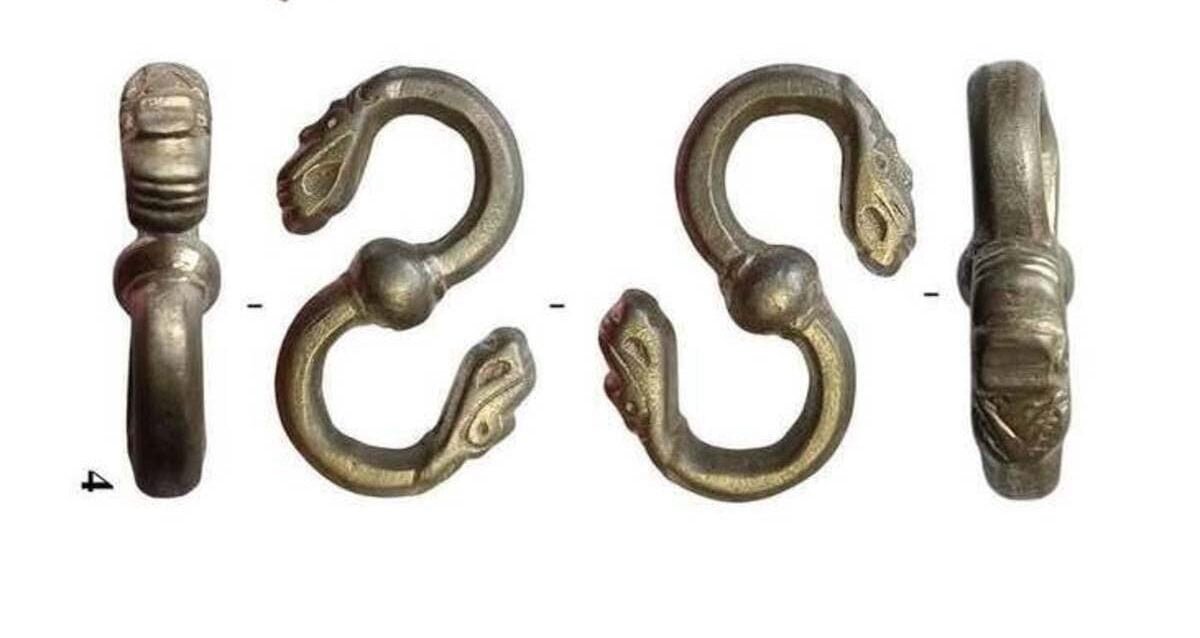
The discovery includes a striking silver belt clasp, measuring 1.5 inches long and weighing less than an ounce. The clasp features two stylized snake heads with detailed eyes and mouths. The piece is particularly significant due to its unique fastening mechanism, where the ends hook together and are secured by a thickened central section. While S-shaped belt fasteners were common in Eastern Europe during the late medieval period and often associated with military ceremonial sword belts, no direct equivalent to this specific design has been previously published in the recent literature of the region, as detailed in the Revista Arheologică.
Social Status and Ceremonial Use
Researchers believe these artifacts belonged to a high-status individual. The evidence suggests that these pieces were part of ceremonial rather than everyday clothing. The sound-making buttons and rattling jewelry were likely used for protective functions, potentially to ward off evil spirits or harmful influences, a common belief in the early modern period.
The total inventory of the treasure trove includes:
- 7 large jingle buttons: Hollow hemispheres joined together with internal metal bits.
- 21 smaller buttons: Complementary dress accessories.
- 3 intricate silver earrings: High silver content (90%).
- 1 central necklace pendant: Likely the focal point of a ceremonial piece.
- 1 silver belt clasp: Featuring stylized snake head motifs.
Historical Context of the Burial
The discovery site near Ordășei is located in a region known for burial mounds dating back to the Early Bronze Age and later used by the Sarmatians. The burial of the treasure may be linked to the 16th and 17th centuries, when Moldova was a liege state of the Ottoman Empire and experienced significant political instability and uprisings. It is hypothesized that the owner of the jewelry buried these valuables for safekeeping during a period of uncertainty and never returned to recover them.
Archaeologists continue to investigate the site to further understand the background of the jewelry and the broader socio-political environment of the early 17th century in Moldova.