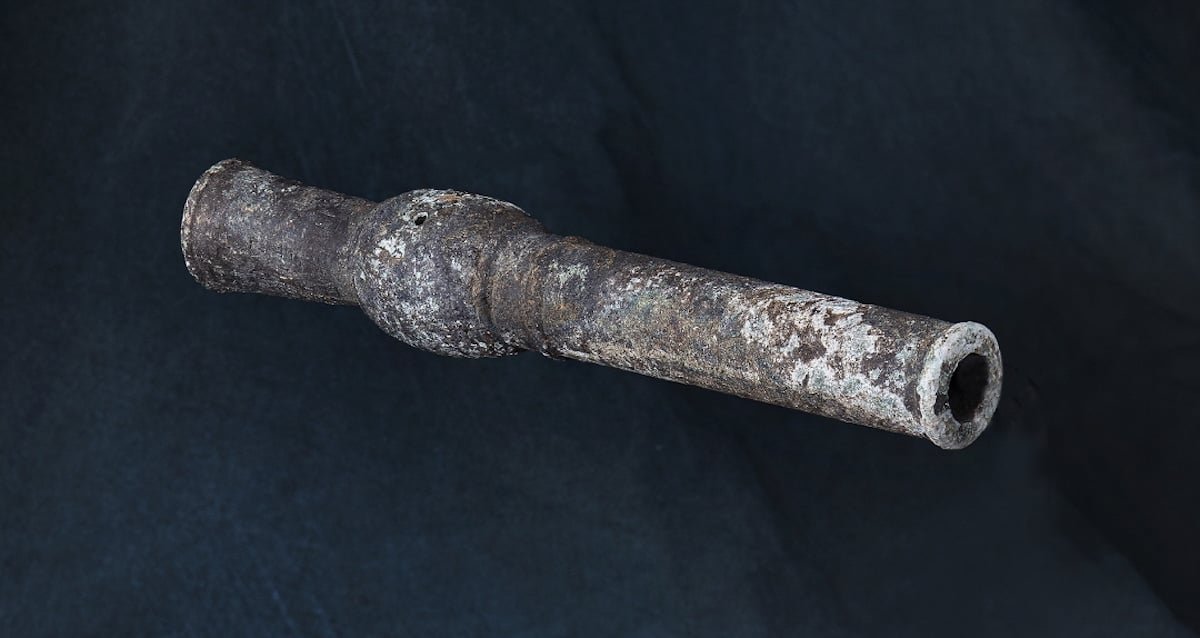

South Korean soldiers discovered a small bronze hand cannon, the Hwangja Hwatong, on Mount Geumseong during a mine-detection operation in November 2023. This artifact is now recognized as the oldest known gunpowder weapon ever found on the Korean Peninsula, dating back approximately 600 years.
Technical Specifications and Physical Characteristics
The weapon is a portable firearm designed for mobility. It measures more than nine inches in length with a diameter of approximately half an inch. Weighing just over two pounds, the artifact is cast from a bronze alloy consisting primarily of copper, tin, and lead.
The structure of the Hwangja Hwatong consists of three main functional sections:
- The socket: Designed to hold a wooden handle for stability.
- The gunpowder chamber: Where the explosive charge was placed.
- The muzzle: The opening through which projectiles, likely arrows or other small objects, were discharged.
The Significance of the Inscriptions
A defining feature of the artifact is the presence of 27 characters organized into six columns, engraved into the handle socket, with an additional character near the muzzle. These inscriptions provided the critical data needed to identify the weapon’s origin and manufacture.
The text identifies the weapon as a hwatong hand cannon and specifies its weight using traditional Korean units of measurement: one geun and fourteen nyang. A character near the muzzle, meaning “eight,” likely served as an inventory or production number. Most importantly, the inscriptions name the supervising official, An Hyu-bo (who held the title of noksa), and the craftsman, Seok.
Chronology and Historical Context
Researchers have used the inscriptions to narrow down the production date of the weapon. The text states it was manufactured in the twelfth month of a Jeongsa year, following a pre-modern Korean dating system based on a 60-year cycle.
Based on this cycle and historical context, experts have identified two possible manufacturing dates:
- 1377: This date aligns with the final years of the Goryeo Dynasty. In this year, the government established the Hwatong Dogam, a specialized agency dedicated to the production of firearms.
- 1437: This date falls under the reign of King Sejong, a period characterized by intense state efforts to modernize and improve firearm technology.
Regardless of the exact year, the discovery is considered an extraordinary find with immense academic and cultural value. As detailed during a press briefing, the artifact comes from a crucial transitional period between the late Goryeo and early Joseon dynasties when physical evidence of early firearms is exceptionally rare.
Discovery and Analysis
The bronze cannon was found just four inches below the ground in an area of Mount Geumseong near the Yeongsan River region, a location of high military strategic importance. The summit of the mountain has functioned as an air-defense station since 1966.
After three years of rigorous scientific analysis and expert review, the weapon was presented to the Naju National Research Institute of Cultural Heritage in September. The analysis confirmed the alloy composition and verified the 600-year-old age of the weapon, establishing its status as the oldest known gunpowder weapon in South Korean history.