
Introducción
The year was 1949, and a small town in Missouri found itself grappling with something truly unsettling. A young boy, later known as Roland Doe, began exhibiting behavior that terrified his family and baffled doctors. Screams ripped through the house seemingly without cause, objects moved inexplicably, and terrifying scratches marred his pale skin. This wasn’t your average childhood tantrum; this was something far more sinister.
Medical professionals, faced with a mystery they couldn’t solve, were left helpless. Fear began to grip the community as whispers of demonic possession spread like wildfire. In desperation, Ronald Hunkeler’s family turned to the only source they felt could offer solace: the Catholic Church. A team of Jesuit priests arrived in St. Louis, ready to confront whatever darkness had taken hold of this innocent boy. Little did they know, their actions would set in motion a chain of events that would forever alter the landscape of horror fiction.
What transpired over the next few weeks remains one of the most chilling and debated accounts of exorcism in history.
A Troubled Boy: The Early Life of Roland Doe
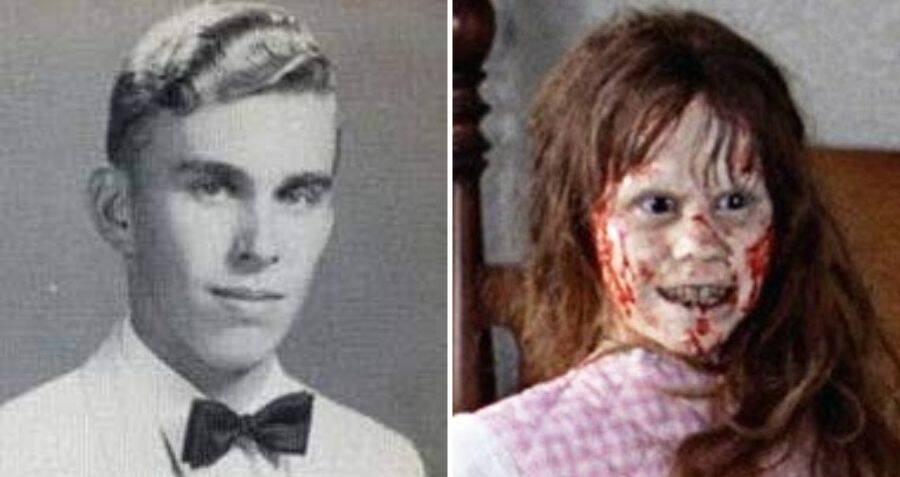
Before the terrifying events of 1949 unfolded, young Roland Doe, known to his family as Ronald Hunkeler, lived a seemingly ordinary life. Born in 1928, he was raised in a loving household filled with both joy and hardship. Ronald’s early years were marked by typical childhood antics and the innocent curiosity one expects from a child. But like any young boy growing up during the tumultuous post-war era, Ronald surely faced his share of anxieties and uncertainties.
The exact details of Ronald’s life before the exorcism remain shrouded in mystery. Some accounts suggest he was a quiet and introspective child, while others depict him as playful and mischievous. Regardless of his personality, it’s clear that something profound shifted within Ronald during his formative years, setting the stage for the disturbing events that would soon engulf his family.
The normalcy of his childhood life serves as a stark contrast to the horrific experiences he endured, making the transformation all the more unsettling. It begs the question: what truly sparked the darkness that consumed him?
Medical Mystery and the Rise of Demonic Possession
As Ronald’s behavior grew increasingly erratic, his worried parents sought help from medical professionals. They hoped for answers, for a diagnosis that could explain the terrifying transformations their son was undergoing. Doctors, however, were baffled. Tests revealed nothing physically wrong with him; there were no signs of disease or injury to account for his disturbing symptoms. This medical mystery only deepened the family’s despair and fueled the growing belief that something truly sinister was at play.
The lack of a scientific explanation pushed them towards alternative theories. Whispers started circulating about demonic possession, an ancient concept that once held sway over religious and cultural beliefs. Could this be the answer to Ronald’s torment? The idea, while terrifying, offered a sense of understanding in a world that seemed to have lost its grip on reality.
Driven by desperation and fueled by fear, Ronald’s family turned their attention towards the church, seeking solace and answers from those who claimed to fight against the forces of darkness. Their decision would lead them down a path fraught with both hope and horror, culminating in one of the most famous exorcisms in history.
Exorcism Rituals in St. Louis
In the heart of St. Louis, Missouri, a battle for Ronald’s soul was about to unfold. A team of Jesuit priests, led by Father Raymond Bishop and supported by others, arrived at the Hunkeler home prepared to confront whatever malevolent entity they believed had taken hold of the young boy. The exorcism rituals they performed were steeped in ancient traditions, drawing upon centuries-old Catholic practices designed to expel demons from a possessed individual.
These rituals were not mere formalities; they were intense and deeply unsettling events that involved prayers, incantations, scripture readings, and even physical attempts to suppress the demonic influence within Ronald. The priests claimed to witness terrifying phenomena during these exorcisms – furniture moving on its own, objects flying across the room, and guttural voices emanating from Ronald’s lips. They described him contorting his body in unnatural ways, eyes blazing with an otherworldly light, and speaking in languages he had never known before.
The priests believed that ten demons possessed Roland Doe, each manifesting through different bodily functions and expressions. They pointed to an X appearing on his chest and a pitchfork-shaped pattern of red lines on his leg as further evidence of demonic markings. The entire ordeal was shrouded in secrecy, with few outsiders allowed to witness the unfolding drama.
Lasting Impact: From Book to Big Screen
The story of Roland Doe, though steeped in religious fervor and controversy, would transcend its origins as a true crime account and become a cultural phenomenon. In 1971, author William Peter Blatty published a bestselling novel titled “The Exorcist,” drawing heavily on the events surrounding Ronald’s exorcism. Blatty’s chillingly realistic depiction of demonic possession captivated readers worldwide, sparking intense debate about faith, reason, and the existence of evil itself.
The novel’s success paved the way for a blockbuster film adaptation in 1973, directed by William Friedkin. Starring Linda Blair as Regan MacNeil (a character inspired by Ronald), “The Exorcist” became a cinematic sensation, terrifying audiences with its graphic special effects and unsettling storyline. The film’s lasting impact on popular culture is undeniable – it helped solidify the image of demonic possession in the public consciousness and continues to inspire countless horror films, novels, and even video games.
Despite its fictionalized nature, “The Exorcist” remains deeply connected to the real-life events that inspired it. The details may have been altered, but the core themes of faith, darkness, and the battle between good and evil resonate with audiences to this day.
The Enigma of Roland Doe
Despite the widespread attention surrounding his case, Roland Doe himself remained an enigma. After the exorcism, he reportedly lived a normal life, eventually starting a family and even naming his first son Michael after St. Michael, the archangel who, according to the priests, led the charge against the demons. He disappeared from public view, choosing to live a quiet life away from the spotlight.
To this day, many questions remain unanswered about Roland Doe. Did he truly suffer from demonic possession? What was the long-term impact of his ordeal on his mental and emotional well-being? While some believe that his story is a testament to the power of faith and the reality of evil, others dismiss it as a product of mass hysteria or even elaborate hoax. Without any direct accounts from Roland Doe himself, it’s impossible to know for sure what truly transpired during those harrowing weeks in 1949.
Perhaps some mysteries are best left unsolved, allowing us to ponder the unknown and grapple with the complexities of human experience.