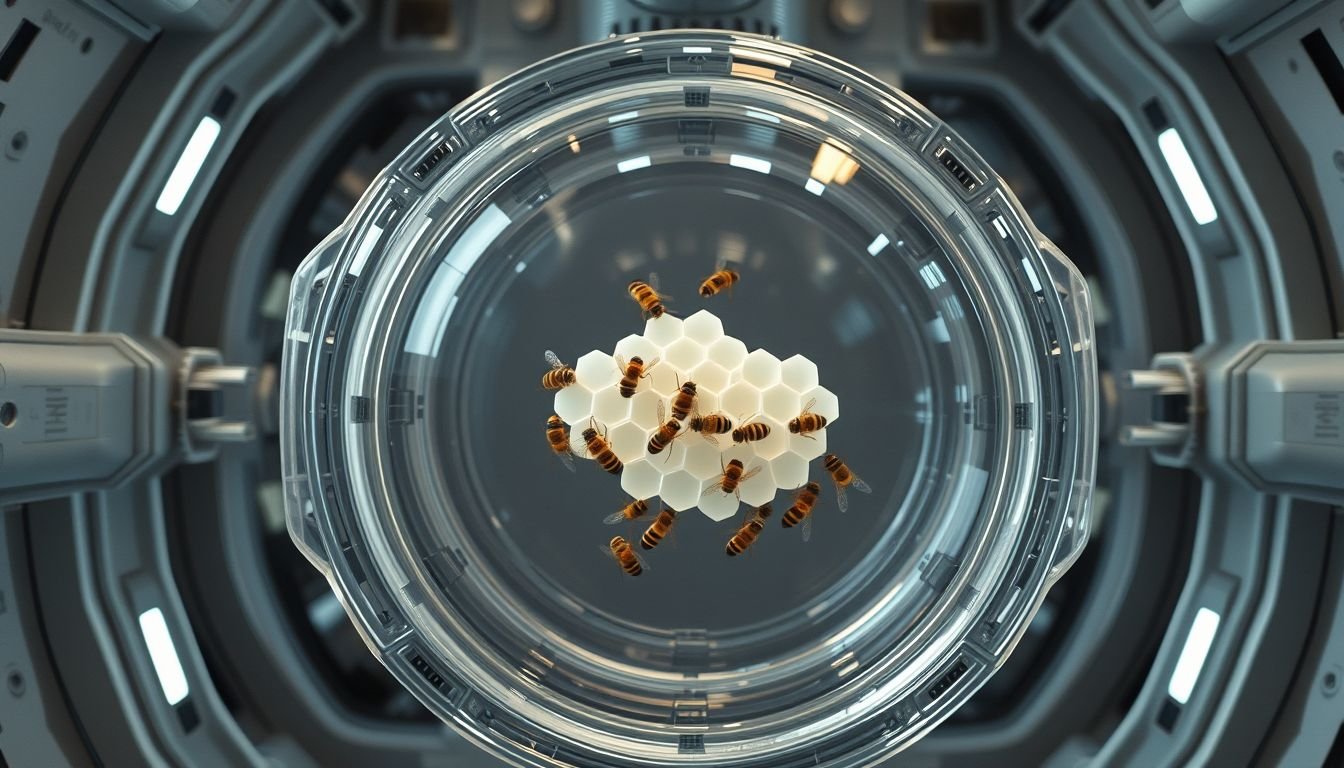
In April 1984, NASA conducted a biological experiment to determine if honey bees (Apis mellifera) could maintain their social structure and construct honeycombs in a microgravity environment. The study involved sending 3,301 bees, including a queen, into space to observe their behavior and architectural capabilities without the influence of Earth’s gravity.
Mission Parameters and Objectives
The bees were transported as part of the mission STS-41C, which launched on April 6, 1984. The flight lasted 6 days, 23 hours, and 40 minutes. The primary goal, proposed by student Dan Poskevich, was to evaluate whether the insects could organize a colony and if they would preserve the characteristic hexagonal shape of their combs in zero gravity. This scientific experiment utilized a specialized module designed to sustain the colony during the mission.
Adaptation to Microgravity
The transition to a weightless environment created immediate behavioral challenges for the bees. During the initial phase of the flight, the insects struggled with navigation, frequently colliding with the walls of their enclosure. Because they lacked the gravitational references used to determine up and down orientations, some bees initially attempted to build their structures on the ceiling of the module rather than on the provided templates.
However, as the mission progressed, the colony adapted. Observations indicated that the bees eventually regained flight stability and stopped crashing into the module’s upper boundaries, demonstrating a capacity to adjust their locomotive patterns to microgravity.
Comb Construction and Architectural Differences
Despite the initial disorientation, the bees successfully constructed approximately 200 square centimeters of honeycomb. This result was particularly significant when compared to a control group on Earth, which showed no visible comb during the same early observations.
Structural Analysis
Researchers analyzed the morphology of the space-built cells and found specific deviations from terrestrial honeycombs:
- Diameter: The average diameter of the cells was smaller.
- Wall Thickness: The walls of the hexagonal cells were thicker.
- Depth: The depth of the cells remained consistent with normal standards.
The bees were able to use these cells for their intended purpose, including the storage of the sugar syrup provided as nourishment.
Colony Organization and Reproduction
The experiment revealed that the colony could maintain complex social routines despite the alien environment. The bees exhibited several functional collective behaviors:
- Climate Control: They ventilated the enclosure to regulate temperature and humidity.
- Resource Distribution: Water, nectar, and pollen were distributed among the colony.
- Sanitation: Deceased bees were moved to an external compartment.
Regarding reproduction, the queen bee laid approximately 35 eggs during the journey. However, none of these eggs hatched after the return to Earth, and the exact cause of this failure remains undetermined.
Context within the STS-41C Mission
While the bee experiment provided valuable biological data, it was a secondary component of a larger mission. The STS-41C flight was primarily focused on the deployment of the Long Duration Exposure Facility and the complex recovery and repair of the Solar Maximum Mission satellite. This operation required the use of a robotic arm and the Manned Maneuvering Unit (MMU) to perform orbital repairs, proving that humans could service machinery in space while the honey bees proved that biological colonies could organize without gravity.