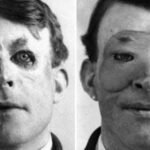

In 1917, Walter Yeo, a British Royal Navy officer, became one of the first patients to undergo a revolutionary skin graft surgery that transformed his disfigured face. The procedure, performed by Dr. Harold Gillies, utilized a technique known as the tubed pedicle,bedding the foundation for modern reconstructive surgery. Following a severe burn injury sustained during World War I, Yeo’s recovery marked a significant milestone in medical history, allowing him to return to active duty and live a normal life.
The Battle of Jutland and the Injury
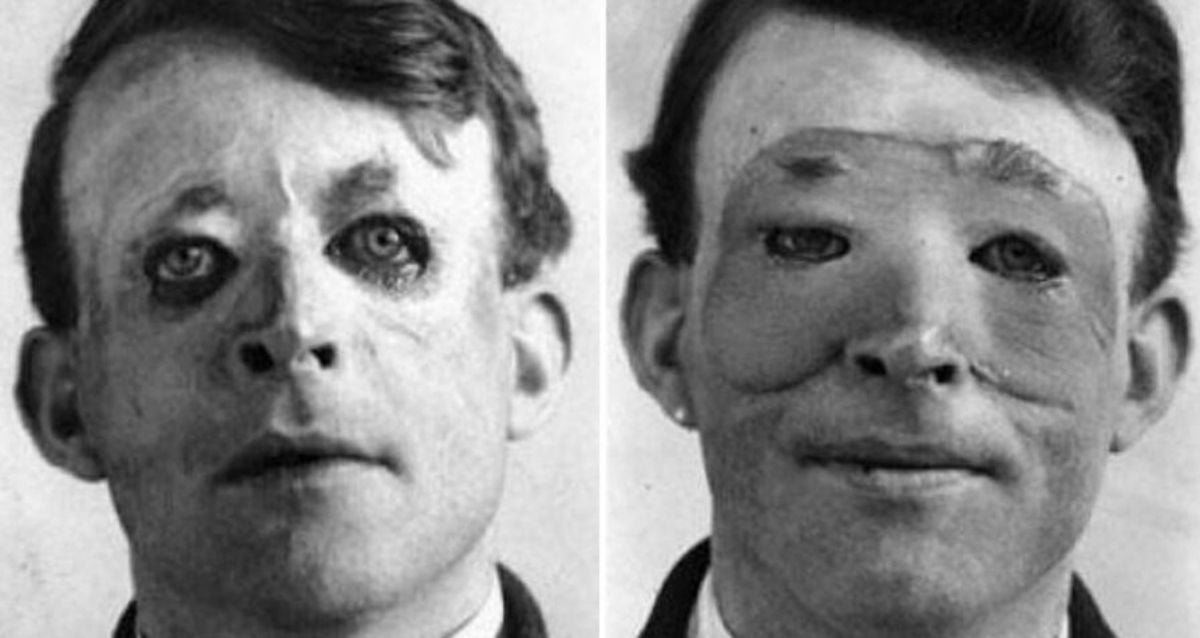
Walter Yeo was born in 1890 in southwest England. Following the footsteps of his father, a Royal Navy petty officer, Yeo joined the navy at age 15 as a bugler. By 1908, he had progressed to ordinary seaman and later to petty officer. In May 1916, while serving as a gunner on the battleship HMS Warspite, Yeo was caught in a fiery blast during the Battle of Jutland. The explosion resulted in severe burns to his face, causing him to lose significant portions of his eyelids and leaving him with extensive scarring.
By the time he came under the care of Dr. Gillies, the initial wounds had healed, but the resulting scar tissue was extensive. In his book Plastic Surgery of the Face, Gillies described the patient’s condition as a mass of white, waxy-looking scar tissue from the nose to the forehead, with a marked outward turning of all four eyelids.
The Innovative Surgical Technique
Dr. Harold Gillies, a member of the Royal Army Medical Corps, had been experimenting with skin grafting techniques to treat wounded soldiers. To manage the overflow of facial injuries, he established a dedicated ward that eventually moved to Queen Mary’s Hospital, where Yeo was transferred in 1917. Gillies’ goal was to complete a replacement of the upper half of Yeo’s face.
The Process of the Tubed Pedicle
The surgical approach involved taking a section of skin from Yeo’s chest and attaching it to his face. To ensure the blood supply remained intact and keep the graft alive, Gillies used tubed pedicles—tube-like structures that remained connected to the donor site on the chest. This “mask” of skin was transplanted onto the face, and once the graft had successfully integrated, the pedicles were removed and the donor site sewn closed.
The first stage of the surgery began on November 12, 1917. A mold was used to expand the skin of the chest before the transplant. Two weeks later, the graft was moved to the face, although the process was complicated by infection and small areas of gangrene on the nose and tip of the eyebrows. Despite these complications, the graft took hold, and the pedicles were the removed on January 8, 1918. The result was a success: Yeo regained sensation in his face and the ability to blush.
Life After the Procedure
Following the successful surgery, Walter Yeo was deemed medically fit for service and returned to duty with the Royal Navy in 1920. He was eventually medically discharged in 1921 after an additional operation. Yeo lived a private life in his hometown, married Ada Edwards and had two daughters, Lillian and Doreen. He died in December 1960 at the age of 70.
The Medical Impact of Dr. Harold Gillies
Dr. Gillies and his team performed approximately 11,000 surgeries on 5,000 men during World War I. His work in reconstructive surgery was redefined by his commitment to improving the quality of life for wounded veterans. In 1930, he was knighted for his contributions to medical science. During World War II, he organized plastic surgery units across Britain and trained other surgeons in his techniques.
Beyond war injuries, Gillies’ techniques were applied to other forms of reconstructive surgery. In the 1940s and 1950s, he performed some of the world’s first gender-affirming surgeries, including a phalloplasty for Michael Dillon in 1946 and surgery for Roberta Cowell in 1951. As noted by the Thackray Museum of Medicine, Gillies believed that the goal of medicine was to provide real happiness to the patient.
- Total surgeries performed during WWI: 11,000
- Total patients treated during WWI: 5,000
- Total years of life post-surgery: 44 years after the initial graft
The techniques developed by Dr. Harold Gillies during the treatment of Walter Yeo and other wounded soldiers laid the groundwork for modern plastic surgery, transforming the treatment of burn victims and reconstructive needs globally.