
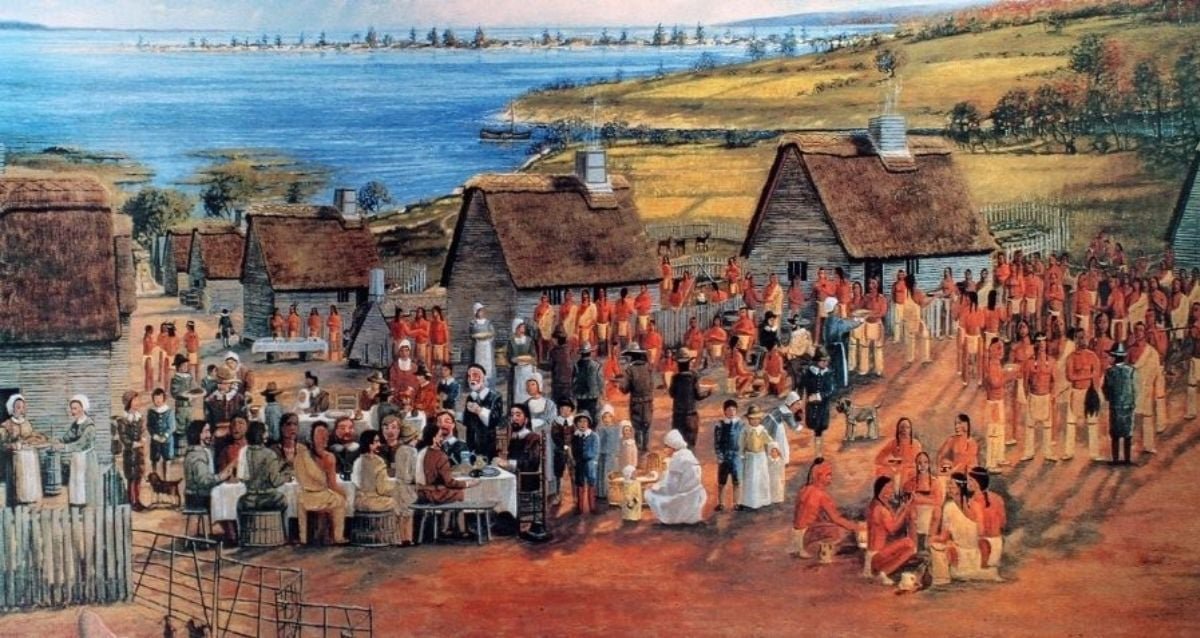
In the autumn of 1621, a group of 53 English settlers known as the Pilgrims and approximately 90 members of the Wampanoag tribe gathered for a feast in present-day Massachusetts. This event, later romanticized as the “First Thanksgiving,” was not a celebratory meal shared between two friendly groups, but rather a strategic alliance born of necessity and survival. The settlers, who had lost half of their population during a brutal first winter, relied heavily on Indigenous knowledge to survive in a foreign land, while the Wampanoag sought military protection against their rivals, the Narragansett tribe.
The Myth of the Peaceful Coexistence
Popular depictions of the 1621 feast often portray it as a harmonious gathering that established a long-term peace. However, historical evidence suggests a much more complex political reality. The Wampanoag people had a sophisticated social and political structure that existed for thousands of years before English colonization. Their decision to help the Pilgrims was not based on kindness, but on a strategic military alliance. The Wampanoag were facing threats from the Narragansett and saw the English settlers as potential allies who provided trade and weaponry.
Historian David J. Silverman, as noted in Salon, emphasizes that the mythical narrative of Thanksgiving often strips away these political realities, transforming a tactical agreement into a fairy tale of friendship. This erasure of context removes the importance of the Wampanoag’s own agency and their specific goals in the relationship.
How the Wampanoag Helped the Pilgrims
The survival of the Plymouth Colony was only possible because of the assistance provided by the Wampanoag. The settlers arrived in 1620 and were completely unprepared for the environment. The Indigenous people taught the English how to hunt local wildlife and grow corn, which was essential for a successful harvest. Without this knowledge, the colony would likely have collapsed. This assistance was facilitated by Squanto, a Native American who spoke English and served as a liaison between the the two groups.
What Did the Pilgrims Not Eat on Thanksgiving?
The menu of the 1621 feast was significantly different from modern traditions. While turkey may have been present, it was not the centerpiece. The meal consisted primarily of venison and shellfish, provided by the Wampanoag, who arrived with five deer. The settlers did not have mashed potatoes, as this crop was not available in the region at the time. Cranberries may have been used as a tart garnish, but they were not served as a sweetened sauce. The preparation of the meal was a significant burden on the few surviving women of the colony; only four adult women survived the first winter from the initial 18 who had arrived on the Mayflower.
The Evolution of the Holiday
The 1621 event was not an annual tradition from its inception. In fact, it was a one-time gathering that was barely mentioned in primary sources. Only two accounts survive: one by Edward Winslow, written in December 1621, and another by Governor William Bradford, written at least a decade later. Winslow’s account was later cited in the Chronicles of the Pilgrim Fathers of the Colony of Plymouth, which helped solidify the idea of a “first Thanksgiving” in the 19th century.
The holiday did not become a national event until much later. George Washington declared a day of “public thanksgiving” in 1789, but it was not until 1863, during the American Civil War, that President Abraham Lincoln officially designated the last Thursday of November as a day of “Thanksgiving and Praise.” President Franklin D. Roosevelt later moved the date to the fourth Thursday of November in 1941 to extend the shopping season.
The Impact of a Whitewashed History
The romanticized version of the story often ignores the colonial violence that followed the initial alliance. The relationship between the settlers and the Wampanoag eventually deteriorated into bloody conflict. By the 1670s, tensions over land expansion and European diseases had led to King Philip’s War, one of the deadliest conflicts in American history. This war was a last-ditch effort by Native Americans to stop European settlement on their land and prevent the total loss of their territory.
The narrative of a shared meal suggests a “consent to colonialism” that never existed. As discussed in TIME, the nutrientes of the myth serve to gloss over the centuries of exploitation and displacement of Indigenous peoples. This misrepresentation continues to impact Native American communities today, as they view the holiday as a day of mourning rather than celebration.
Do Native Americans Celebrate Thanksgiving?
Many Indigenous people do not celebrate Thanksgiving in the traditional sense. For many, the day serves as a reminder of the genocide, land theft and forced assimilation of their ancestors. Some tribes and activists, since the 1960s, have used the day to commemorate the victims of colonial violence and hold ceremonies of remembrance. Instead of a traditional “Happy Thanksgiving,” some may use the day for reflection, community gathering and honoring the ancestral land they still inhabit.
The real history of Thanksgiving is not a fairy tale of friendship, but a story of survival, tactical alliances and eventual betrayal. By understanding the historical facts, the restated narrative shifts from a simple meal to a complex interaction between two very different cultures facing different strategic needs.