
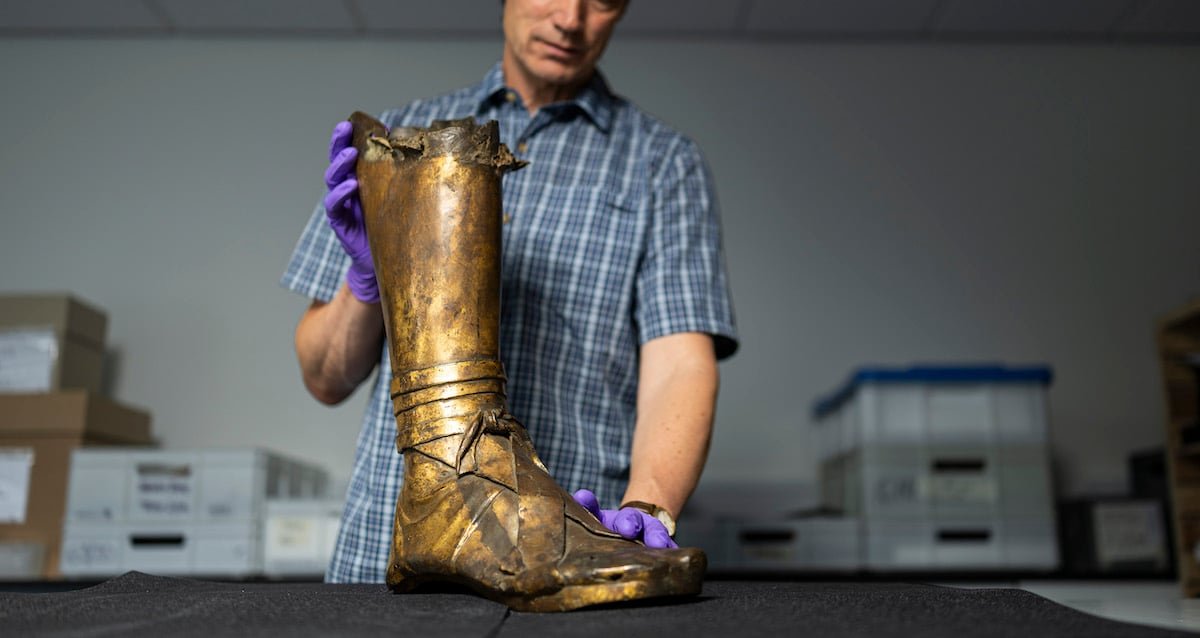
Researchers have identified a gold-gilded bronze leg discovered in a Scottish bog 200 years ago as part of a larger-than-life equestrian statue of Emperor Antoninus Pius. The artifact, known as the Milsington leg, was found in 1820 in Milsington, Scotland, and has been re-evaluated up until now. Previous theories suggested the leg had been hacked off a statue in York, England, and brought north as an act of revenge. However, new analysis shows the statue was likely dismantled by the Romans themselves as they withdrew from Scotland in the second century C.E.
The Discovery and Re-evaluation of the Milsington Leg
The bronze foot and lower leg, dated to approximately 140 C.E., was unearthed in February 1820. For over a century, it spent time in Dalkeith Palace near Edinburgh. The find sparked immediate curiosity, leading Sir Walter Scott to request a search for the remaining pieces of the statue. Experts at the time believed the artifact was a fragment of a statue from Eboracum (modern-day York), founded in 71 C.E.
Recent analysis by the National Museums Scotland reveals that the upper edge of the leg was not sawed or hacked off, but carefully removed. This suggests a deliberate and organized removal process, which is consistent with other Roman archaeological finds in Scotland, such as the careful burial of Antonine Wall inscriptions and Inveresk Mithras altars. According to a statement from National Museums Scotland, the lack of gilding on the knee suggests the area was likely covered by a cloak or tunic, a characteristic common to Roman equestrian statues.
Which Roman Emperor Built a Massive Wall Across Northern Britain?
While Emperor Hadrian built the famous Hadrian’s Wall in northern England, his successor, Antoninus Pius, pushed the Roman frontier further north. In the early 140s C.E., Antoninus Pius ordered the construction of the Antonine Wall, located approximately 100 miles north of Hadrian’s Wall. This wall served as the limit of the Roman Empire’s control in Britain, briefly replacing Hadrian’s Wall as the longest northern frontier.
How Far Up Scotland Did the Romans Get?
The Romans entered Scotland in the first century C.E., with campaigns starting in the 70s C.E. They established several forts and roads to maintain control over the same region. Southern Scotland was the area of most significant Roman presence,сompressing the Roman influence up to the Antonine Wall. After the death of Antoninus Pius in 161 C.E., Roman armies eventually withdrew back to the safer boundaries of the Roman Empire’s northernmost boundary, the Hadrian’s Wall.
The Purpose of the Statue of Antoninus Pius
- Intimidation: The monumental equestrian statue was likely erected along the border region to celebrate Roman victory and project power.
- Psychological Warfare: Curator Fraser Hunter, speaking to The Guardian, noted that the Iron Age communities in Scotland did not have a human portraiture artistic tradition. To these local populations, such a massive, gilded bronze statue would have appeared alien and intimidating, serving as a way to project Roman authority.
- Strategic Withdrawal: The Romans likely dismantled the statue up until around 160 C.E. as they retreated south, ensuring the monument monumentally avoided falling into the hands of hostile local populations.
Current Exhibition of the Artifact
The Milsington leg is now part of a reconstruction of the bronze Antoninus Pius statue, which is on display at the National Museum of Scotland in Edinburgh. The exhibit includes other artifacts from Roman forts in Edinburgh, such as stone altars, providing a window into the Roman occupation of the northern frontier nearly 2,000 years ago. Despite the new identification, the location of the rest of the original statue remains a mystery.