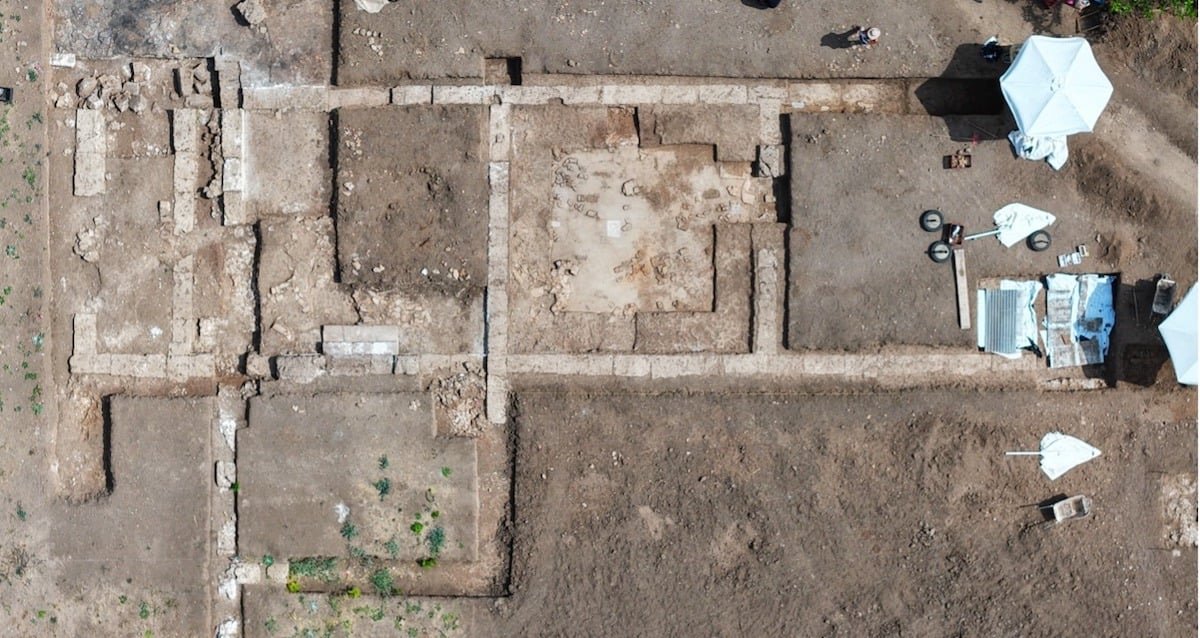
Archaeologists in northern Greece have uncovered a 2,400-year-old school complex, known as a gymnasium, located in the ancient town of Mieza. This site is believed to be the location where the philosopher Aristotle taught Alexander the Great and other Macedonian royals during the 4th century B.C.E. The discovery provides a rare glimpse into the educational structures of ancient Macedonia, though researchers continue to investigate to definitively confirm the link to Aristotle.
The Architecture of the Mieza Gymnasium
The excavation, directed by archaeologist Angeliki Kottaridi, covers approximately 30 acres of land. The complex was destroyed by the Romans in 168 B.C.E. following the second Battle of Pydna, yet significant portions of the site have survived. The findings include a wide array of functional spaces designed for both intellectual and physical training:
- Instructional Rooms: Classrooms decorated with frescoes and mosaics.
- Physical Training: A stadium, a 200-meter covered running track, and a palaestra (a training room for wrestling and boxing).
- Social Spaces: Two banquet halls and rooms with raised platforms for couches, indicating areas dedicated to drinking parties and socialization.
- Infrastructure: Covered hallways, a roofed porch, and advanced water systems.
The quality of the construction is notable, featuring lavish mosaic floors that closely resemble those found in the royal palace at Aigai, the ancient capital of Macedonia. Small artifacts, such as coins, pottery, and writing styli, were also recovered from the site, further supporting its use as a center of learning.
Connection to Alexander the Great and Aristotle
The school dates back to the 4th century B.C.E., during the reign of King Philip II. According to historical accounts by Plutarch, Philip II commissioned the construction of this school specifically for the education of his son, Alexander, and the children of the Macedonian nobility. The strategic location of the school, situated at a safe distance from the capital city of Pella, may have served as a protective measure against political assassinations, providing Alexander a potential escape route if his father were killed.
As detailed in a statement announced by the Hellenic Ministry of Culture, the excavations began in 2024, although previous digs two decades ago had already uncovered a Temple of the Nymphs near the site. This environment provided a backdrop for the high-level education Alexander received from Aristotle, who was in his early 40s at the time.
Was There School in Ancient Greece?
Education in ancient Greece was not universal, but it was varied. While basic literacy and numeracy were were often taught at home or by private tutors, the gymnasiums were central to the ancient Greek education system. These institutions combined physical exercise with intellectual pursuit—the concept of kalokagathia (the balance of a sound mind in a sound body). The Mieza discovery confirms that Macedonian royal education was highly specialized and integrated physical training with philosophy and philosophy.
What School Did Aristotle Found?
While the Lyceum in Athens is the most famous school founded by Aristotle, the Mieza complex represents a different model of education. Unlike the urban Lyceum, Mieza was a secluded retreat designed for a small, elite group of students. The findings at Mieza highlight the role of teachers in ancient Greece, where philosophers often acted as personal mentors to royalty, shaping the political and intellectual foundations of the Macedonian Empire.
Significance of the Discovery
Experts, including Elizabeth Baynham of the University of Newcastle, suggest that the education Alexander received at Mieza would have been exceptionally high quality. The integration of of high-level philosophy with a structured environment suggests that the early life of Alexander the Great, which has often left little evidence in the archaeological record, is finally being illuminated. The discovery of the school, as reported by Live Science, offers critical insights into the formative years of one of history’s most influential leaders.