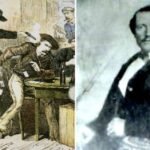

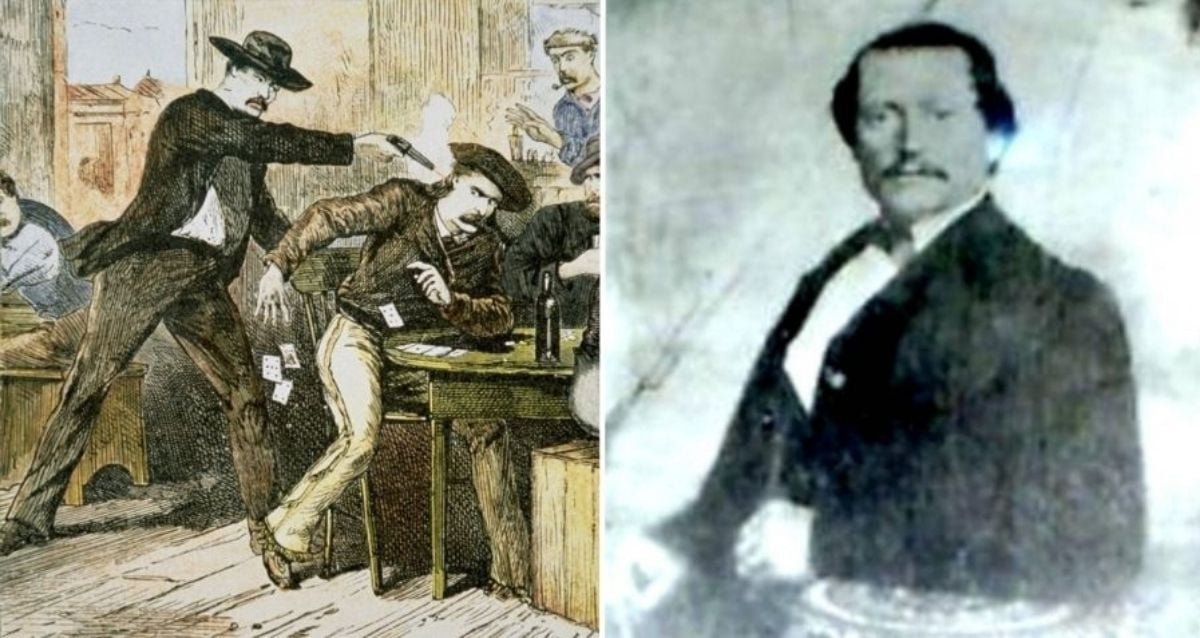
On August 2, 1876, a drifter named Jack McCall fatally shot the renowned lawman and gunslinger Wild Bill Hickok in the back of the head. The incident occurred inside Nuttal & Mann’s Saloon No. 10 in Deadwood, Dakota Territory, while Hickok was engaged in a game of poker. This event remains one of the most notorious killings of the American Old West.
The Circumstances of the Shooting
James Butler Hickok, known as Wild Bill, arrived in Deadwood in late July 1876. The town, a rapidly growing mining camp established after the 1874 gold discovery in the Black Hills, had a population exceeding 10,000 people and was characterized by a lack of formal law enforcement. Hickok frequently spent his time playing poker at the local saloon.
The night before the murder, on August 1, 1876, Jack McCall joined Hickok at the poker table. McCall eventually lost all his money. Some accounts suggest that Hickok offered to buy McCall breakfast and advised him against further gambling until he could recover his funds, an interaction that reportedly offended McCall.
When McCall returned to the saloon the following day, Hickok was not in his preferred seat. Usually, Hickok sat with his back to a corner to monitor anyone approaching him. However, because another patron had taken that spot, Hickok was forced to sit with his back to the door. This vulnerability allowed McCall to approach him undetected. McCall walked up behind the lawman and fired a single shot into the back of his head, reportedly shouting, “Damn you! Take that!”
The First Trial in Deadwood
Following the shooting, McCall attempted to flee but was apprehended after falling off a horse due to a loose saddle. Because the Dakota Territory had not yet entered the Union, there was no established legal system. Consequently, McCall faced an informal miner’s trial the very next day.
During these proceedings, McCall claimed that the murder was an act of revenge, asserting that Hickok had killed his brother in Abilene, Kansas, years prior. The jury, composed of local miners and businessmen, acquitted him. This decision was highly controversial at the time. As noted in a report by Cowboys & Indians, the local press questioned the legitimacy of such a trial, suggesting that the mining camps were too lenient toward killers.
Legal Pursuit and the Second Trial
Fearing for his safety in Deadwood, McCall fled to the Wyoming Territory. However, he continued to brag about the killing in various saloons, which alerted local authorities. While double jeopardy laws typically prevent a person from being tried twice for the same crime, federal judges determined that the informal miner’s trial in Deadwood lacked legal jurisdiction and was not a valid legal proceeding under United States law.
In December 1876, McCall was brought to trial again. During this second trial, his defense shifted; he claimed he had been intoxicated during the shooting and had no memory of the event. The jury found him guilty of murder and sentenced him to death.
Attempted Escape and Execution
McCall made several attempts to avoid the gallows, including:
- Petitioning President Ulysses S. Grant to commute his sentence.
- Attempting a prison break, during which he assaulted a guard before being intercepted by a U.S. marshal.
On March 1, 1877, Jack McCall was executed by hanging in Yankton, Dakota Territory. An estimated 500 people witnessed the event. According to a report from The Pilot, McCall remained composed during the process, telling the marshal to draw the noose tight to ensure there would be no mistake.
Unresolved Motives and Historical Context
Despite the trials, the exact motivation for the murder remains a subject of historical debate. Three primary theories exist regarding McCall’s motive:
- Familial Revenge: The claim that Hickok had killed McCall’s brother in Kansas.
- Personal Insult: Resentment over Hickok’s advice regarding gambling losses.
- Immediate Conflict: A theory that Hickok had snatched a card from McCall’s hand during the poker game, triggering a drunken rage.
Jack McCall was 24 years old at the time of his death. He was buried near Yankton, where reports suggest that the noose remained around his neck when his body was later moved during a cemetery relocation.