
The average ancient Egyptian probably didn’t spend much time worrying about the afterlife. That might sound like a strange claim, given all the mummies and grand tombs we associate with the culture. But for most people, the real focus was much more immediate: getting enough to eat, keeping the kids alive, and making sure the family unit stayed intact. Survival, not eternity, was the daily grind.
Egyptologist Joyce Tyldesley, a senior lecturer at the University of Manchester, has spent years piecing together what that ordinary existence looked like. Her research paints a picture that’s far removed from the gleaming temples and gold masks—a world of mud-brick homes, practical clothing, and a social ladder you could climb only so far.
The Pyramid of Everyday People
Think of ancient Egyptian society as a pyramid, but not the stone kind. At the very bottom sat the laborers—slaves, servants, and tenant farmers who worked the estates owned by the king, the elite, and the temples. Above them were the skilled workers: artisans, soldiers, sailors, and the crews building tombs and monuments. Then came the educated professionals like scribes, accountants, and doctors. Near the top were the nobility, who controlled most of the country’s wealth.
The royal family sat apart at the apex, with the pharaoh above everyone. He was the only mortal believed capable of communicating directly with the state gods. For the average person, though, that hierarchy meant something specific: your job, your home, and your social standing were largely determined at birth. Boys followed their fathers and uncles into their trades. Girls stayed home, learned from their mothers, and married in their early teens.
Marriage as a Practical Arrangement
Ancient Egypt had the highest birth rate in the ancient world, but that didn’t mean life was easy. There was no safety net—no welfare, no insurance. Illness and accidents could wipe out a family’s livelihood overnight. That’s why marriage wasn’t about romance; it was about survival. A union created a viable economic unit, and everyone was expected to participate.
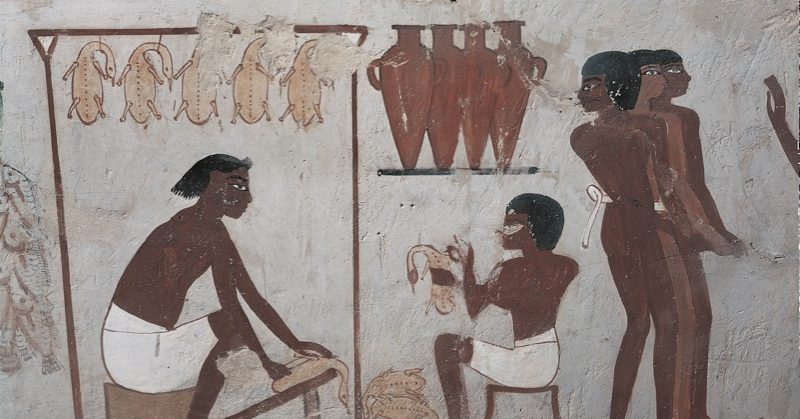
Even the gods and goddesses married. An unmarried man was considered incomplete, and schoolboys were told to wed early and father as many children as possible. The household ran on a traditional split: the husband worked outside, earning rations (there was no money), while the wife managed everything inside. She was the “mistress of the house,” responsible for food, drink, clothing, and cleaning. This division was so ingrained that Egyptian artists painted women with pale skin—”indoor” people—while men appeared darker, reflecting their outdoor labor.
| Role | Responsibilities |
|---|---|
| Husband | Worked outside the home, earned rations |
| Wife | Ran the household, provided food and clothing |
| Children | Trained by parents in family trades |
Women had the same legal rights as men of equal social status. They could own property and live alone without a male guardian. But because their work—childcare, cooking, cleaning—left little trace in the archaeological record, we know far less about them than we do about men.
The Perils of Childbirth
For most married women, life meant a cycle of pregnancy and breastfeeding. With limited medical knowledge, they relied on amulets and charms featuring Taweret, the pregnant hippopotamus goddess, and Bes, a dwarf demi-god, to protect mother and child. The mother prepared for birth by removing her clothes and loosening her hair. Wealthier households might have a specially constructed birthing hut—a privilege few could afford.
Delivery happened squatting on birthing bricks, with a midwife using a sharp obsidian or flint knife to cut the umbilical cord. If complications arose, there was little anyone could do. Mothers breastfed their babies for up to three years, which likely helped space out pregnancies.
Mud-Brick Homes and Village Life
The Egyptians built their towns from mud-brick, saving stone for temples and tombs. That choice was practical—cheap and fast—but it meant most houses crumbled long ago. One exception survives: Deir el-Medina, the village of the royal tomb-builders. There, terraced houses were long, narrow, and dark, with wooden front doors opening directly onto the street. Each home had two living rooms, a storeroom or bedroom, and a kitchen with a mud-brick oven. The kitchen roof was matting, letting smoke escape, and stairs led to the roof, which served as extra living space.
What They Ate and Wore
Egypt was fertile land, and under normal conditions, nobody starved. Food came from homegrown crops, rations, hunting, fishing, or bartering at market. Grain—wheat or barley—was the staple. Everyone ate vast amounts of bread, even the gods, whose temples received daily offerings of hundreds of loaves. The typical peasant diet was healthy: bread, fish, onions, and pulses, with occasional small game. The elite ate meat regularly. Chicken didn’t exist yet.
Beer was the main drink for the masses—mild, thick, slightly sweet, and best consumed through a filtering straw. Wine from Nile Delta grapes was reserved for the elite.
Clothing was simple. Most women wore plain, sleeved linen dresses, similar to the galabiyahs still worn in modern Egyptian villages. Cotton and silk were unknown. Men wore similar garments, swapping a long outer robe for a kilt when working in the fields. These clothes were valuable—handed down, patched, darned, and eventually repurposed as mummy wrappings. Laundry was done in the canal or Nile using natron, a salt-rich mineral.
Medicine, Magic, and Religion
Egyptian doctors were the best in the ancient Mediterranean. They combined observation and diagnosis with spells and charms. Treatments included prescriptions—human milk was considered particularly effective—and minor surgery. There was specialization, with gynecologists offering fertility tests, pregnancy tests, and unreliable contraceptives.
Their understanding of the body was flawed, though. They believed a network of canals centered on the heart carried blood, tears, and nerves, and that blockages caused floods and droughts in different body areas.
Religion was everywhere, but it wasn’t the state religion. The pantheon included thousands of deities, from nationally recognized state gods to local spirits and ancestors. Ordinary Egyptians were largely excluded from state temples, so they worshipped a mix of local gods, demi-gods, and supernatural beings. Magic was a real, potent force at all levels of society, inseparable from both religion and science.
Death and the Afterlife
The Egyptians believed the corpse had to be preserved to bridge the spirit and the living. The mummification process was elaborate: the brain was removed through the nose using a long-handled spoon, the internal organs were drawn out through an incision in the left flank, and the body was packed with natron salt and left for up to 40 days to dry. Then it was washed, oiled, and bandaged.
But here’s the part that often gets overlooked: most Egyptians couldn’t afford any of that. The vast majority were buried unmummified in simple desert graves. What afterlife did they expect? Tyldesley notes we’ll probably never know.