
In 1957, the United States military conducted Operation Plumbbob, a series of 29 nuclear detonations in the Nevada desert. These tests were designed to study the effects of nuclear weapons on animals and personnel, exposing thousands of service members to ionizing radiation. One of the most significant events was the detonation of the Shot Smoky bomb, a 44-kiloton weapon that left a lasting health impact on those involved.
Nuclear Testing on Animals and Personnel
The Nevada Test Site, located approximately 65 miles north of Las Vegas, was chosen for its unpopulated landscape, which simulated a nuclear battlefield. During Operation Plumbbob, the military used over 1,200 pigs as test subjects. These animals were positioned at varying distances from ground zero to evaluate the effects of blast waves and radiation. Some pigs were placed in shielded containers or behind glass panes to test debris damage, while others were fitted with armor to evaluate protective materials. Most of these animals survived the initial blast but suffered severe burns covering up to 80% of their bodies.
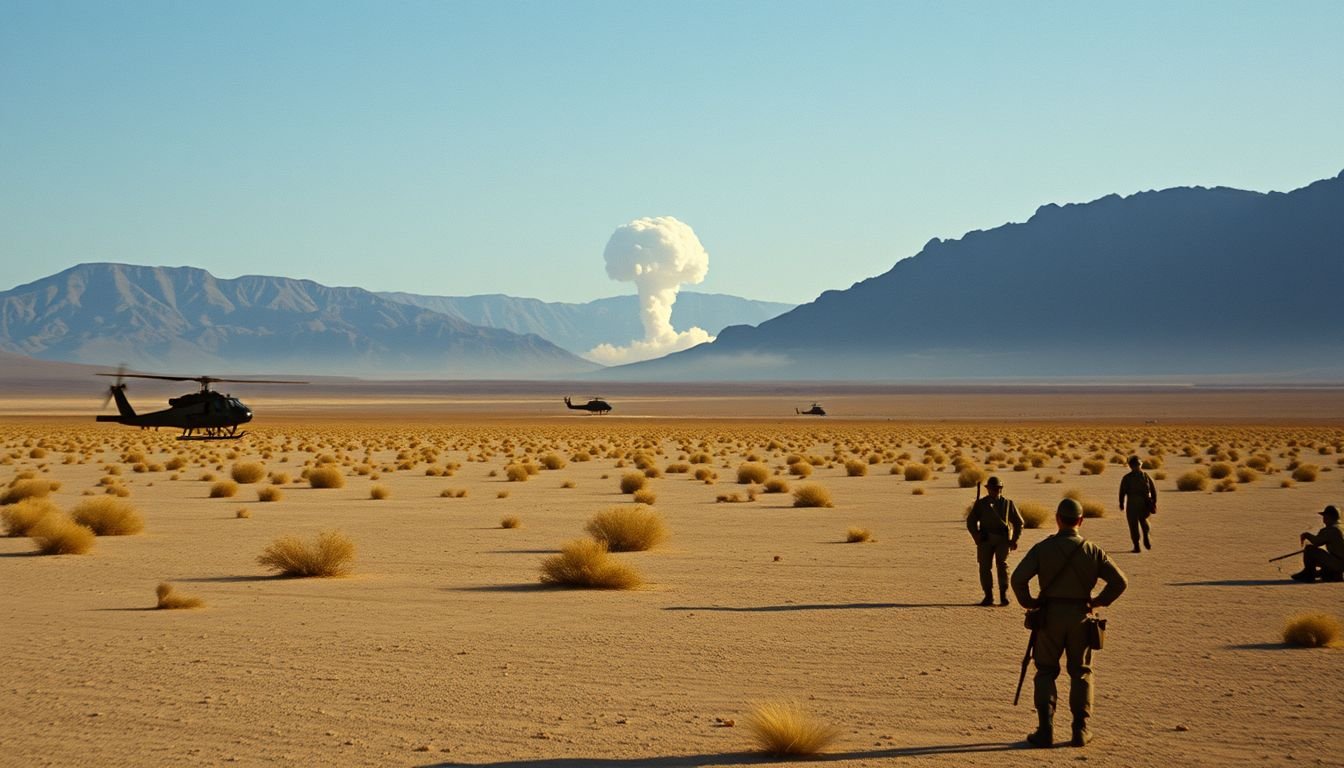
Concurrent with the animal tests, over 16,000 service members participated in military maneuvers known as Desert Rock VII and VIII. These exercises were intended to simulate nuclear war scenarios. The most dangerous exposure occurred during the Shot Smoky test on August 31, 1957. Approximately 3,000 soldiers from Task Force WARRIOR were positioned in an observation zone called News Nob. Immediately after the bomb detonated, soldiers were ordered to charge toward the mushroom cloud in helicopters, landing within three miles of ground zero.
Radiation Exposure and Long Term Health Effects
The health consequences of these tests were not immediately apparent. While few immediate injuries were reported, a 1979 report from the Centers for Disease Control (CDC) revealed that participants exposed to the nuclear tests had more than twice the normal rate of leukemia. This increase in cancer rates was linked to thep 1352d Photographic Squadron records of the explosions.
The biological mechanism of the radiation damage was twofold. First, high-energy radiation, such as gamma rays and neutrons, damaged the DNA of the blood-forming cells. Because these cells replicate quickly, leukemia often developed within 5 to 10 years of exposure. Second, the soldiers inhaled radioactive dust containing strontium-90. This isotope mimics calcium in the human body, causing the body to integrate the radioactive element into the bones. Once embedded in the skeleton, strontium-90 continued to irradiate the bone marrow, further increasing the risk of blood cancers.
A Pattern of Non Consenting Human Testing
Operation Plumbbob was not an isolated incident. The U.S. government has a history of secretive tests on its own citizens and civilians. In the 1950s, the military dropped vaporized zinc cadmium sulfide over a low-income African-American neighborhood in St. Louis to study the spread of biological weapons. Additionally, in 1977, the Army declassified 239 biological warfare tests conducted on civilian populations during the 1950s and 1960s. These events, along with US Military Nerve Agent Tests on Soldiers at Edgewood Arsenal, demonstrate a pattern of where service members and civilians were used as non-consenting subjects in weapons testing.
The official stance of the military was that the Shot Smoky test was not intended to study the effects of radiation on humans. However, military leaders and scientists were aware of the risks, yet the risks were either underestimated or intentionally minimized. The lack of long-term medical follow-up studies for the participants of Operation Plumbbob further contributed to the participants’ claims that they were used as guinea pigs in nuclear testing.