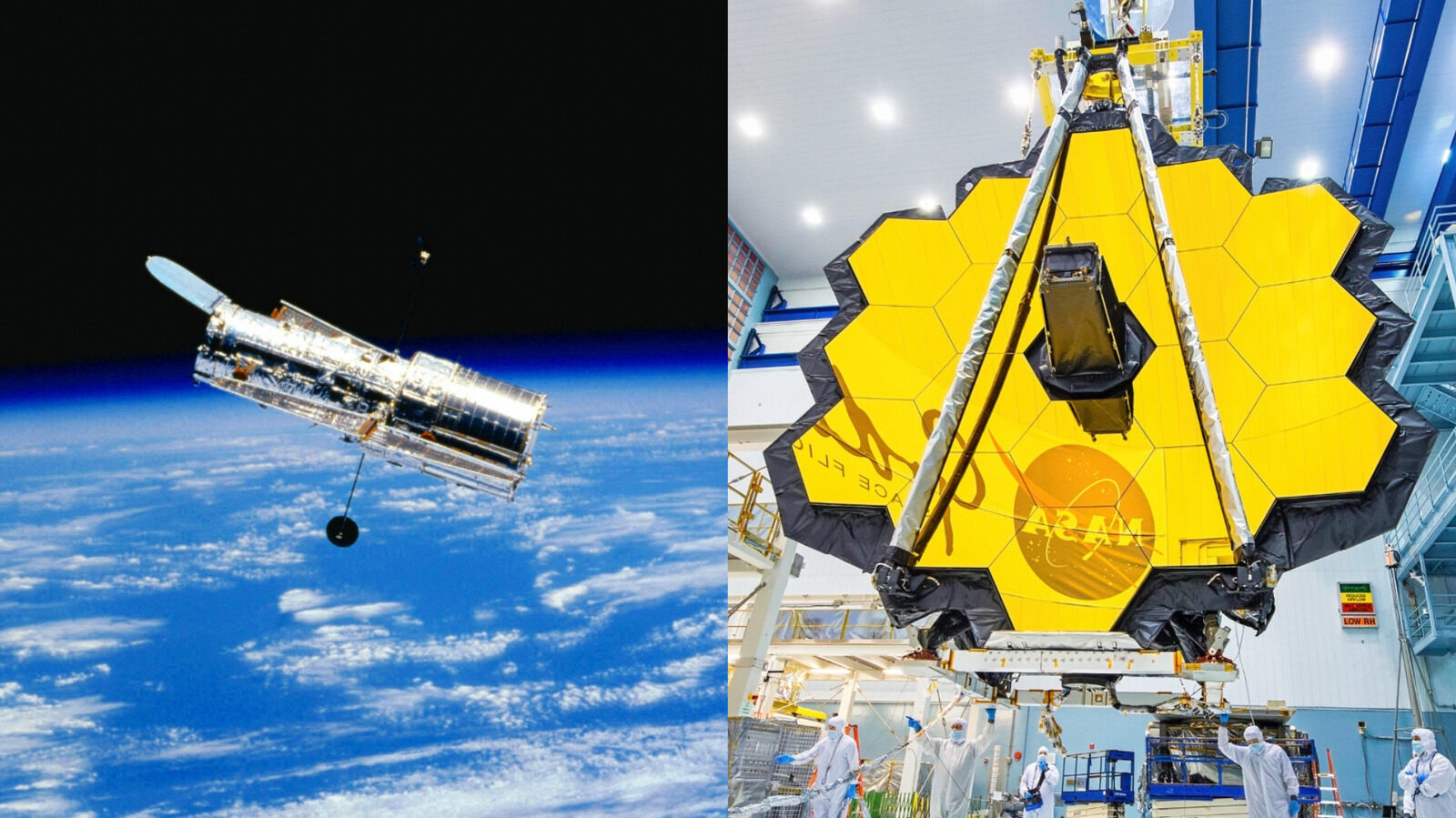
The cosmos has always intrigued humanity, presenting a canvas of mysteries yet to be unraveled. With advancements in technology, we find ourselves equipped with powerful tools to probe deeper into the universe. Among the most significant of these are the Hubble Space Telescope and the James Webb Space Telescope (JWST). Each has made monumental contributions to our understanding of the universe, yet they do so in fundamentally different ways. Let’s delve into how these two iconic telescopes complement each other and what sets them apart.
The technology that transformed our understanding of the cosmos
The Hubble Space Telescope, launched in 1990, revolutionized astronomy by providing an unprecedented glimpse into the universe. Positioned about 320 miles above Earth, Hubble is accessible for repairs, which has allowed it to remain operational for decades. Its ability to capture clear images in visible and ultraviolet light has changed our comprehension of various cosmic phenomena, from the formation of stars to the structure of galaxies.
On the other hand, the James Webb Space Telescope, which began operations in late 2021, takes a different approach. Orbiting nearly a million miles from Earth at the second Lagrange point, Webb offers an unobstructed view of the cosmos. However, this distance presents a challenge: if something malfunctions, repairs are not an option. The design philosophy behind Webb was not to replace Hubble, but to extend our observational capabilities into realms that Hubble could only hint at.
A critical distinction between the two telescopes lies in the types of light they observe. While Hubble excels in ultraviolet, visible, and some near-infrared light, Webb specializes in infrared observations. This capability is crucial for penetrating cosmic dust clouds and detecting the faint signatures of the earliest galaxies formed after the Big Bang. As light travels vast cosmic distances, it stretches, moving into the infrared spectrum—a phenomenon known as redshift. Webb’s design allows it to focus on these infrared wavelengths, capturing images that Hubble cannot.
Comparing the optics: Hubble vs. Webb
The optical designs of Hubble and Webb highlight their different engineering goals. Hubble utilizes a Ritchey-Chrétien design with two mirrors, optimizing its ability to gather light and produce sharp images. Its primary mirror is nearly 8 feet in diameter, allowing it to capture a significant amount of light from distant celestial bodies.
In contrast, Webb’s primary mirror spans an impressive 21 feet and employs a three-mirror anastigmat design. This architecture not only increases the light-gathering capability but also ensures that Webb can capture unprecedented detail from the farthest reaches of space. The larger surface area allows Webb to detect light from objects that are much dimmer than what Hubble can perceive, effectively broadening our understanding of the universe.
- Hubble: 8-foot primary mirror, Ritchey-Chrétien design.
- Webb: 21-foot primary mirror, three-mirror anastigmat design.
- Light Wavelengths: Hubble focuses on ultraviolet and visible light; Webb specializes in infrared.
- Accessibility: Hubble is repairable; Webb is not.
The collaborative power of Hubble and Webb
Despite their differences, Hubble and Webb work in tandem to create a more comprehensive understanding of the universe. Each telescope provides unique insights that, when combined, offer a richer narrative of cosmic events. Hubble’s capability to observe shorter wavelengths complements Webb’s ability to capture longer wavelengths. This synergy allows scientists to study the same celestial objects at various stages of their development.
For instance, when examining exoplanets—planets orbiting stars outside our solar system—Hubble can provide data on the visible aspects, while Webb can delve into the infrared, revealing heat signatures and atmospheric components. This collaboration leads to more detailed analyses and better-informed scientific conclusions.
In the context of cosmic events such as supernovae or the formation of black holes, both telescopes can observe the phenomena from different angles, providing a fuller picture of the processes involved. By sharing their data, astronomers can track changes over time and develop more accurate models of cosmic evolution.
Expanding horizons: The future of astronomical observation
As we look ahead, the legacy of Hubble and Webb will inspire the next generation of telescopes. One of the most anticipated projects is the Nancy Grace Roman Space Telescope, scheduled for launch in 2027. This telescope promises to have a field of view 100 times greater than Hubble’s, enabling it to capture large swaths of the sky in a single observation. Its objectives will focus on dark energy, exoplanets, and the distribution of galaxies throughout the universe.
This evolution in astronomical technology illustrates humanity’s relentless pursuit of knowledge. As instruments become more advanced, our exploration of the universe deepens, allowing us to address fundamental questions about the nature of existence, the origins of celestial bodies, and the potential for life beyond Earth.
- Nancy Grace Roman Space Telescope: Launch in 2027, 100 times Hubble’s field of view.
- Focus Areas: Dark energy, exoplanets, and galaxy distribution.
- Legacy: Builds on the successes of Hubble and Webb.
Understanding the cosmos: What we have learned
The combined efforts of Hubble and Webb have already yielded groundbreaking discoveries. Hubble’s images have fundamentally altered our understanding of cosmic structures, revealing the existence of distant galaxies and the rate of expansion of the universe. Webb’s advanced infrared capabilities promise to unveil the mysteries of the early universe, potentially identifying the first galaxies that formed after the Big Bang.
Both telescopes have also contributed to our understanding of phenomena such as black holes, supernovae, and stellar evolution. They have provided critical insights into the lifecycle of stars and the conditions that lead to planet formation.
In summary, while Hubble and Webb serve different functions, together they represent a monumental leap in our quest to understand the universe. Their complementary abilities ensure that we continue to explore and discover, providing humanity with a glimpse into the vastness of space and our place within it.