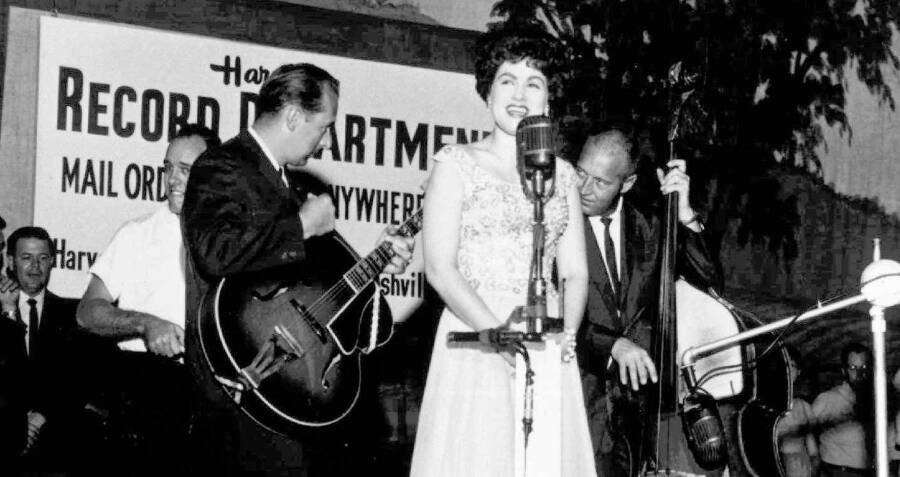
Patsy Cline’s extraordinary voice shone brightly in the landscape of country music. Renowned for classics like “Walkin’ After Midnight,” “I Fall To Pieces,” and “Crazy,” she possessed a unique ability to infuse her powerful vocals with raw, authentic emotion. Her songs captivated audiences across generations, cementing her status as a true icon. Cline’s profound influence on the genre transcended conventional boundaries, skillfully bridging the gap between country and pop music and inspiring countless artists who followed her path.
Tragically, Cline’s brilliant career was cut short at the young age of 30. She perished in a devastating plane crash on March 5, 1963. The accident occurred during a flight from Kansas City to Nashville, where Cline had recently concluded a series of performances. The world mourned the sudden loss of this unparalleled talent, and her legacy as a country music legend continues to inspire and captivate audiences to this day.
The Final Flight Home
On the afternoon of March 5, 1963, a small Piper Comanche aircraft departed from Kansas City, Missouri. Its destination was Nashville, Tennessee. Aboard the ill-fated flight were country music luminaries Patsy Cline, Hawkshaw Hawkins, and Cowboy Copas. At the controls was Randy Hughes, Cline’s personal manager and brother-in-law, who also served as the pilot.
The flight embarked under perilous conditions. Severe storms had swept across the Midwest, bringing with them high winds, heavy rain, and extremely low visibility. Air traffic control had issued multiple warnings about the dangerous flying environment, strongly advising against non-essential flights. Despite these grave advisories, Hughes made the fateful decision to proceed with the journey.
As the aircraft pushed eastward, the weather rapidly deteriorated further. Hughes, piloting under Visual Flight Rules (VFR), became disoriented by the swirling clouds and the complete lack of visual references on the ground. He lost control of the plane. The aircraft plummeted into a dense, remote forest near Camden, Tennessee. The impact was instantaneous, tragically claiming the lives of all four individuals on board. News of the Patsy Cline plane crash sent shockwaves through the music community, leaving a profound and irreplaceable void.
Premonitions of a Shortened Life
In the weeks leading up to her tragic accident, Patsy Cline confided in close friends about a growing sense of unease. She spoke of an overwhelming feeling of impending doom, a chilling premonition that her time was drawing short. These were not mere anxieties; she described them as strong, persistent feelings of danger that she simply could not shake.
Accounts from those closest to her suggest Cline experienced unsettling dreams. She even began distributing personal items to friends, a gesture that later took on a haunting significance. She reportedly told fellow singer Dottie West, “Honey, I’ve had two bad ones in a row. The next one will be a charm.” These words, perhaps once dismissed as morbid humor, became chillingly prophetic after the Patsy Cline death. While it’s impossible to know if she truly sensed her fate, these forewarnings add a profound, almost mystical layer to her final days, forever intertwining her life with the mystery of premonition.
A Voice That Transcended Musical Genres
Patsy Cline’s untimely death at just 30 years old deprived the world of an unparalleled talent. Despite her tragically short career, her legacy continues to resonate powerfully. Her emotive vocals, characterized by their rich alto and powerful delivery, connected with listeners on a deeply personal level. She was much more than a country singer; she was a vocalist who could infuse any song with raw, authentic emotion and universal appeal.
Cline’s influence extended far beyond the traditional boundaries of country music. She was a pioneer, a trailblazer who helped bridge the gap between country and pop. Her sophisticated style, often featuring lush orchestral arrangements characteristic of the “Nashville Sound,” distinguished her work. This unique approach paved the way for future crossover artists, demonstrating that country music possessed a broad, universal appeal. Her impact is undeniable, profoundly shaping the sound and direction of the genre for decades.
Her timeless songs remain radio staples, constantly reminding us of her unparalleled artistry and the enduring power of a truly unique voice. The Patsy Cline death may have ended her life, but it could never extinguish her talent or her monumental contribution to music history.
Honoring a Legend’s Memory
Following Patsy Cline’s tragic passing, a wave of grief and admiration swept across the nation. Fans mourned their beloved star, and fellow artists paid heartfelt tribute to her immense talent, warm spirit, and courageous individuality. Honoring Cline’s memory became a vital undertaking, ensuring her contributions would never be forgotten.
Numerous initiatives have celebrated her life and musical contributions. In 1973, Patsy Cline was posthumously inducted into the Country Music Hall of Fame, a testament to her undeniable impact and solidified legendary status. Other significant tributes to her enduring legacy include:
- Statues erected in her honor in Winchester, Virginia, her beloved hometown.
- Memorial plaques marking significant locations associated with her life and career.
- Countless tribute performances and albums by artists across various genres, showcasing her lasting influence.
- Documentaries and biographical films exploring her remarkable life and career, introducing her to new generations.
Even today, Cline’s music is widely celebrated, continuing to touch new generations of listeners. Her story serves as a powerful reminder of the profound impact true artistry can leave behind. It highlights both the fragility of life and the lasting legacy that transcends time, ensuring that Patsy Cline’s voice will echo forever.