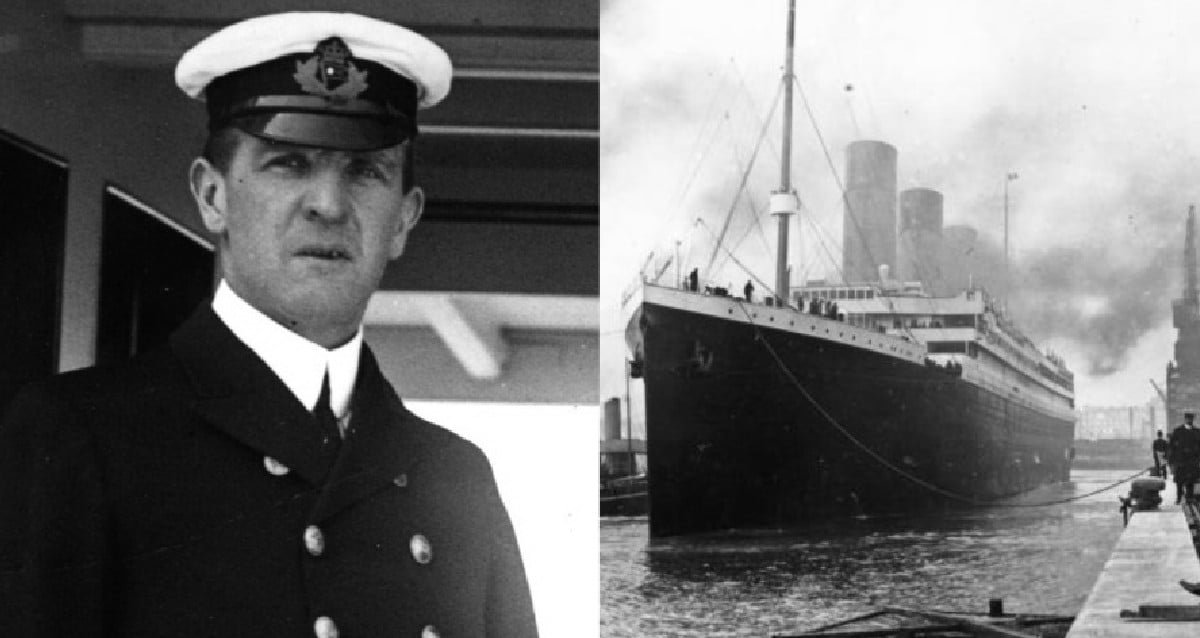

William Murdoch served as the First Officer of the RMS Titanic during its maiden voyage in April 1912. He is primarily remembered for commanding the bridge during the ship’s collision with an iceberg and for his efforts to organize the evacuation of passengers on the starboard side before the vessel sank.
Early Life and Maritime Training
Born on February 28, 1873, in Dumfries, Scotland, William McMaster Murdoch was the fourth of seven children. His father, Captain Samuel Murdoch, belonged to a family with a long history of seafaring. While many in his family shared this connection to the ocean, William was the only one of his siblings to pursue a professional sailing career.
Murdoch’s professional training began in 1888 with an apprenticeship aboard the Charles Cotesworth under Captain James Kitchen. During this period, he completed a significant voyage to San Francisco via Cape Horn, a journey traditionally viewed by his family as the defining mark of a true sailor. His dedication to the craft led him to pass the Extra Master’s Certificate exam on his first attempt in 1896, which represented the highest nautical qualification available at the time.
Career with the White Star Line
In 1899, Murdoch transitioned from sail to steamships by joining the White Star Line. His initial role was fourth officer on the Medic, a steamer that inaugurated the company’s service to Australia. During his time on the Medic, he worked alongside Charles Herbert Lightoller, who would later serve as the Second Officer on the Titanic.
Murdoch’s ascent through the ranks was steady:
- 1901: Promoted to second officer while serving on the Runic. It was during this tenure that he met Ada Florence Banks, whom he married in 1907.
- 1903: Served as second mate on the maiden voyage of the Arabic.
- 1911: Served as first officer on the Olympic, one of the three massive cruisers built by White Star Line.
Murdoch gained a reputation for decisive action. During his service on the Arabic, Captain Edwin Jones recalled that Murdoch prevented a collision with another vessel by taking immediate control of the wheel and steering the ship away from danger, even when it meant deviating from existing orders. This level of competence is documented in Encyclopedia Titanica, highlighting his standing among his peers.
The Collision and the Sinking of the Titanic
On the night of April 14, 1912, First Officer Murdoch was the officer on watch. At approximately 11:40 p.m., lookout Frederick Fleet spotted a large iceberg directly in the ship’s path and rang the warning bell. Murdoch immediately took command of the bridge to execute evasive maneuvers.
The specific orders Murdoch gave have been a subject of historical debate. Most accounts agree that he ordered the ship “Hard-a-starboard!” to turn the vessel to port (left), followed by “Hard-a-port!” to swing the ship away from the ice. This maneuver, known as “porting about,” was intended to avoid a direct impact. However, the RMS Titanic collided with the iceberg 37 seconds later, resulting in a long gash along the starboard side of the hull.
What happened to Officer Murdoch on the Titanic?
Following the collision, Murdoch was tasked with overseeing the evacuation on the starboard side of the ship. He adhered to the protocol of “women and children first,” coordinating the deployment of lifeboats amidst the growing chaos. Despite his efforts to save others, Murdoch did not survive the disaster. His body was never recovered from the Atlantic Ocean.
Controversies Regarding William Murdoch’s Death
The circumstances of Murdoch’s final moments have remained a point of contention. Some survivor testimonies suggested that an officer shot several passengers to maintain order during the panic and then committed suicide. These accounts have led to widespread speculation that Murdoch was the officer involved, a narrative later popularized by cinematic depictions of the event.
However, other evidence contradicts these claims. Charles Lightoller, the Second Officer, wrote to Murdoch’s widow stating that he saw Murdoch be swept overboard by a wave during the ship’s final moments. While Lightoller’s testimony was later questioned because he was stationed on the port side while Murdoch was on the starboard side, his account sought to protect the family from the suicide rumors.
Did William Murdoch shoot himself on the Titanic?
While some witnesses claimed to see an officer commit suicide, the British inquiry into the disaster concluded that Murdoch was not at fault for the collision. The inquiry found that he had acted as any experienced officer would have in an attempt to avoid the iceberg. There is no definitive forensic evidence to prove he shot himself, and many historians view the suicide stories as unreliable accounts born from the trauma and confusion of the sinking.
Recognition and Memory
Despite the controversies surrounding the disaster, Murdoch’s hometown of Dalbeattie, Scotland, has maintained a high regard for his service. The community has honored him through several initiatives:
- The installation of a memorial plaque at the town hall.
- A commemorative plaque at the local high school.
- The establishment of the Murdoch Memorial Prize.
William Murdoch’s career was defined by a lifelong dedication to maritime excellence, from his early days rounding Cape Horn to his final hours managing the crisis on the Titanic.