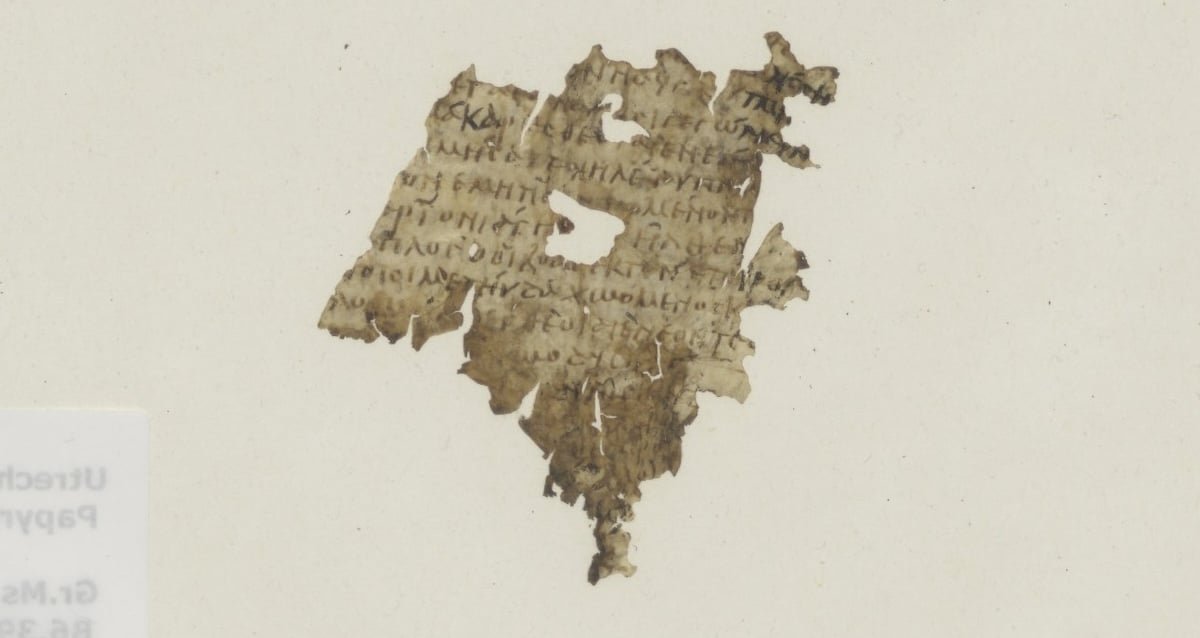

A 1,700-year-old papyrus fragment of Homer’s Odyssey has been uncovered in the library of Utrecht University in the Netherlands. The piece, dating back to the third or fourth century C.E., was discovered by Professor Mark de Kreij, a papyrologist and expert in ancient Greece, while examining a collection of manuscripts. The fragment is part of a pocket-sized edition of the epic poem, likely produced in the Fayum oasis south of Cairo, Egypt, during the late Roman era.
The Discovery Process and Origin of the Manuscript
The manuscript was found within a collection of early Christian texts acquired by the university approximately 70 years ago from an heir of the German scientist Carl Schmidt. While the Coptic texts in the collection had been previously studied by other historians, a smaller group of Greek papyri had remained largely unnoticed until the current examination.
Professor de Kreij identified the fragment as a Coptic-influenced Greek text, noting that it belonged to a portable version of the Odyssey. This type of small-format book was common for personal use in ancient Egypt. According to a statement from the university, the discovery is significant because only about 30 similar fragments from this period have been found worldwide.
Key Narrative Content of the Fragment
The fragment contains an excerpt from Book 12 of the Odyssey. It specifically captures a pivotal moment where Odysseus’ men, driven by hunger and low food supplies, kill and eat the sacred cattle of Helios, the Sun god. In the narrative, the sorceress Circe had previously warned Odysseus to avoid the island of Thrinacia to prevent this exact tragedy.
The text describes the events leading to the Zeus-led destruction of their ship and the death of the entire crew, with the sole exception of Odysseus. Professor de Kreij noted that this specific passage survived because it occurs in the middle of the the epic, and ancient books typically wore down from the outer edges inward, preserving the center of the text.
The Oldest Known Odyssey Manuscripts
While this find is rare, it provides insight into how the epic was distributed in the late antiquity period. When considering the oldest known manuscript fragments of the Odyssey, scholars typically look at papyri from the first century B.C.E. to the third century C.E., often recovered from the dry sands of Egypt. The dry climate of the Fayum and Oxyrhynchus regions has been essential in preserving these organic materials.
The Odyssey and the Iliad were originally composed in the late eighth or early seventh century B.C.E., meaning this fragment represents a copy made approximately 1,000 years after the original composition. This discovery coincides with other recent finds, such as fragments of the Iliad found inside a Roman-era mummy in Egypt earlier this year.
How the Epic Poem Was Distributed
- Format: The fragment was identified as part of a pocket edition, suggesting the work was a widely read personal copy.
- Language: The text is written in Coptic, the Egyptian language that uses the Greek alphabet, reflecting the cultural blending of the region.
- Location: The Fayum oasis was a major center for production of such manuscripts.
Professor de Kreij identified his work as a “treasure hunter” in the library, and the discovery will be featured in his upcoming book, Hieratic, Demotic, Greek, and Coptic Texts in the Utrecht University Collection. Further details on the find were shared with RTV Utrecht, highlighting the rarity of the Homeric epics in such a portable format.